Kerala Government Criticized Over Coastal Mining and Liquor Tax
Source:Indian Express ↗
Why It Matters
The article serves as an excellent case study for two major UPSC themes: the ecological impact of coastal mining for critical minerals (GS3 Environment/Geography) and the policy dilemma between state revenue generation via liquor taxation and constitutional welfare mandates (GS2 Governance).
Summary
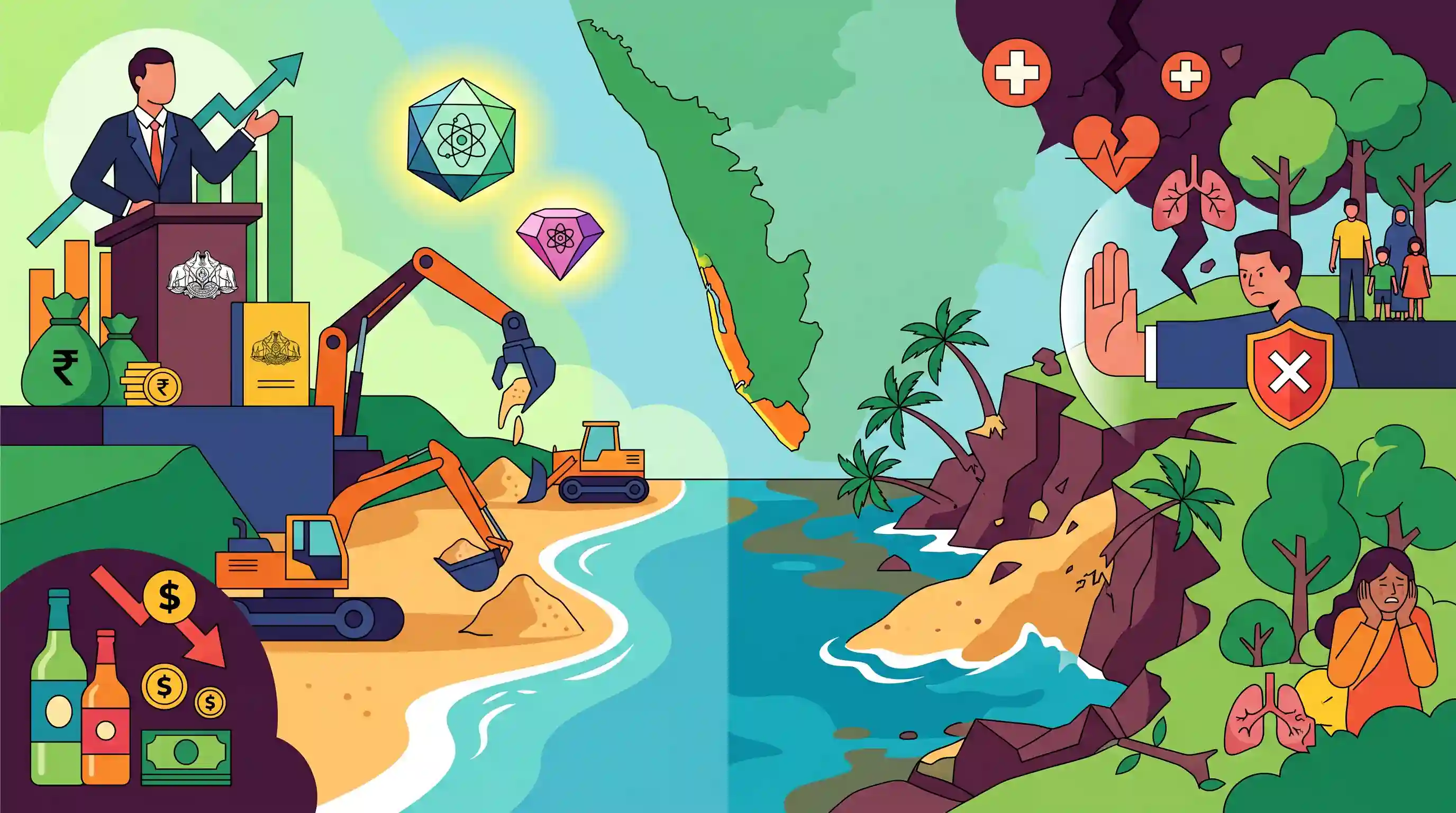
Veteran Congress leader V M Sudheeran has criticized the state budget proposals of the newly formed V D Satheesan-led government in Kerala. He specifically opposed two major policies: the reduction of taxes on low-alcohol beverages and the proposed extraction of critical minerals along the coast. Sudheeran warned that the proposed Southern Kerala Economic Corridor and Rare Earth and Critical Minerals Corridor, which would allow private entities to mine beach sand, poses a severe environmental threat to Kerala's vulnerable coastline. His critique underscores the ongoing policy dilemmas states face when balancing revenue generation and strategic resource exploitation against ecological sustainability and public health directives.
Key Points
- Veteran Congress leader V M Sudheeran has publicly criticized the budget proposals of the newly formed V D Satheesan-led government in Kerala.
- Sudheeran strongly opposed the proposal to mine mineral sand under the planned Southern Kerala Economic Corridor and Rare Earth and Critical Minerals Corridor, warning of severe ecological threats to the coastline.
- He also condemned the state's move to reduce taxes on low-alcohol beverages, framing it as contrary to public health and historical party stances.
- The internal critique highlights the persistent governance challenge of balancing state revenue generation and strategic resource extraction against environmental preservation and social welfare goals.
Important Terms
Article 47 of the Constitution

A Directive Principle of State Policy (Part IV) mandating the State to improve public health and prohibit the consumption of intoxicating drinks and injurious drugs.
UPSC context
GS Paper II (Polity) — fundamental for discussing the constitutional basis of liquor bans and health-governance tradeoffs.
Critical Minerals
Naturally occurring elements essential for high-tech manufacturing, defense, and clean energy (e.g., lithium, cobalt), characterized by high supply risk and strategic economic importance.
UPSC context
GS Paper I (Resources) & Paper III (Economy/Security) — tests knowledge of strategic resource management and industrial self-reliance.
Rare Earth Elements (REE)
A set of 17 chemical elements (like neodymium and scandium) vital for electronics and green technology, found in India primarily within monazite beach sands.
UPSC context
GS Paper I (Geography/Resources) — focus on mineral distribution and the "Rare Earth Corridor" for high-tech industrial growth.
Beach Sand Mining
The extraction of heavy minerals like monazite and ilmenite from coastal deposits; regulated under the MMDR Act, it faces opposition due to coastal erosion concerns.
UPSC context
GS Paper III (Environment) — relevant to Coastal Regulation Zone (CRZ) rules and sustainable mineral exploitation.
United Democratic Front (UDF)
A political alliance in Kerala led by the Indian National Congress; it competes with the LDF and focuses on centrist-to-social-welfare governance.
UPSC context
GS Paper II (Polity) — representative of the coalition politics and federal governance structures in Indian states.
Economic Corridor
A synchronized infrastructure network connecting industrial hubs and ports to facilitate trade, employment, and regional development through specialized transport and logistics.
UPSC context
GS Paper III (Infrastructure/Economy) — covers regional development models and specialized industrial clustering.
Prelims Trap
"State governments have exclusive powers to auction and grant mining leases for all coastal beach sand minerals."
Beach sand minerals containing monazite (thorium) are "prescribed substances" under the Atomic Energy Act. The Centre restricts their mining, reserving it largely for PSUs.
Static Concepts Connected
What are the key beach sand minerals found along India's coasts?
- Ilmenite & Rutile: Primary sources of titanium, these heavy minerals are heavily concentrated in the placer deposits of Kerala (Chavara) and Tamil Nadu.
- Monazite: A radioactive phosphate mineral containing thorium and rare earth elements (REEs), classified strictly as a prescribed substance under India's atomic energy laws.
- Zircon & Garnet: Heavy minerals found alongside titanium ores, primarily utilized in refractories, ceramics, and as industrial abrasives.
How does Article 47 of the DPSP address intoxicating drinks?
- Public Health Duty: It directs the State to raise the level of nutrition and improve public health as among its primary duties.
- Prohibition Directive: It explicitly mandates the State to endeavor to bring about the prohibition of intoxicating drinks and drugs which are injurious to health.
- Non-Justiciable Nature: Like all DPSPs, it is non-justiciable. States routinely balance this constitutional directive against the massive revenue generated from liquor excise duties.
Cross-Topic Patterns
Strategic Minerals vs Coastal Ecology
The drive to secure critical minerals from coastal sands directly clashes with Coastal Regulation Zone (CRZ) protections, testing the balance between strategic supply chain autonomy and ecological vulnerability.
Article 47 vs State Excise Revenue
States rely heavily on liquor excise duty to fund welfare schemes, creating a persistent paradox where DPSP public health directives (Art 47) are practically overridden by fiscal necessities.

Expect a Prelims question testing the overlap of Atomic Energy Act rules on Monazite and the jurisdiction of state vs central mining rights.
Linked PYQs · 5
Linked PYQs · 5
- 2026PrelimsGS1
Which of the following statements about Rare Earth Elements (REEs) and Critical Minerals is/are correct ? 1. Modern technological innovations including Artificial Intelligence, robotics and space exploration extensively utilise Rare Earth Elements (REEs). 2. China has the highest share in mining of REEs followed by India. 3. The Government of India launched the National Critical Mineral Mission (NCMM) in 2025 to establish a robust framework for self-reliance in the critical mineral sector. 4. Rare Earth Elements are a set of 13 metallic elements. Select the answer using the code given below :
- 2021PrelimsGS1
Consider the following statements : 1. The Global Ocean Commission grants licences for seabed exploration and mining in international waters. 2. India has received licences for seabed mineral exploration in international waters. 3. 'Rare earth minerals' are present on seafloor in international waters. Which of the statements given above are correct?
- 2025MainsGS3
Mineral resources are fundamental to the country's economy and these are exploited by mining. Why is mining considered an environmental hazard? Explain the remedial measures required to reduce the environmental hazard due to mining.
- 2019MainsGS3
Coastal sand mining, whether legal or illegal, poses one of the biggest threats to our environment. Analyze the impact of sand mining along the Indian coasts, citing specific examples.
- 2021MainsGS2
“Besides being a moral imperative of a Welfare State, primary health structure is a necessary precondition for sustainable development.” Analyze.
