Wayanad Landslide Rehabilitation and Resilient Township Project
Source:The Hindu ↗
Why It Matters
Serves as a key case study for post-disaster rehabilitation, resilient infrastructure, and community rebuilding, directly relevant to GS3 Disaster Management questions.
Summary
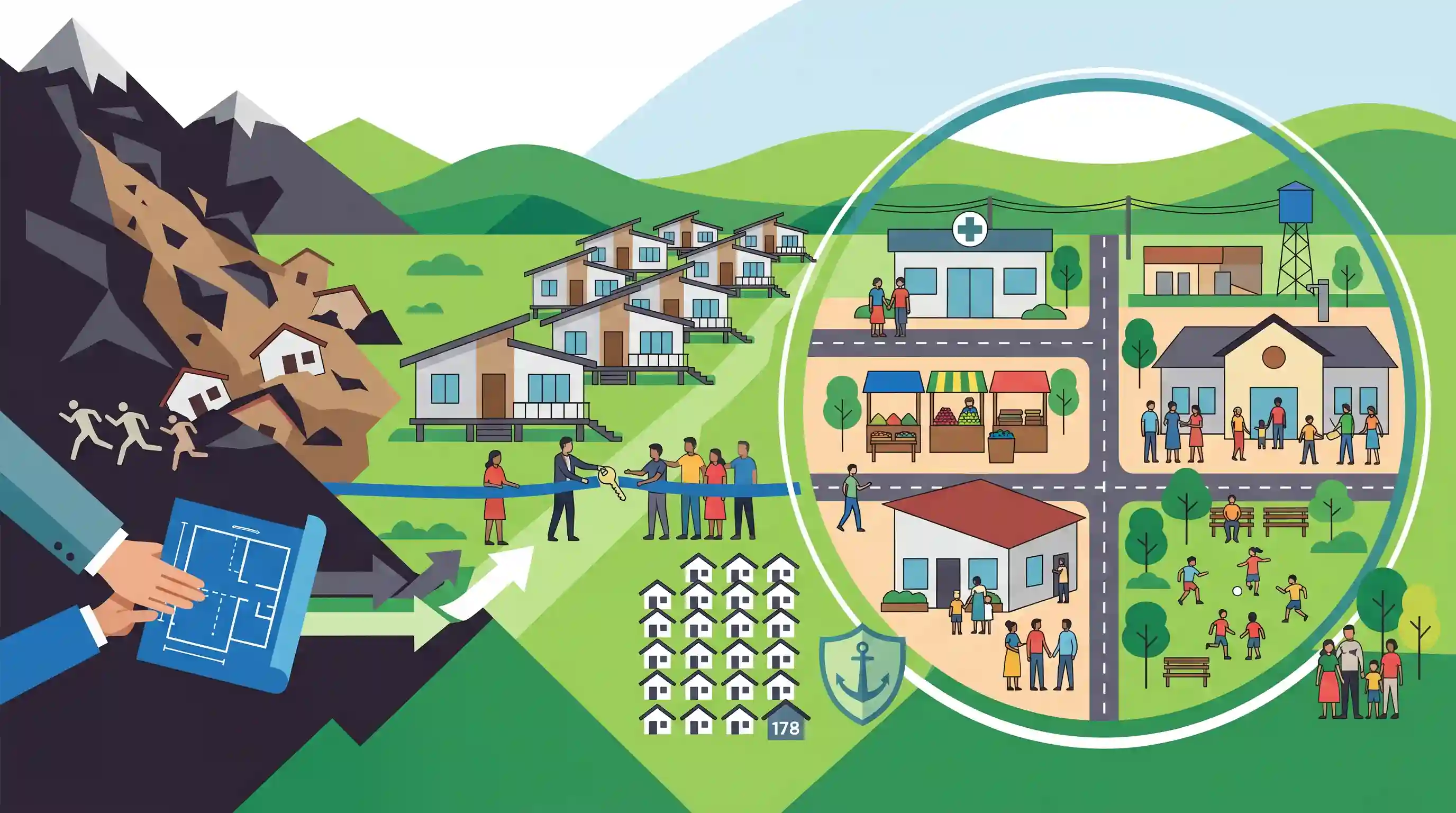
The Kerala government is set to inaugurate the first phase of the Meppadi township project in Wayanad, primarily aimed at rehabilitating survivors of the catastrophic Mundakkai-Chooralmala landslides. This phase involves handing over 178 disaster-resilient houses built on the Elstone estate. The comprehensive project aims to build a self-contained community for over 1,600 people with modern infrastructure, health centres, public markets, and recreational facilities, demonstrating a robust model of post-disaster recovery and community-centric urban planning.
Key Points
- Kerala Chief Minister Pinarayi Vijayan will inaugurate the first phase of the Meppadi township in Wayanad, aimed at rehabilitating survivors of the catastrophic Mundakkai-Chooralmala landslides.
- The first phase includes the handover of 178 disaster-resilient houses, each with a built-up area of 1,000 sq ft on a seven-cent plot.
- The township is planned as a self-contained residential area that will eventually house over 1,662 people across 410 homes.
- Comprehensive civic amenities are being developed alongside housing, including modern roads, a health centre, an anganwadi, a community centre, and recreational facilities.
Important Terms
Mundakkai-Chooralmala Landslides

Catastrophic landslides in Wayanad (July 2024) caused by high-intensity rainfall in the ecologically sensitive Western Ghats, necessitating the state's largest ever integrated rehabilitation effort.
UPSC context
GS3: Disaster Management; highlights rainfall-induced landslide risks and vulnerability of the Western Ghats.
Disaster-Resilient Housing
Infrastructure designed to withstand hazards; the Meppadi houses feature reinforced foundations for future expansion and climate-responsive designs to ensure safety in landslide-prone terrains.
UPSC context
GS3: Disaster Management/Infrastructure; tests structural mitigation and resilient urban planning concepts.
Build Back Better (BBB)
A Sendai Framework strategy that uses disaster recovery as an opportunity to enhance community resilience through improved infrastructure, social systems, and livelihood security.
UPSC context
GS3: Disaster Management; fundamental recovery principle aligned with global and national DM guidelines.
Uralungal Labour Contract Cooperative Society (ULCCS)
A prominent Kerala-based cooperative society and infrastructure giant that served as the lead Engineering, Procurement, and Construction (EPC) contractor for the Meppadi township.
UPSC context
GS2/3: Governance/Infrastructure; case study for cooperative-led large-scale public infrastructure projects.
Sendai Framework (2015-2030)
A global disaster risk reduction agreement; Priority 4 specifically guides the enhancement of disaster preparedness for effective response and "Building Back Better" in reconstruction.
UPSC context
GS3: Disaster Management; key international framework informing India’s national disaster policy and risk reduction.
Kerala Electrical and Allied Engineering Company Ltd. (KEL)
A Kerala government-owned engineering PSU specializing in electrical equipment and turnkey civil projects, acting as an accredited agency for state-led development initiatives.
UPSC context
GS3: Infrastructure/Economy; highlights the role of state-level Public Sector Undertakings (PSUs) in project implementation.
Prelims Trap
"The Sendai Framework for DRR is a legally binding international treaty."
The Sendai Framework (2015-2030) is a voluntary and non-binding agreement. Aspirants often mistakenly assume it carries the legal weight of binding climate treaties.
Static Concepts Connected
What is the "Build Back Better" principle in disaster management?
- Origin: It is enshrined as Priority 4 of the UN Sendai Framework for Disaster Risk Reduction (2015-2030).
- Definition: Integrating disaster risk reduction measures into the restoration of physical infrastructure and societal systems post-disaster.
- Goal: Making recovering nations and communities more resilient to future hazards than they were before the disaster struck.
Why is the Western Ghats region highly susceptible to landslides?
- Geomorphology: Steep slopes and fragile, highly weathered rock formations covered with thick lateritic soil create natural instability.
- Meteorology: The region receives intense, localized rainfall during the Southwest monsoon, saturating the soil and triggering debris flows.
- Anthropogenic factors: Deforestation, unscientific quarrying, and extensive plantation cash-crop farming alter natural drainage and destabilize slopes.
Cross-Topic Patterns
Ecology vs. Development in Ghats
Wayanad landslides consistently revive the Gadgil vs. Kasturirangan committee debates regarding the demarcation of Ecologically Sensitive Areas (ESAs) in the Western Ghats.
CDRI and Global South Leadership
India's domestic push for resilient housing like the Meppadi township mirrors its international diplomacy initiatives through the Coalition for Disaster Resilient Infrastructure (CDRI).

Expect a GS3 Mains question linking Western Ghats ecological fragility with the necessity of 'Build Back Better' rehabilitation models.
Linked PYQs · 3
Linked PYQs · 3
- 2021MainsGS3
Describe the various causes and the effects of landslides. Mention the important components of the National Landslide Risk Management Strategy.
- 2019MainsGS3
Disaster preparedness is the first step in any disaster management process. Explain how hazard zonation mapping will help disaster mitigation in the case of landslides.
- 2024MainsGS3
What is disaster resilience? How is it determined? Describe various elements of a resilience framework. Also mention the global targets of Sendai Framework for Disaster Risk Reduction (2015–2030).
