Centre State Friction Highlights Kerala Welfare Challenges
Source:The Hindu ↗
Why It Matters
The article provides a real-world example of friction in Centre-State relations and cooperative federalism, particularly regarding resource allocation and disaster assistance. It is relevant for understanding the challenges States face in implementing welfare schemes amidst alleged fiscal constraints and federal disputes.
Summary
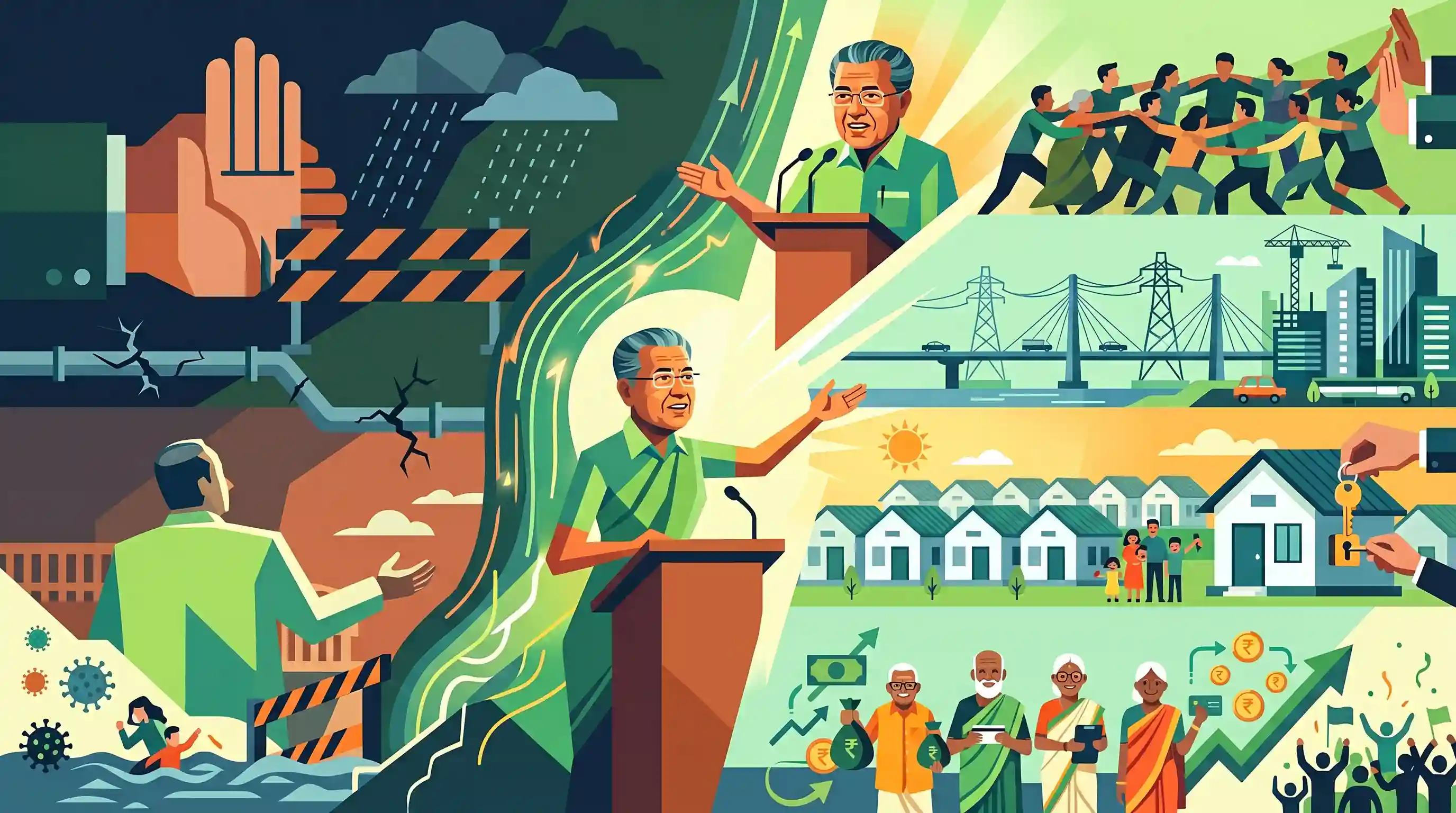
Kerala Chief Minister Pinarayi Vijayan accused the Central government of neglecting the State and withholding vital support during crises like natural disasters and the COVID-19 pandemic. Speaking at the Left Democratic Front (LDF) government's fourth-anniversary celebrations in Kasaragod, Vijayan stated that despite the Centre's indifference and financial bottlenecks, Kerala thrived due to collective willpower. He outlined key development milestones, including infrastructure advancements, the distribution of over 4.5 lakh homes under the LIFE Mission, and the streamlining of social welfare pensions.
Key Points
- Kerala Chief Minister Pinarayi Vijayan launched a scathing attack on the Central government, accusing it of systematically neglecting the State during crises such as natural disasters, Nipah, and the COVID-19 pandemic.
- Vijayan alleged the Centre adopted a negative stance, discouraging those who tried to help, and appeared more interested in seeing Kerala collapse than aiding its recovery.
- The CM highlighted Kerala's resilience and listed development milestones, including the near completion of the national highway, progress on coastal and hill highways, and the successful GAIL pipeline project.
- He noted that under the State's LIFE Mission, over 4.5 lakh homes were built and nearly 4 lakh land title deeds were distributed, despite financial constraints.
Important Terms
LIFE Mission

Livelihood Inclusion and Financial Empowerment; Kerala's flagship housing project providing homes and livelihood support to the landless and homeless through a convergence of various social services.
UPSC context
GS Paper II: Welfare schemes for vulnerable sections; tests knowledge of state-led social security and housing models.
GAIL Pipeline Project
The 450 km Kochi-Koottanad-Bengaluru-Mangaluru (KKBMPL) natural gas pipeline; an infrastructure project facilitating cleaner energy distribution and industrial growth in Kerala and Karnataka.
UPSC context
GS Paper III: Infrastructure and Energy; GS Paper II: Cooperative federalism and land acquisition challenges in development.
Left Democratic Front (LDF)
The ruling coalition of left-wing political parties in Kerala, led by the CPI(M); notable for its emphasis on public welfare and its recurring tenure in the state.
UPSC context
GS Paper II: Polity and Federalism; tests understanding of regional political dynamics and coalition governance in India.
Ente Keralam Exhibition
A major state-level exhibition and marketing fair organized by the Kerala government to showcase development achievements, provide public services, and promote regional products.
UPSC context
GS Paper II: Governance and Public Service Delivery; illustrates methods of government-public engagement and awareness.
Prelims Trap
"NDRF allocations can be flexibly utilized by States for long-term climate-resilient rebuilding and infrastructure restoration."
NDRF and SDRF guidelines strictly limit fund usage to immediate emergency relief and victim compensation, explicitly prohibiting states from using them for long-term reconstruction.
Static Concepts Connected
What are the Constitutional provisions governing the borrowing powers of States?
- Article 293: States can borrow only within the territory of India upon the security of the Consolidated Fund of the State, subject to limits set by the State legislature.
- Centre's Consent: Under Article 293(3), a State cannot raise any loan without the Centre's consent if it has any outstanding loan owed to the Government of India.
- Imposition of Conditions: The Centre may impose conditions while granting borrowing consent (Article 293(4)), a provision currently utilized to enforce Net Borrowing Ceilings (NBC) including off-budget liabilities.
How is disaster relief funding structured between the Centre and States?
- SDRF primary role: The State Disaster Response Fund (SDRF) is the primary fund. The Centre contributes 75% for general states and 90% for special category states.
- NDRF for severe crises: The National Disaster Response Fund (NDRF) is fully central-funded, disbursed at the Union's discretion for disasters of a 'severe nature' when a State's SDRF is depleted.
- Immediate relief only: Both funds are strictly earmarked for immediate emergency relief and victim compensation, prohibiting States from deploying them for long-term reconstruction or mitigation projects.
Cross-Topic Patterns
Fiscal Federalism vs. State Welfare
Kerala's borrowing limits (NBC) and off-budget constraints link directly to the broader debate on fiscal federalism, mirroring issues faced by other States regarding central fund devolution and FRBM norms.
Disaster Framework vs. Climate Adaptation
The reliance on NDRF for immediate relief exposes a policy gap: increasing climate-induced extreme weather events require long-term mitigation funding, which the rigid existing DM Act frameworks explicitly restrict.

Expect a multi-statement Prelims question on Article 293 and State borrowing limits, linked to off-budget liabilities and FRBM mandates.
Linked PYQs · 5
Linked PYQs · 5
- 2024MainsGS2
What changes has the Union Government recently introduced in the domain of Centre-State relations ? Suggest measures to be adopted to build the trust between the Centre and the States and for strengthening federalism.
- 2015MainsGS2
The concept of cooperative federalism has been increasingly emphasized in recent years. Highlight the drawbacks in the existing structure and the extent to which cooperative federalism would answer the shortcomings.
- 2020MainsGS3
Discuss the recent measures initiated in disaster management by the Government of India departing from the earlier reactive approach.
- 2019MainsGS2
Performance of welfare schemes that are implemented for vulnerable sections is not so effective due to absence of their awareness and active involvement at all stages of policy process. Discuss.
- 2023MainsGS2
“Development and welfare schemes for the vulnerable, by its nature, are discriminatory in approach.” Do you agree? Give reasons for your answer.
