Kerala Graphene Policy and advanced nanomaterials manufacturing
Source:The Hindu ↗
Why It Matters
Graphene and advanced nanomaterials are recurring themes in UPSC Prelims and Mains (GS3). This policy development is significant as it demonstrates state-level governance stepping in to transition emerging technologies from academic research to industrial-scale manufacturing, aligning with syllabus topics on awareness in nanotechnology and technology-driven economic growth.
Summary
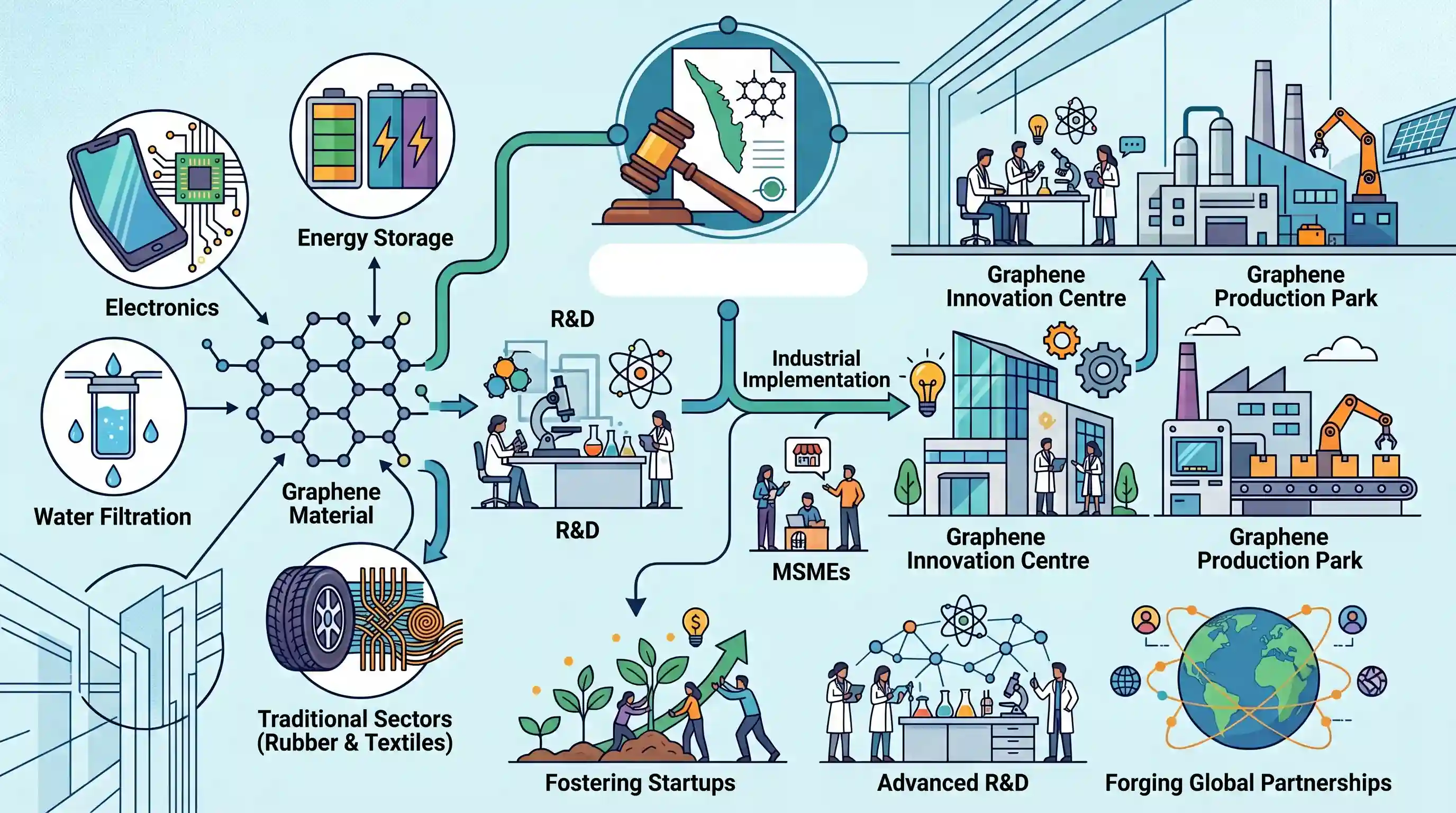
The Kerala Cabinet has approved the Kerala Graphene Policy to build a robust ecosystem for graphene-based research, manufacturing, and innovation. Graphene, a single-atom-thick 'wonder material', offers transformative applications across electronics, energy storage, water filtration, and traditional sectors like rubber and textiles. The state's dedicated policy framework seeks to bridge the gap between advanced nanotechnology and industrial application by establishing a Graphene Innovation Centre and a Graphene Production Park to foster startups, advance R&D, and forge global partnerships.
Key Points
- The Kerala Cabinet approved a pioneering Graphene Policy to catalyze the research, development, and industrial use of the nanomaterial.
- Graphene acts as a crucial additive, significantly enhancing the mechanical, electrical, and physical properties of composite materials.
- The material's potential applications span emerging high-tech fields (electronics, sensors, energy storage) as well as traditional industries (rubber, packaging, construction, and textiles).
- The state's policy framework includes establishing a Graphene Innovation Centre and a Graphene Production Park to stimulate a local start-up ecosystem, support R&D, and foster international collaborations.
Important Terms
Kerala Graphene Policy

India's first dedicated state policy (approved Feb 2026) aimed at creating a global hub for graphene R&D, manufacturing, and commercialization.
UPSC context
GS III: Science & Tech / Economy. Tests knowledge of state-led innovation models and advanced material governance.
Graphene Innovation Centre (IICG)
A collaborative "idea-to-prototype" facility in Kochi (MeitY, Kerala Govt, Tata Steel) bridging the gap between laboratory research and industrial application.
UPSC context
GS III: Indigenization of Technology. Important for understanding Public-Private Partnerships (PPP) in deep-tech sectors.
Graphene Production Park
A ₹237-crore facility in Palakkad designed for pilot-scale manufacturing and developing a commercial supply chain for graphene-based products.
UPSC context
GS III: Infrastructure / Manufacturing. Tests awareness of specialized industrial clusters and MSME ecosystem support.
Graphene
A single-atom-thick layer of carbon atoms arranged in a hexagonal lattice; it is 200 times stronger than steel and highly conductive.
UPSC context
GS III: Nanotechnology. A frequent topic in Prelims (properties) and Mains (applications in electronics, energy, healthcare).
Grefine Park
The specialized industrial hub/cluster planned under the Kerala Graphene Policy to host startups and large-scale graphene manufacturing units.
UPSC context
GS III: S&T / Industry. Relevant for questions on "Viksit Bharat" and indigenous manufacturing of advanced materials.
Prelims Trap
Graphene is a three-dimensional carbon nanomaterial that acts as a perfect electrical insulator in advanced electronics.
Graphene is a two-dimensional, one-atom-thick allotrope of carbon. It is prized in high-tech industries precisely because it is an exceptional conductor of both heat and electricity, not an insulator.
Static Concepts Connected
What distinguishes Graphene from other key carbon allotropes?
- Diamond: A 3D network of carbon atoms with strong covalent bonds, making it the hardest natural substance and an electrical insulator.
- Graphite: Composed of stacked 2D layers held by weak Van der Waals forces; conducts electricity and acts as a solid lubricant.
- Graphene: A single, one-atom-thick 2D sheet of carbon arranged in a hexagonal lattice; exceptionally strong and highly conductive.
- Fullerenes: Molecular carbon structures like hollow spheres (C60) or nanotubes, used extensively in targeted drug delivery and nanomedicine.
How does the nanoscale physically alter material properties?
- Quantum Effects: At the nanoscale (1-100 nm), quantum mechanics dominate over classical physics, fundamentally changing optical, magnetic, and electrical behaviors.
- Surface-to-Volume Ratio: Nanomaterials possess an exceptionally high surface area relative to their volume, exponentially increasing chemical reactivity and catalytic efficiency.
- Composite Enhancement: Small amounts of nanomaterials (like graphene) added to traditional materials (rubber, concrete) drastically increase tensile strength while reducing overall weight.
Cross-Topic Patterns
Next-Gen Batteries & Graphene Anodes
Graphene is increasingly tested as an advanced anode material to replace traditional graphite, aiming to solve charge-time and thermal degradation bottlenecks in next-generation Lithium-ion and solid-state batteries.
Deep-Tech Innovation & State Industrial Policies
Kerala's standalone graphene policy highlights a trend where state-level frameworks preempt national industrial policy in deep-tech domains, similar to early state-led IT and biotechnology policies.

Expect a multi-statement Prelims question testing graphene's 2D structure, conductivity, and real-world applications like water filtration.
Linked PYQs · 4
Linked PYQs · 4
- 2012PrelimsGS1
Graphene is frequently in news recently. What is its importance? 1. It is a two-dimensional material and has good electrical conductivity. 2. It is one of the thinnest but strongest materials tested so far. 3. It is entirely made of silicon and has high optical transparency. 4. It can be used as 'conducting electrodes' required for touch screens, LCDs and organic LEDs. Which of the statements given above are correct?
- 2020MainsGS3
What do you understand by nanotechnology and how is it helping in health sector?
- 2025MainsGS3
How does nanotechnology offer significant advancements in the field of agriculture? How can this technology help to uplift the socio-economic status of farmers?
- 2023MainsGS3
Faster economic growth requires increased share of the manufacturing sector in GDP, particularly of MSMEs. Comment on the present policies of the Government in this regard.
