Kerala state comprehensive urban policy framework and planning
Source:The Hindu ↗
Why It Matters
Kerala's urban policy serves as a pioneering case study for handling 'rurban' (rural-urban) sprawl, climate resilience, and decentralized governance. It can be cited in Mains answers regarding sustainable urbanization, the evolving role of local bodies, and innovative funding models like PPPP.
Summary
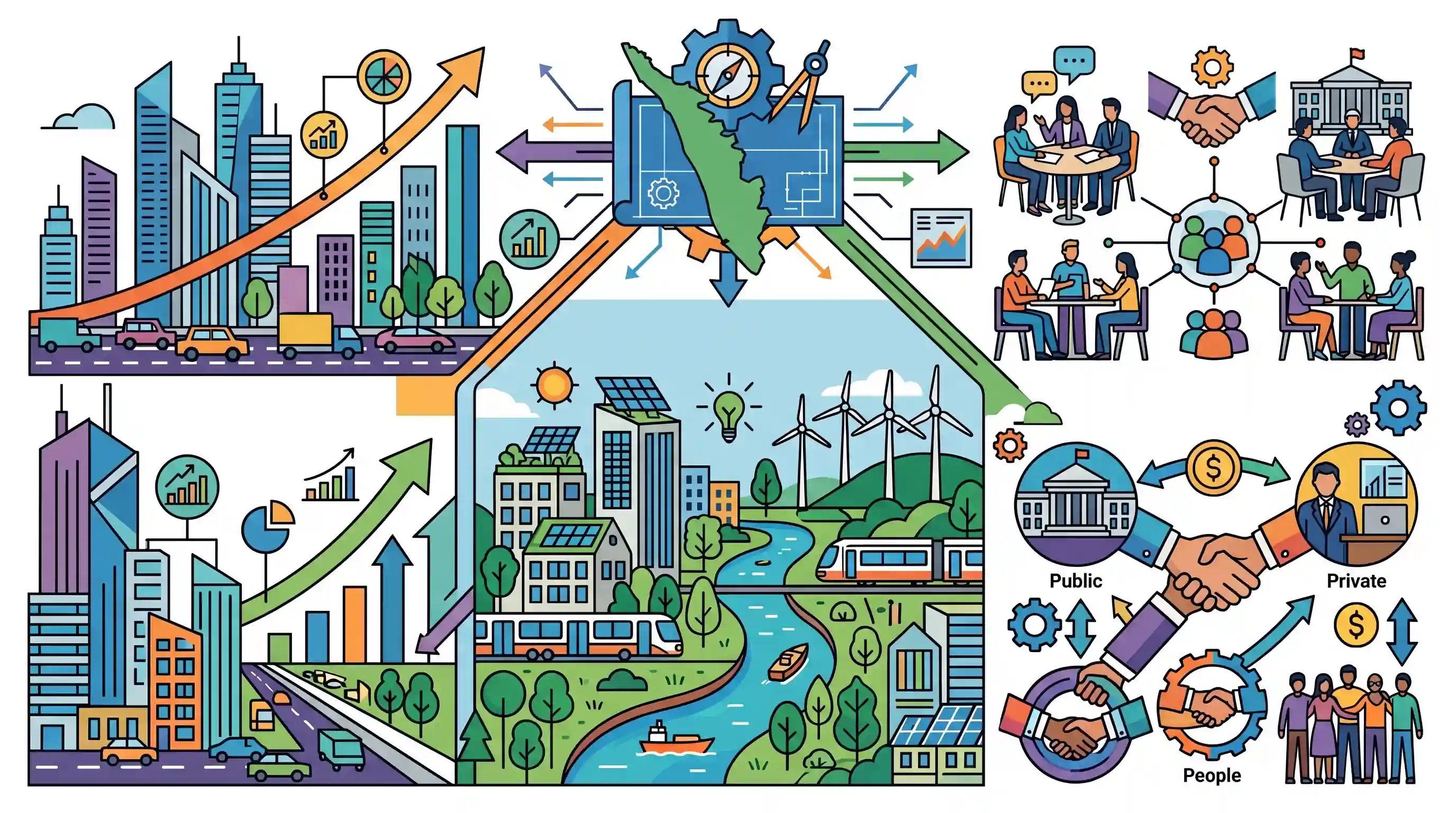
Kerala has approved India's first comprehensive State-level urban policy, aimed at managing its rapid and decentralised urbanisation. With projections indicating that 80% of the state will be urbanised by 2050, the policy serves as a foundational blueprint for the next 25 years. It emphasizes the creation of climate-smart cities, integration of environmentally sensitive areas into planning, and robust participatory governance through local bodies. Additionally, it introduces a 'Public, Private, and People's Partnership' (PPPP) framework to sustainably finance and manage future urban growth.
Key Points
- Kerala has become the first state in India to formulate a comprehensive urban policy to guide development activities for the next 25 years.
- The policy addresses a unique demographic trend where 80% of Kerala is projected to be urbanised by 2050 through decentralised growth across coastal and hilly areas.
- Key pillars of the policy include establishing climate-smart cities, scientific and participatory planning, and ensuring good decentralised governance.
- The state plans to utilize a 'Public, Private, and People's Partnership' (PPPP) model to fund and execute future urban development projects.
Important Terms
Kerala Urban Policy

India's first state-level comprehensive roadmap (2025-2050) for managing urban growth, focusing on climate-resilient cities, financial sustainability, and participatory governance.
UPSC context
GS I (Urbanization) & GS III (Disaster Management); tests state-led policy innovation for sustainable development.
Kerala Urban Policy Commission (KUPC)
A high-level expert body established in 2023 to draft Kerala's urban roadmap, marking the first dedicated state-level commission for strategic urban planning in India.
UPSC context
GS II (Governance); relevant for institutional mechanisms and expert-led policy formulation.
Public, Private, and People's Partnership (PPPP)
An inclusive governance framework that adds 'People' to the traditional PPP model, emphasizing community participation and social equity in urban infrastructure projects.
UPSC context
GS II (Governance/Local Bodies); tests understanding of inclusive governance and democratic decentralization.
Climate-Smart Cities
Urban development integrated with climate adaptation strategies, using hazard mapping and green infrastructure to mitigate risks like flooding in vulnerable regions.
UPSC context
GS III (Environment/Disaster Management); vital for discussing urban resilience and climate adaptation.
Decentralized Urbanisation
A spatial growth pattern where development is spread across small towns and villages (rurban continuum) rather than concentrated in a few mega-cities.
UPSC context
GS I (Geography/Urbanization); essential for analyzing regional development models and the 'Kerala Model'.
Prelims Trap
Kerala's urban policy operationalizes the 74th Constitutional Amendment's mandate for directly elected Metropolitan Planning Committees (MPCs).
Article 243ZE mandates that 2/3rd of MPC members be elected INDIRECTLY by and from municipal/panchayat members. Kerala's recommendation for DIRECTLY elected MPCs is a novel state-level proposal, not constitutional law.
Static Concepts Connected
What are the constitutional provisions for Metropolitan Planning Committees (MPCs)?
- Mandate: Required in every metropolitan area with a population of 10 lakhs or more under Article 243ZE of the Constitution.
- Composition: At least two-thirds of members must be elected indirectly by and from elected municipal members and panchayat chairpersons.
- Core Function: To prepare a draft development plan, ensuring coordinated spatial planning and resource sharing between municipalities and panchayats.
How do Municipal Bonds and Pooled Finance work for ULBs in India?
- SEBI Framework: Governed by SEBI regulations; a municipality must have a positive net worth in preceding years and no major loan defaults to issue bonds.
- Pooled Bonds: Smaller municipalities can aggregate their infrastructure financing needs into a single joint bond issuance to attract institutional investors and mitigate individual risk.
Cross-Topic Patterns
Climate-linked urban financing (GS1/GS3)
Kerala's integration of 'green fees' and parametric climate insurance bridges GS1 urbanization with GS3 disaster management, offering a proactive model compared to reactive urban flood management in other metros.
Evolution from PPP to PPPP models
Adding 'People' to Public-Private Partnerships (PPPP) elevates community-led governance. It connects GS2 local governance decentralization with GS3 infrastructure financing models, moving beyond purely corporate PPPs.

GS2 Mains will likely ask to evaluate Kerala's 'PPPP' model and 'City Cabinets' as remedies for the structural flaws of the 74th CAA.
Linked PYQs · 5
Linked PYQs · 5
- 2025MainsGS1
How does smart city in India, address the issues of urban poverty and distributive justice?
- 2013MainsGS1
Discuss the various social problems which originated out of the speedy process of urbanization in India.
- 2024MainsGS2
Analyse the role of local bodies in providing good governance at local level and bring out the pros and cons merging the rural local bodies with the urban local bodies.
- 2016MainsGS3
What are 'Smart Cities'? Examine their relevance for urban development in India. Will it increase rural-urban differences? Give arguments for 'Smart Villages' in the light of PURA and RURBAN Mission.
- 2024MainsGS3
Flooding in urban areas is an emerging climate-induced disaster. Discuss the causes of this disaster. Mention the features of two such major floods in the last two decades in India. Describe the policies and frameworks in India that aim at tackling such floods.
