FCRA Enforcement Stalls BJP Christian Outreach in Kerala
Source:Indian Express ↗
Why It Matters
This issue exemplifies the real-world friction between macro-level national security/regulatory policies (FCRA amendments) and micro-level regional electoral strategies. It serves as an excellent case study for GS2 answers on the impact of government policies on civil society organizations and minority groups.
Summary
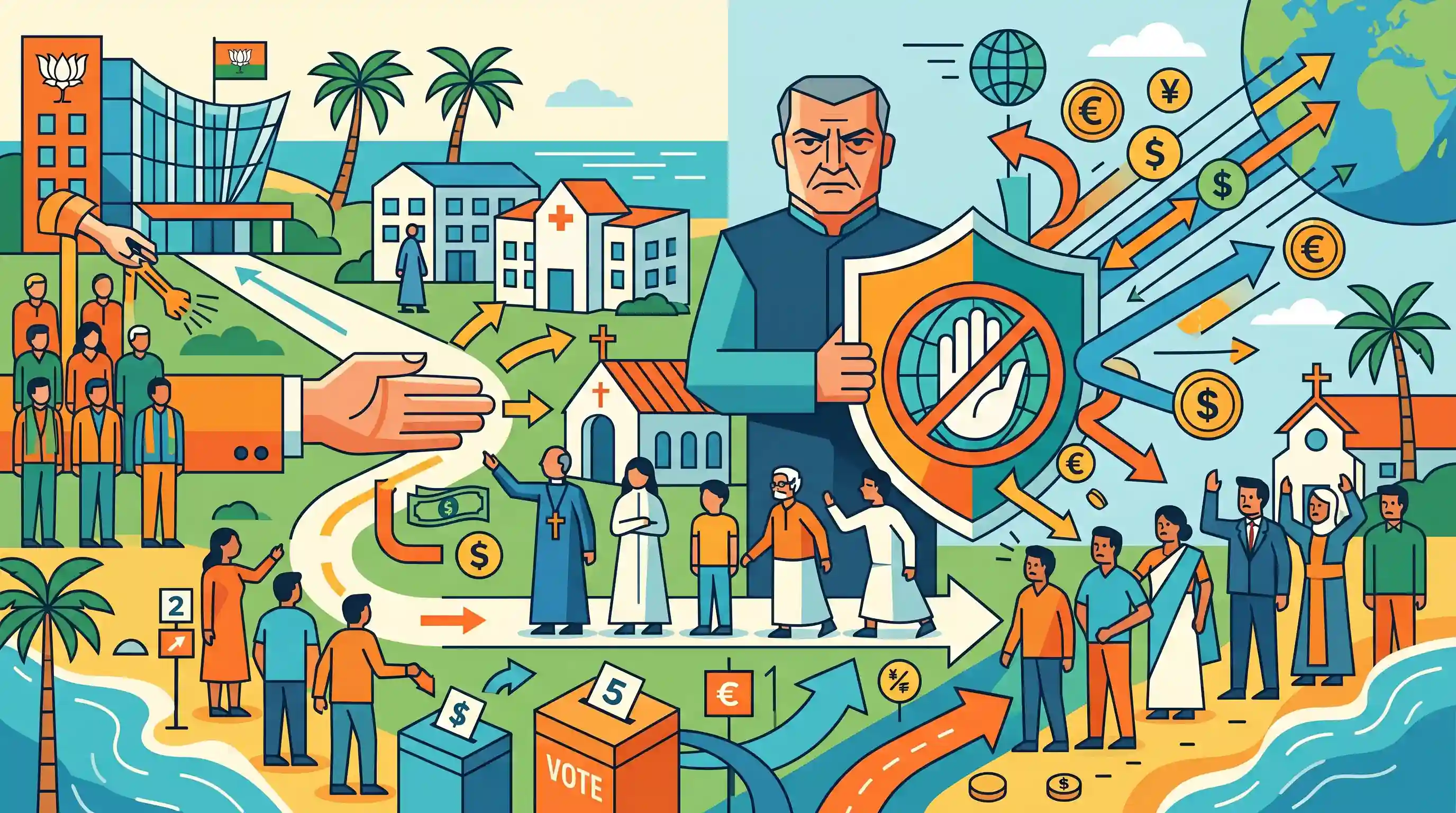
The BJP's strategic outreach to the Christian community ahead of the Kerala Assembly elections is encountering resistance due to the central government's strict enforcement of the Foreign Contribution (Regulation) Act (FCRA), which has significantly curtailed the foreign funding relied upon by many Christian NGOs and institutions.
Key Points
- The BJP's electoral strategy to court Christian voters in Kerala is being undermined by the central government's strict enforcement of the FCRA.
- Stringent FCRA norms have choked off crucial foreign funding for various Christian-run NGOs, educational, and healthcare institutions.
- This policy clash highlights the tension between national governance objectives (regulating foreign funds for accountability/security) and regional political imperatives (minority outreach).
Important Terms
Foreign Contribution (Regulation) Act (FCRA)

A central law regulating the receipt and utilization of foreign donations by NGOs and individuals to ensure funds do not compromise India's sovereignty or internal security.
UPSC context
GS Paper II (Governance) and Paper III (Internal Security); tests regulatory oversight of civil society and national security safeguards.
Non-Governmental Organization (NGO)
Voluntary, non-profit groups independent of government that work for social welfare, advocacy, and development, often acting as a bridge between the state and grassroots.
UPSC context
GS Paper II (Governance); crucial for understanding the role of civil society in development and participative democracy.
Minority Outreach
Strategic political efforts to gain electoral support from India's six notified religious minorities by addressing their specific socio-economic and security concerns.
UPSC context
GS Paper II (Polity/Social Justice); evaluates understanding of secularism, constitutional protections (Articles 29-30), and inclusive representation.
Social Engineering
A political strategy to restructure electoral coalitions by appealing to diverse social groups (caste or religion) to broaden a party's traditional vote base.
UPSC context
GS Paper II (Polity); relevant for analyzing shifting electoral dynamics, caste-based mobilization, and strategic political behavior in India.
Internal Security
The preservation of peace and rule of law within a nation's borders, frequently cited by the state as the primary rationale for strict NGO funding regulations.
UPSC context
GS Paper III (Internal Security); tests the balance between fundamental rights and the state's power to prevent foreign interference.
Prelims Trap
"FCRA-registered NGOs can transfer foreign contributions to other FCRA-registered organizations."
The FCRA Amendment Act 2020 strictly prohibited the transfer of foreign contributions to any other person or organization, regardless of whether the recipient is FCRA-registered.
Static Concepts Connected
What key restrictions were introduced by the FCRA Amendment Act 2020?
- Transfer prohibition: Banned the transfer or sub-granting of foreign contributions to any other person or NGO.
- Administrative cap: Reduced the maximum limit for using foreign funds on administrative expenses from 50% to 20%.
- Designated account: Mandated that foreign funds be received exclusively in a designated SBI main branch in New Delhi.
- Aadhaar mandate: Made Aadhaar mandatory for all office bearers, directors, or key functionaries of an NGO.
Which entities are expressly prohibited from receiving foreign contributions under FCRA?
- Electoral participants: Election candidates, registered political parties, and members of legislatures (MPs/MLAs).
- Media entities: Journalists, columnists, newspaper publishers, and broadcast media companies.
- State actors: Government servants, judges, and employees of government-controlled corporations.
Cross-Topic Patterns
Internal Security vs. Civil Society Space
The strict regulation of NGOs via FCRA highlights the ongoing tension between curbing illicit foreign influence (internal security) and preserving operational freedom for developmental and minority-run civil society groups.
Central Governance vs. State Politics
Centralized regulatory mandates (like FCRA managed by MHA) can inadvertently collide with regional electoral strategies, showcasing how national security policies shape grassroots political dynamics.

Expect a 2026 Prelims question testing FCRA 2020 amendments, specifically the 20% administrative cap and the total ban on sub-granting.
Linked PYQs · 2
Linked PYQs · 2
- 2015MainsGS2
Examine critically the recent changes in the rules governing foreign funding of NGOs under the Foreign Contribution (Regulation) Act (FCRA), 1976.
- 2021MainsGS3
Analyse the multidimensional challenges posed by external state and non-state actors, to the internal security of India. Also discuss measures required to be taken to combat these threats.
