Welfare Guarantee Schemes in State Electoral Politics
Source:The Hindu ↗
Why It Matters
The article highlights the growing trend of political parties using 'guarantee schemes' (often debated as freebies) as central electoral planks in state elections, sparking discussions on the balance between welfare economics, populism, and state finances.
Summary
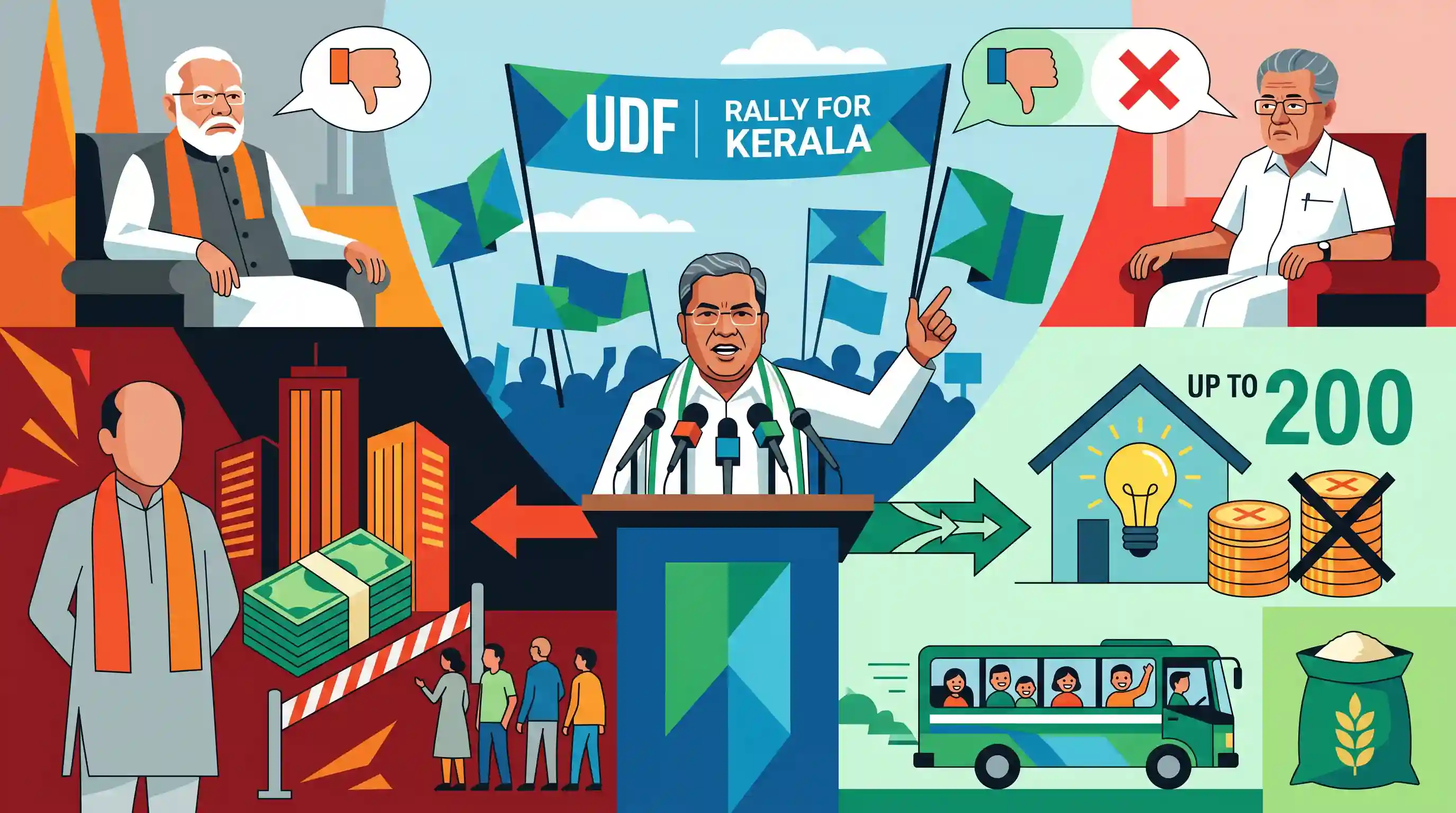
During a UDF election rally for the 2026 Kerala Assembly polls, Karnataka Chief Minister Siddaramaiah criticized the BJP-led NDA government's policies, labeling them as anti-poor and pro-corporate. He promised that a UDF government in Kerala would replicate Karnataka's successful 'guarantee schemes,' specifically highlighting the provision of free electricity up to 200 units. He further took a dig at both Prime Minister Narendra Modi and Kerala Chief Minister Pinarayi Vijayan for previously dismissing such welfare initiatives.
Key Points
- Karnataka CM Siddaramaiah addressed a UDF election rally ahead of the 2026 Kerala Assembly polls, accusing the NDA government of being pro-corporate and anti-poor.
- He promised that the UDF would introduce welfare-oriented initiatives in Kerala similar to Karnataka's 'guarantee schemes', such as providing free electricity up to 200 units under the Indira Gandhi scheme.
- Siddaramaiah criticized both PM Narendra Modi and Kerala CM Pinarayi Vijayan for historically dismissing and ridiculing these welfare proposals.
Important Terms
Guarantee Scheme

Pre-poll contractual promises by political parties to provide specific welfare benefits, like cash transfers or free utilities, immediately upon winning an election to ensure accountability.
UPSC context
GS-II (Welfare Schemes/Governance). Tests understanding of fiscal federalism and the debate between social security and 'revdi culture' (populism).
Indira Guarantees
A specific set of five welfare promises (e.g., free travel, health insurance) proposed by the UDF for the 2026 Kerala Assembly elections, branded after Indira Gandhi.
UPSC context
GS-II (Social Justice). Relevant for analyzing state-level social security models and the impact of gender-targeted welfare in electoral politics.
United Democratic Front (UDF)
An Indian National Congress-led alliance of centrist and regional parties in Kerala that has traditionally alternated power with the Left Democratic Front (LDF).
UPSC context
GS-II (Federalism/Political Parties). Essential for understanding regional coalition dynamics and the evolution of the bipolar political system in Kerala.
National Democratic Alliance (NDA)
A national-level center-right political coalition in India led by the Bharatiya Janata Party (BJP), currently serving as the governing alliance at the Union level.
UPSC context
GS-II (Parliamentary System/Governance). Tests knowledge of coalition politics, executive-legislature relations, and national political alliances in India.
Bharatiya Janata Party (BJP)
A major national political party in India, known for its right-wing and pro-Hindutva ideology; it is the lead constituent of the NDA coalition.
UPSC context
GS-II (Political Parties). Important for studying the multi-party system, ideological frameworks, and their influence on national policy-making.
Welfare State
A governance model where the government ensures the social and economic well-being of citizens through measures like education, healthcare, and financial aid.
UPSC context
GS-II (Governance/Social Justice). A foundational concept for discussing the State's duty toward vulnerable sections versus fiscal sustainability.
Prelims Trap
Promising freebies in an election manifesto constitutes a corrupt practice under the Representation of the People Act, 1951.
The Supreme Court ruled in the 2013 S. Subramaniam Balaji case that manifesto promises do not constitute a corrupt practice under Section 123 of the RPA.
Static Concepts Connected
What is the legal standing of election manifesto promises under the RPA 1951?
- Not corrupt practice: The Supreme Court ruled (2013) that making promises in election manifestos does not violate Section 123 of the RPA.
- ECI disclosure guidelines: Under Article 324, the ECI requires political parties to disclose the fiscal rationale and funding sources for their manifesto pledges via the Model Code of Conduct.
How do free electricity schemes negatively impact state economies?
- Cross-subsidization burden: DISCOMs charge higher tariffs to commercial/industrial consumers to offset domestic freebies, which raises production costs and hurts global competitiveness.
- Crowding out Capex: Funding large-scale consumption guarantee schemes increases state revenue deficits, diverting funds away from vital long-term infrastructure investments.
Cross-Topic Patterns
DPSP Mandate vs. Fiscal Prudence
The debate pits Article 38's welfare state mandate against macroeconomic risks, differentiating between capacity-building "merit goods" (health) and debt-inducing "non-merit freebies".
ECI's expanding Article 324 powers
The ECI's mandate requiring parties to disclose the financial rationale of manifesto pledges shows the evolving, proactive use of Article 324 to curb opaque populism.

Expect a GS2 Mains question balancing the DPSP welfare mandate against the fiscal strain of competitive populism on state DISCOMs/capex.
Linked PYQs · 3
Linked PYQs · 3
- 2022MainsGS2
Besides the welfare schemes, India needs deft management of inflation and unemployment to serve the poor and the underprivileged sections of the society. Discuss.
- 2019MainsGS2
Performance of welfare schemes that are implemented for vulnerable sections is not so effective due to absence of their awareness and active involvement at all stages of policy process. Discuss.
- 2022MainsGS2
“While the national political parties in India favour centralisation, the regional parties are in favour of State autonomy.” Comment.
