Election Commission Enforcement of Model Code against Money Power
Source:The Hindu ↗
Why It Matters
The article provides a real-world example of how illicit funds are allegedly distributed during election campaigns and highlights the practical challenges the Election Commission faces in enforcing the Model Code of Conduct and monitoring election expenditure.
Summary
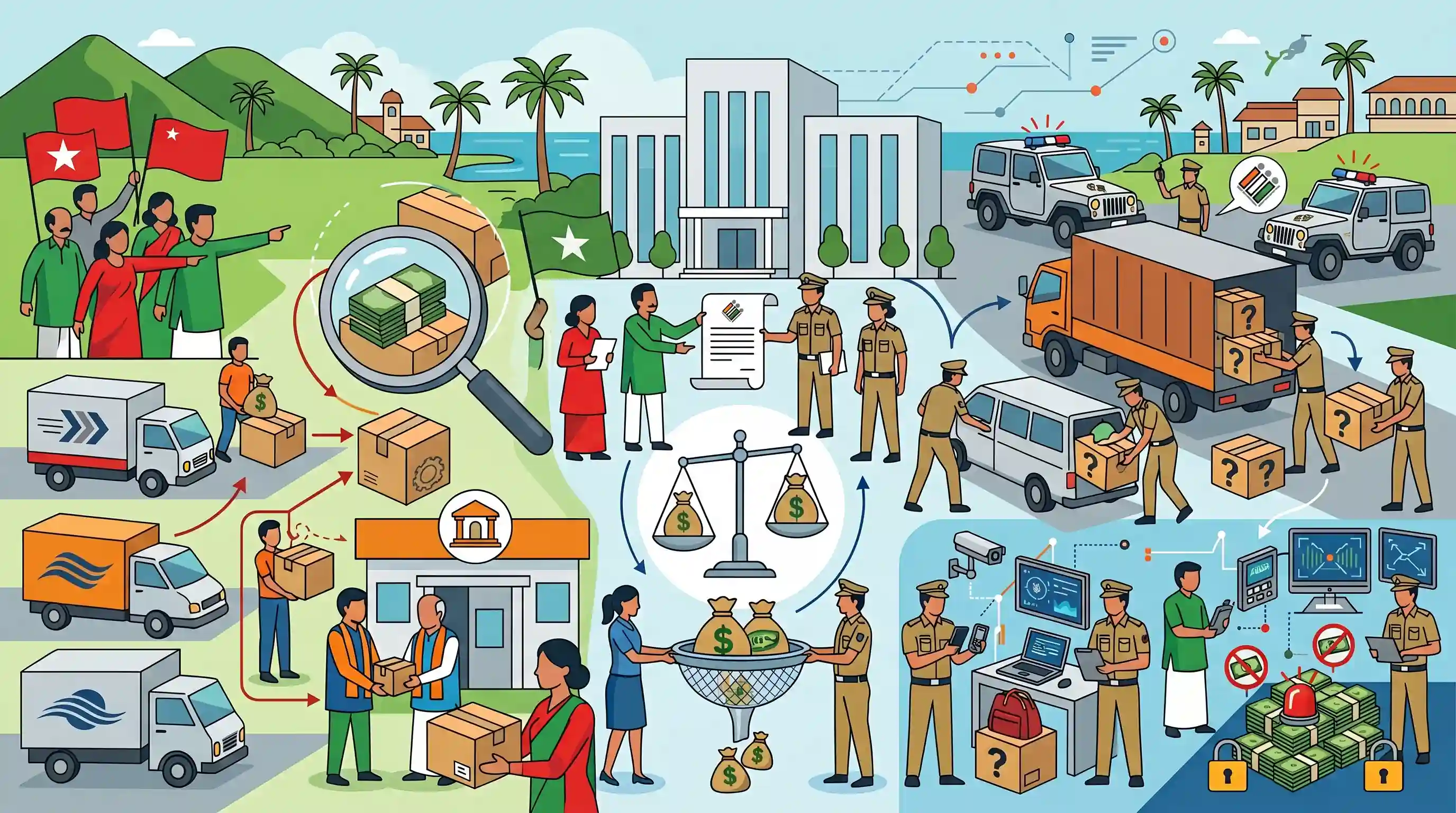
The LDF election camp in Kerala's Nemom constituency has filed a formal complaint with the Election Commission of India (ECI) alleging that unaccounted cash is being transported to BJP election offices via postal and private cargo services. The complaint seeks immediate intervention by ECI flying squads and static surveillance teams to inspect suspicious parcels and intercept unauthorized vehicles. This incident underscores the ongoing challenges of money power and electoral malpractices, highlighting the critical need for robust election expenditure monitoring.
Key Points
- The election camp of LDF candidate V. Sivankutty in Nemom, Kerala, filed a complaint with the Election Commission of India (ECI).
- The complaint alleges the use of postal and private cargo services to deliver unaccounted cash to BJP election offices for influencing voters.
- The LDF urged the ECI to deploy flying squads and static surveillance teams to inspect suspicious parcels and tighten highway patrolling.
- The incident highlights the growing challenge of monitoring election expenditure and curbing the use of money power in elections.
Important Terms
Election Commission of India (ECI)

A permanent autonomous constitutional body (Article 324) responsible for administering Union and State election processes to ensure free and fair democratic outcomes.
UPSC context
GS Paper II (Constitutional Bodies); tests mandate, powers, and role in upholding democratic integrity.
Model Code of Conduct (MCC)
A set of consensus-based guidelines issued by the ECI to regulate political parties and candidates, ensuring a level playing field during election periods.
UPSC context
GS Paper II (Governance); examines electoral reforms and the ECI's regulatory reach via moral and legal norms.
Representation of the People Act (RPA)
Parliamentary legislation (1950 and 1951) providing the legal framework for voter eligibility, seat allocation, poll conduct, candidate disqualifications, and electoral offenses.
UPSC context
GS Paper II (Polity); a syllabus-specific topic on the statutory basis of elections and candidate accountability.
Money Power in Elections
The use of unaccounted wealth or excessive funding to influence voters, often distorting the 'level playing field' and bypassing legal expenditure limits.
UPSC context
GS Paper II (Polity); relates to electoral funding reforms, transparency, and challenges to free and fair elections.
Flying Squads and Static Surveillance Teams
Field enforcement units of the ECI tasked with intercepting illegal cash, liquor, or arms and investigating voter inducement complaints during polls.
UPSC context
GS Paper II (Governance); tests operational mechanisms used by the ECI to curb ground-level malpractices.
Left Democratic Front (LDF)
A coalition of left-wing political parties in Kerala, led by the Communist Party of India (Marxist), prominent in the state's bi-polar political system.
UPSC context
GS Paper II (Polity); relevant for understanding regional party systems and coalition politics in Indian states.
Prelims Trap
Candidates exceeding election expenditure limits are disqualified by the President on the binding advice of the ECI.
False. Under Section 10A of the RPA 1951, the Election Commission itself (not the President) directly disqualifies candidates for failing to lodge election expense accounts.
Static Concepts Connected
What constitutes a "Corrupt Practice" under the Representation of the People Act, 1951?
- Bribery: Any gift, offer, or promise by a candidate or their agent to induce a voter is explicitly classified as bribery under Section 123(1).
- Undue Influence: Any direct or indirect interference by a candidate with the free exercise of any electoral right.
- Appeal to Identity: Appealing to vote or refrain from voting on the grounds of religion, race, caste, community, or language.
How is Election Expenditure regulated in India?
- Statutory Mandate: Section 77 of RPA 1951 mandates candidates to keep a separate and correct daily account of all election expenditure incurred between nomination and result declaration.
- Ceiling Limits: The maximum expenditure limit is prescribed under Rule 90 of the Conduct of Election Rules, 1961, which is amended by the Union Government, not the ECI.
- Penalty & Disqualification: Under Section 10A of RPA 1951, the ECI can disqualify a candidate for up to three years for failing to lodge valid expenditure accounts.
Cross-Topic Patterns
ESMS, E-Governance & Free Elections
ECI's Election Seizure Management System (ESMS) and cVIGIL reflect the integration of digital intelligence platforms to enforce the Model Code of Conduct, bridging Polity and E-Governance in Mains GS-II.
Shadow Economy & Electoral Funding Loophole
The alleged use of private cargo for unaccounted cash highlights the overlap between black money circulation, PMLA enforcement, and electoral finance loopholes (GS-III Economy & GS-II Polity).

Questions in 2026 will likely test the distinction between ECI's direct disqualification powers (Sec 10A) vs Presidential powers (Art 103)
Linked PYQs · 4
Linked PYQs · 4
- 2022MainsGS2
Discuss the role of the Election Commission of India in the light of the evolution of the Model Code of Conduct.
- 2025MainsGS2
Discuss the 'corrupt practices' for the purpose of the Representation of the People Act, 1951. Analyze whether the increase in the assets of the legislators and/or their associates, disproportionate to their known sources of income, would constitute 'undue influence' and consequently a corrupt practice.
- 2020MainsGS2
There is a need for simplification of procedure for disqualification of persons found guilty of corrupt practices under the Representation of Peoples Act". Comment.
- 2021PrelimsGS1
Which one of the following effects of creation of black money in India has been the main cause of worry to the Government of India?
