FCRA rule amendments spark federal friction between Centre and Kerala
Source:The Hindu ↗
Why It Matters
Understanding the regulatory framework for NGOs and foreign funding is crucial for GS-2. The Kerala Assembly's resolution highlights real-world federal friction and debates over natural justice, executive overreach, and the operational autonomy of civil society organizations.
Summary
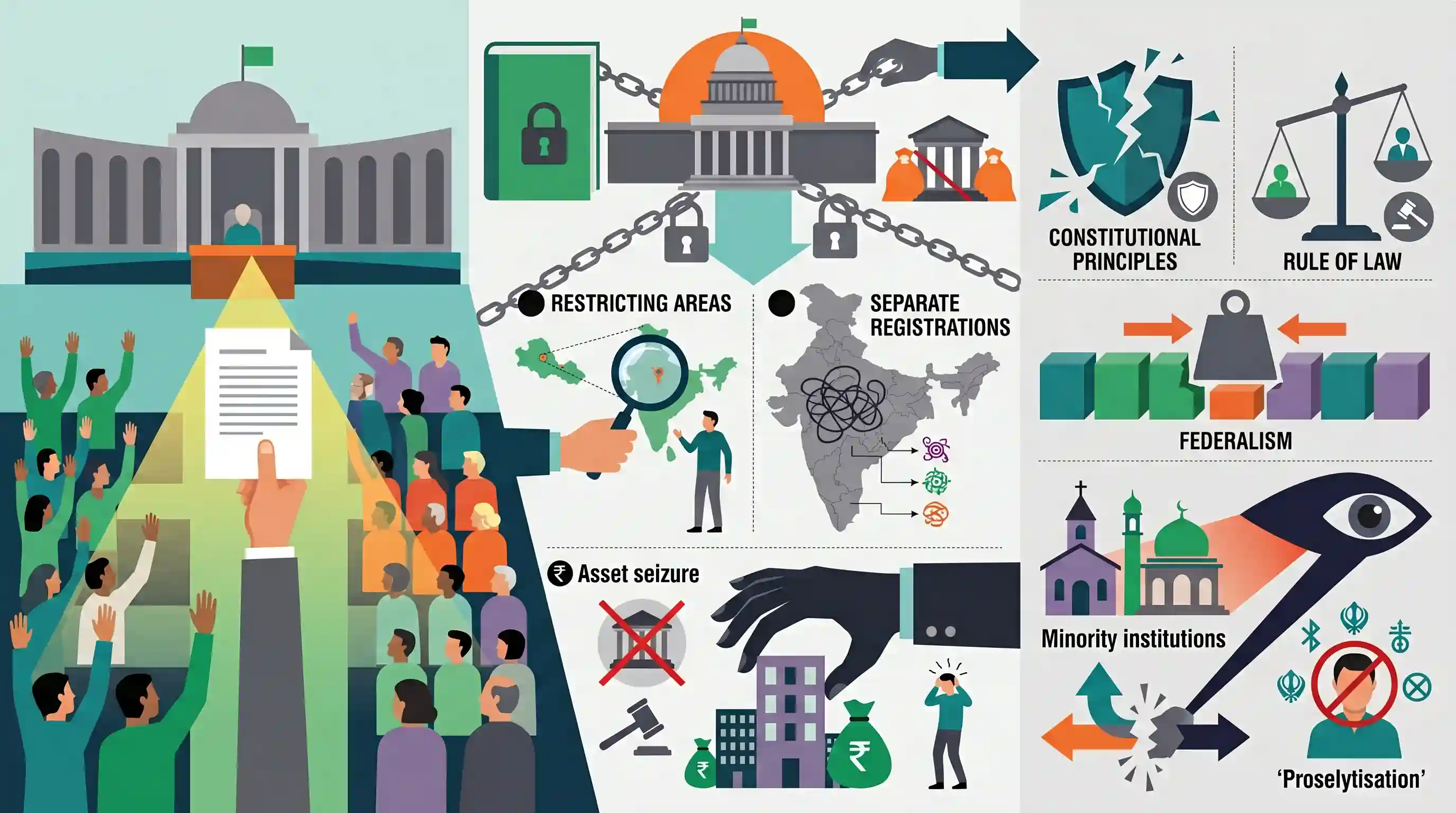
The Kerala Assembly unanimously passed a resolution urging the Union government to repeal recent amendments to the Foreign Contribution (Regulation) Act (FCRA) rules, terming them a breach of constitutional and federal principles. Supported by both the ruling LDF and the Opposition, the resolution criticized the amendments for creating stringent hurdles for NGOs, such as restricting their operational areas and requiring separate registrations across States. Significant concern was raised over provisions allowing the government to seize foreign-funded assets without court approval upon license cancellation, which the Assembly called a violation of natural justice. Furthermore, the inclusion of the term 'proselytisation' in the rules was flagged as a potential threat to minority institutions, highlighting broader tensions in Centre-State relations regarding civil society regulation.
Key Points
- The Kerala Legislative Assembly unanimously passed a resolution urging the Union government to repeal recent amendments to the FCRA rules.
- The resolution argued the amendments restrict NGOs by limiting operations to 105 areas and mandating fresh registration to operate in another State.
- Lawmakers criticized the provision empowering the government to seize assets created by foreign aid without court approval as a violation of natural justice and the rule of law.
- The introduction of the term 'proselytisation' in the rules was highlighted as a potential tool to wrongfully cancel licenses of minority institutions.
- The resolution reflects ongoing federal friction, with a State legislature formally opposing a Central regulation that affects civil society operations.
Important Terms
Foreign Contribution (Regulation) Act (FCRA)

A law enacted to regulate the acceptance and utilisation of foreign donations to ensure they do not adversely affect India's sovereignty or national interest.
UPSC context
GS-II: Governance and Government Policies; tests knowledge of regulatory frameworks for non-state actors and internal security.
FCRA Amendment Rules (2026)
Specific 2026 regulations mandating activity-specific registration, geographical limits on fund usage, and explicit exclusions for religious conversion activities.
UPSC context
GS-II: Important for questions on tightening executive control over civil society and potential impacts on social welfare.
Non-Governmental Organization (NGO)
A non-profit, voluntary group of citizens organized at local, national, or international levels to address social, environmental, or developmental objectives.
UPSC context
GS-II: Role of NGOs, SHGs, and various groups; tests understanding of their contribution to development and governance.
Proselytisation
The act of attempting to convert people to another religion or opinion; explicitly excluded from permissible religious activities under new FCRA rules.
UPSC context
GS-II: Fundamental Rights (Article 25) and Social Justice; tests sensitivity to minority rights and religious freedom.
Federalism
A constitutional system of government where power is divided between a central authority and constituent political units like states.
UPSC context
GS-II: Issues and challenges pertaining to the federal structure; tests knowledge of Centre-State legislative and administrative friction.
Prelims Trap
"FCRA regulations and NGO foreign funding compliance are monitored by the Ministry of Finance."
A classic trap. Despite involving foreign funds and financial assets, FCRA is strictly administered by the Ministry of Home Affairs (MHA) to safeguard internal security, not the Finance Ministry.
Static Concepts Connected
Who administers the Foreign Contribution (Regulation) Act (FCRA) and what are its core mandates?
- Nodal Ministry: Administered by the Ministry of Home Affairs (MHA), not the Ministry of Finance.
- Core Objective: To regulate foreign donations to associations/NGOs ensuring they do not adversely affect India's internal security or national interest.
- Key Mandates: NGOs must register (valid for 5 years), open a mandatory SBI account in New Delhi, and cannot transfer/sub-grant foreign funds to other entities.
Do State Assembly resolutions against Central laws have legal binding force?
- Legal Standing: No. They are merely political expressions of dissent and possess no legal power to override, stay, or repeal a Central law or regulation.
- Constitutional Recourse: If a State genuinely wishes to challenge the constitutional validity of a Central law, it must approach the Supreme Court under Article 131.
Cross-Topic Patterns
FCRA rules + Right to Privacy
Mandating social media disclosure for NGO office-bearers directly tests the proportionality doctrine established in the Puttaswamy judgment under Article 21 (Right to Privacy).
Executive powers vs. Natural Justice
Seizing assets without prior judicial approval invokes debates around Article 14 (arbitrariness) and violates the core natural justice principle of audi alteram partem.
State resolutions + Federal Friction
Similar to the anti-CAA and Farm Law protests, Kerala's resolution highlights the growing trend of using State legislative assemblies to politically signal federal discontent.

Expect a 2026 prelims question pairing the new FCRA asset-seizure powers with the MHA's regulatory scope and Article 21 privacy limits.
Linked PYQs · 3
Linked PYQs · 3
- 2015MainsGS2
Examine critically the recent changes in the rules governing foreign funding of NGOs under the Foreign Contribution (Regulation) Act (FCRA), 1976.
- 2024MainsGS2
What changes has the Union Government recently introduced in the domain of Centre-State relations ? Suggest measures to be adopted to build the trust between the Centre and the States and for strengthening federalism.
- 2024MainsGS2
Public charitable trusts have the potential to make India's development more inclusive as they relate to certain vital public issues. Comment.
