Postal Ballot Delays and Voting Rights of Election Officials
Source:The Hindu ↗
Why It Matters
The right to vote is a foundational constitutional right (Article 326) in a democracy. The disenfranchisement of government officials deployed on election duty due to administrative delays in issuing postal ballots exposes logistical vulnerabilities in the electoral process, highlighting the need for systemic reforms and stricter accountability by the Election Commission.
Summary
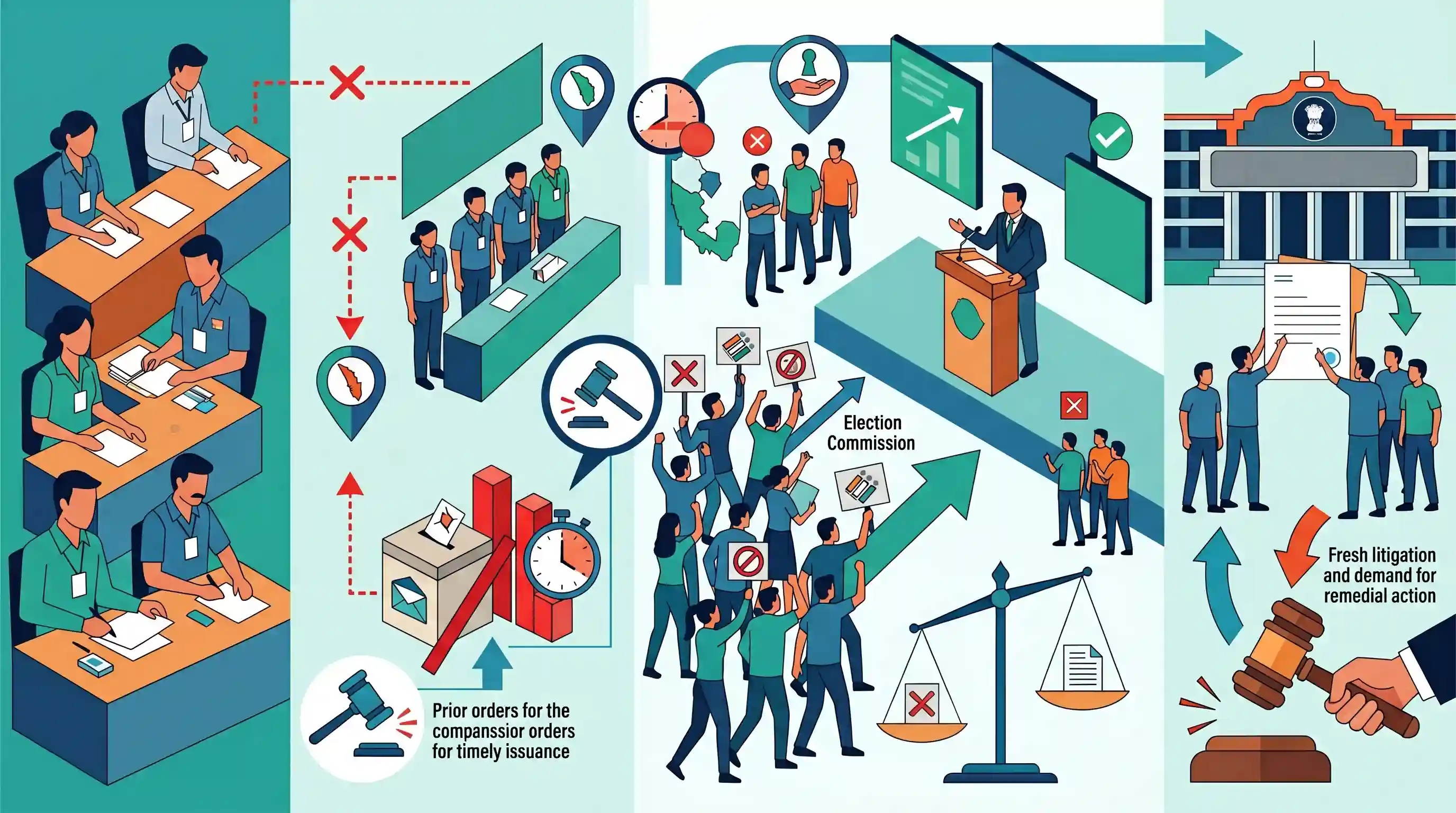
During the Kerala Assembly elections, employee unions alleged that nearly 750 polling officials in Ernakulam district were denied their constitutional right to vote due to the unavailability of postal ballots at designated facilitation centres. Despite prior High Court directives to ensure timely issuance, administrative lapses reportedly prevented officials from exercising their franchise. While the Chief Electoral Officer maintained that the process is rule-bound and over 1.36 lakh officials had voted, the issue has sparked protests and led to fresh litigation in the Kerala High Court seeking remedial action.
Key Points
- Approximately 750 polling officials in Ernakulam district were unable to cast their votes in the Kerala Assembly elections due to delays in the issuance of postal ballots.
- Employee unions, including the NGO Union and Joint Council, allege that thousands of employees across the state were deprived of their voting rights and are demanding they be allowed to vote before counting day.
- Despite earlier High Court directions to ensure postal ballot availability by April 8, many designated voter facilitation centres did not receive them on time.
- Chief Electoral Officer Rathan U. Kelkar maintained that the process was rule-bound, noting that over 1.36 lakh polling officials successfully voted, and advised legal recourse for those affected.
- A fresh petition regarding the denial of voting rights to polling officials has been filed and is pending before the Kerala High Court.
Important Terms
Election Commission of India (ECI)

A permanent constitutional body (Article 324) responsible for the "superintendence, direction, and control" of elections to Parliament, State Legislatures, and the offices of President and Vice-President.
UPSC context
GS II - Constitutional bodies; crucial for understanding electoral integrity, the Model Code of Conduct, and administrative oversight.
Kerala High Court
The highest judicial authority in Kerala and Lakshadweep, empowered by Article 226 to issue writs for enforcing fundamental and legal rights, including those related to electoral grievances.
UPSC context
GS II - Judiciary; illustrates the role of courts in protecting constitutional rights (like the right to vote) via writ jurisdiction.
Postal Ballot
A voting facility allowing specific categories like service voters, senior citizens, and polling officials to cast votes remotely via mail or at designated facilitation centres.
UPSC context
GS II - Salient features of the RPA 1951; essential for ensuring universal adult franchise for citizens on official duty.
NGO Union (Kerala)
An influential, Left-leaning service organization in Kerala representing non-gazetted government employees, primarily affiliated with the CPI(M) and active in advocating for civil service rights.
UPSC context
GS II - Governance; illustrates the role of employee unions as pressure groups influencing administrative and electoral processes.
Joint Council (Kerala)
A prominent service organization for Kerala state government employees, ideologically aligned with the Communist Party of India (CPI), advocating for the professional and constitutional rights of members.
UPSC context
GS II - Governance/Pressure Groups; highlights unionism's impact on public administration and the implementation of state policies.
Communist Party of India (Marxist) [CPI(M)]
A major Marxist-Leninist political party in India and a recognized National Party. It currently leads the ruling Left Democratic Front (LDF) coalition in Kerala.
UPSC context
GS II - Political Parties; relevant for regional politics, coalition governance, and ideological electoral mobilization.
Communist Party of India (CPI)
One of India’s oldest communist parties, currently holding 'State Party' status in Kerala and Tamil Nadu after its national status was revoked by the ECI in 2023.
UPSC context
GS II - Political Parties; important for understanding the criteria for party recognition and the evolution of the Left.
Prelims Trap
High Courts can issue writs to alter or halt the polling process if voting rights are denied.
Article 329(b) explicitly bars judicial interference in the electoral process once it has begun. Grievances must be addressed via an Election Petition post-election.
Static Concepts Connected
Who is legally eligible to cast a vote via Postal Ballot?
- Service Voters: Armed forces personnel, state armed police posted outside their state, and government employees posted abroad.
- Election Duty: Polling officers, presiding officers, and security personnel specifically assigned to election duties.
- Absentee Voters: Senior citizens (currently 85+), Persons with Disabilities (PwDs), and notified essential service workers.
How does Article 329 restrict judicial intervention in elections?
- Absolute Bar: Courts cannot halt or interfere with the electoral process once the ECI officially issues the election notification.
- Election Petition: Electoral disputes can only be raised after results are declared, exclusively via an Election Petition submitted to the High Court.
Cross-Topic Patterns
Nature of the Right to Vote
UPSC frequently tests if the Right to Vote is constitutional or statutory. It derives from Article 326 (Universal Adult Suffrage) but is heavily operationalized by the RPA 1951.
Article 329 vs Judicial Review
The bar on High Court writ intervention during active elections is a rare constitutional carve-out limiting judicial review to ensure democratic continuity without stays.

Expect a tricky Prelims question on the specific legal categories eligible for Postal Ballots vs. Proxy Voting under RPA 1951.
Linked PYQs · 4
Linked PYQs · 4
- 2017PrelimsGS1
Right to vote and to be elected in India is a
- 2020PrelimsGS1
Consider the following statements: 1. According to the Constitution of India, a person who is eligible to vote can be made a minister in a State for six months even if he/she is not a member of the Legislature of that State. 2. According to the Representation of People Act, 1951, a person convicted of a criminal offence and sentenced to imprisonment for five years is permanently disqualified from contesting an election even after his release from prison. Which of the statements given above is/are correct?
- 2022MainsGS2
Discuss the procedures to decide the disputes arising out of the election of a Member of the Parliament or State Legislature under The Representation of the People Act, 1951. What are the grounds on which the election of any returned candidate may be declared void ? What remedy is available to the aggrieved party against the decision ? Refer to the case laws.
- 2019MainsGS2
On what grounds a people's representative can be disqualified under the Representation of Peoples Act, 1951? Also mention the remedies available to such person against his disqualification.
