Ken Betwa Project Protest Ends After Fresh Verification Ordered
Source:downtoearth ↗
Why It Matters
The Ken-Betwa Link Project is highly relevant for MPPSC Prelims, which frequently tests knowledge on Madhya Pradesh's river systems (Ken, Betwa origins), regional geography (Panna, Chhatarpur, Bundelkhand), and related environmental and tribal issues.
Summary
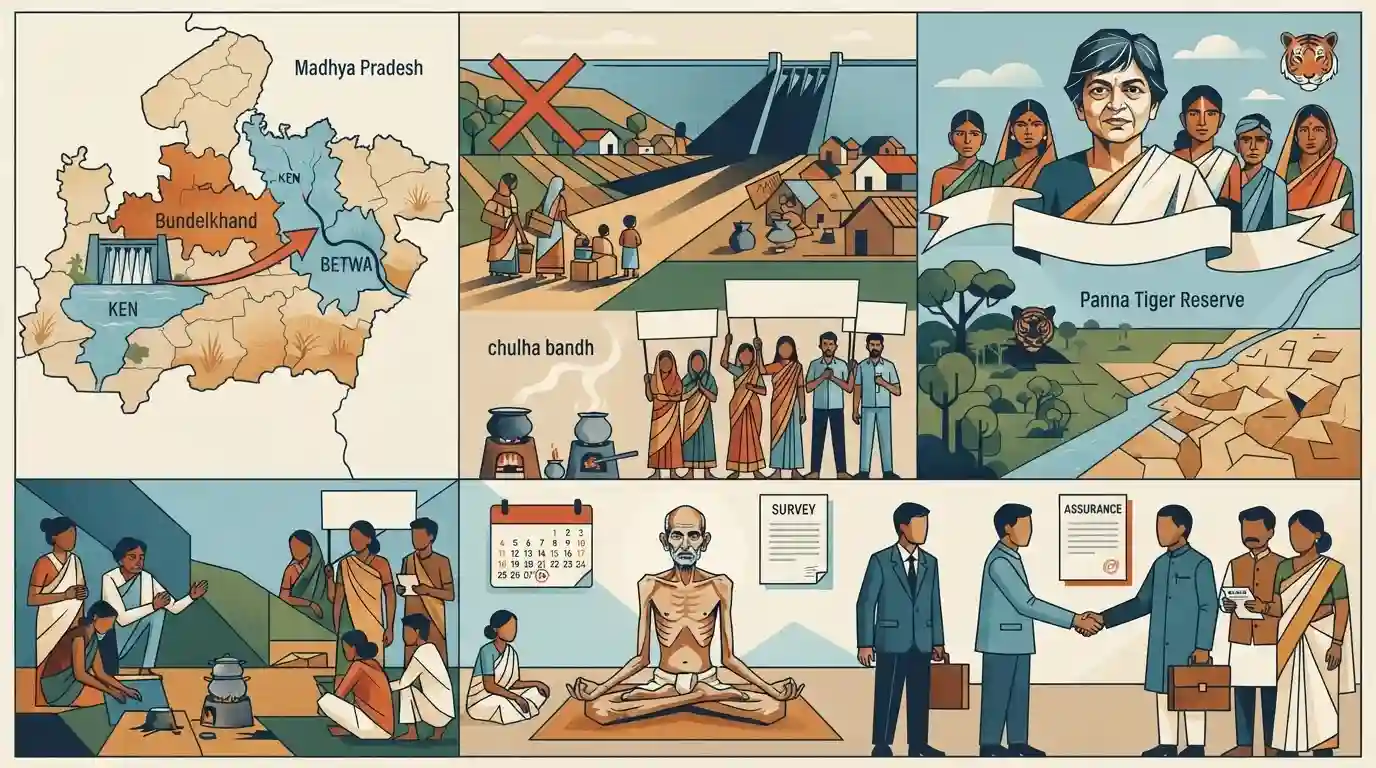
Amit Bhatnagar, a leader of the Jai Kisan Organisation, concluded an 18-day fast following assurances from the Panna district administration to conduct fresh surveys for families displaced by the Ken-Betwa Link Project (KBLP). Residents of the affected Chhatarpur and Panna districts in Madhya Pradesh had launched a 'chulha bandh' (stove protest) alleging arbitrary land acquisition, skipped Gram Sabha consent, and poor compensation. The movement garnered support from tribal forums and prominent environmentalists like Medha Patkar of the Narmada Bachao Andolan. The KBLP, aiming to transfer water from the Ken to the Betwa river basin, has long been criticized for its severe ecological and social consequences in the region.
Key Points
- Protests have erupted in Panna and Chhatarpur districts over irregular land surveys and compensation related to the Ken-Betwa Link Project (KBLP).
- Jai Kisan Organisation leader Amit Bhatnagar ended an 18-day fast after the administration ordered fresh verifications of the affected villages.
- Medha Patkar (Narmada Bachao Andolan) and various tribal platforms supported the 'chulha bandh' (stove strike) highlighting the forced displacement without fair rehabilitation.
- The Ken-Betwa project, India's first major river interlinking initiative, faces continuous criticism for its socio-ecological footprint in the Bundelkhand region.
Important Terms
Ken-Betwa Link Project

India's first major river-interlinking project under the National Perspective Plan, designed to transfer surplus water from Madhya Pradesh's Ken River to Uttar Pradesh's Betwa River to irrigate the drought-prone Bundelkhand region.
UPSC context
Crucial for GS-1 and GS-3 regarding water resource management, river interlinking debates, and the ecological impact on the Panna Tiger Reserve.
Jai Kisan Organisation
A civil society and farmers' rights group that advocates for marginalized communities. It recently spearheaded grassroots protests demanding transparent land surveys and fair rehabilitation for families displaced by the Ken-Betwa Link Project.
UPSC context
Relevant for GS-2 and GS-3 (Role of NGOs, Rehabilitation), highlighting civil society's role in enforcing accountability in state-led infrastructure projects.
Narmada Bachao Andolan
A landmark Indian social movement launched in 1985 by activists like Medha Patkar. It mobilised indigenous communities, farmers, and environmentalists against mass displacement and ecological damage caused by large Narmada River dams.
UPSC context
A vital case study for GS-1 (Social Movements) and GS-3, illustrating the historical conflict between mega-development projects and indigenous human rights.
Adivasi Coordination Forum India
A national coalition of tribal rights organizations. It supports indigenous communities facing forced displacement, advocating for fair compensation, environmental protection, and the strict enforcement of consent laws during major infrastructure developments.
UPSC context
Tests GS-2 (Vulnerable Sections, Tribal Rights) by demonstrating pan-India civil solidarity and the push for enforcement of the Forest Rights Act and PESA.
Prelims Trap
"The Ken-Betwa Link Project transfers surplus water from the Betwa river to the water-deficit Ken basin."
UPSC frequently reverses the direction of river linkages to test precision. Water is transferred *from* the Ken River (surplus) *to* the Betwa River (deficit).
Static Concepts Connected
What is the geographical profile of the Ken and Betwa rivers?
- Origins: Both originate in Madhya Pradesh (Ken in the Kaimur Range, Betwa in the Vindhyan Range).
- Drainage: Both are major right-bank tributaries of the Yamuna River, converging with it in Uttar Pradesh (Banda and Hamirpur respectively).
- Key Features: Betwa hosts the Matatila and Rajghat dams. Ken flows directly through the Panna Tiger Reserve.
When is Gram Sabha consent mandatory for land acquisition?
- LARR Act 2013: Requires consent of 80% of affected families for private projects and 70% for PPPs; Gram Sabha consultation is strictly mandatory in Scheduled Areas.
- PESA Act 1996: Prior consultation with the Gram Sabha or Panchayats at the appropriate level is mandatory before acquiring land in Scheduled Areas.
- Forest Rights Act 2006: Diversion of forest land for non-forest purposes (like dams) requires certification of Gram Sabha consent indicating settlement of rights.
Cross-Topic Patterns
River interlinking vs. Tiger Habitats
The Daudhan dam submerging ~10% of Panna's critical tiger habitat mirrors debates around the Great Nicobar Project and Dibang multipurpose dam regarding severe biodiversity trade-offs for mega-infrastructure.
Evolution of anti-dam displacement protests
Support from Narmada Bachao Andolan links KBLP protests to legacy environmental movements, shifting the focus from pure ecology to tribal rehabilitation and PESA/FRA violations in Scheduled Areas.

Expect a multi-statement question mapping Ken/Betwa tributaries, Panna Tiger Reserve's submergence zone, and Yamuna basin geography.
Linked PYQs · 3
Linked PYQs · 3
- 2020MPPSC_PRELIMSGS1
Betwa river originate from
- 2023MPPSC_PRELIMSGS1
Which of the following rivers of Madhya Pradesh flows in three states?
- 2024MPPSC_PRELIMSGS1
Which of the following pairs is false? Sanctuary District
