Ken-Betwa project faces resistance despite compensation payout
Source:indianmasterminds ↗
Why It Matters
Evaluates the socio-economic, legal, and environmental trade-offs of river interlinking projects. It tests practical knowledge on statutory rights (Land Acquisition Act) and the ecological impact on key biodiversity hotspots like Panna Tiger Reserve.
Summary
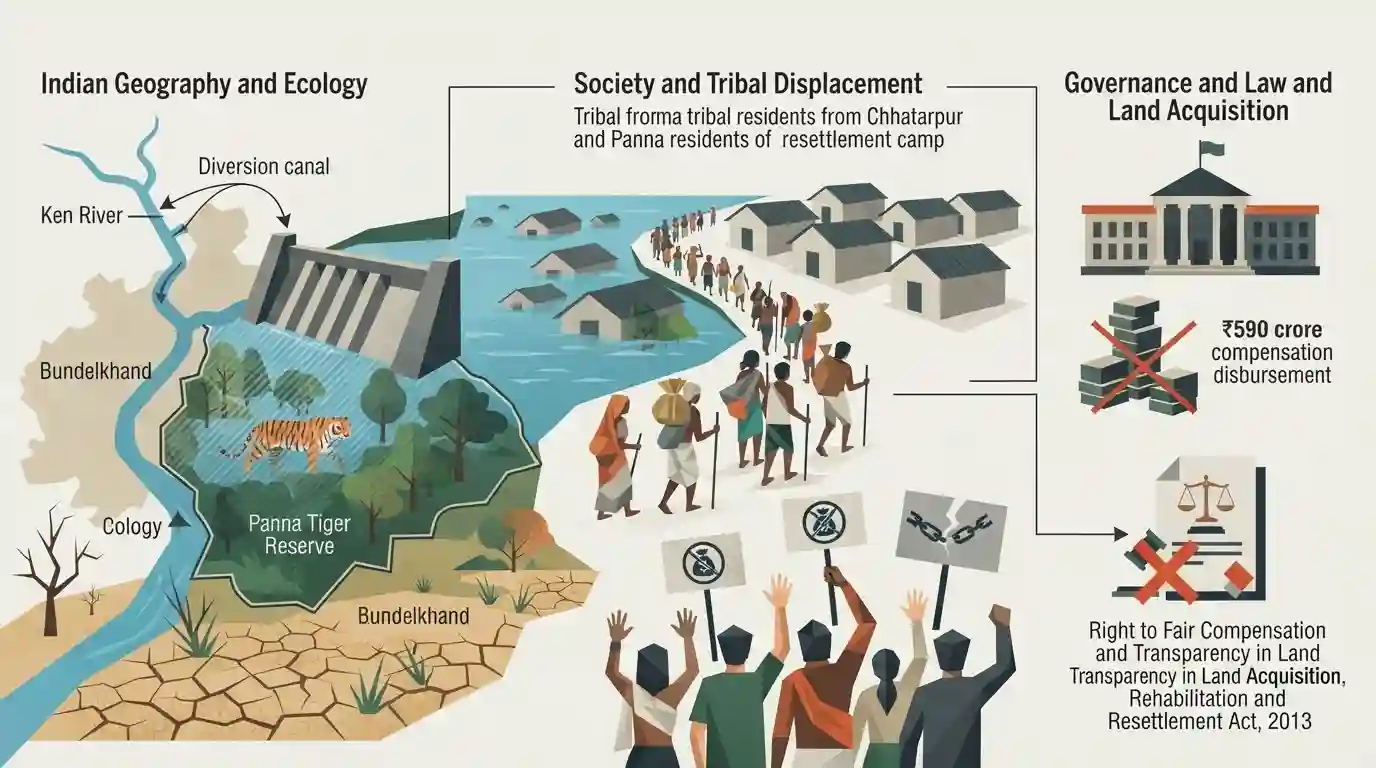
Protests are ongoing against the Ken-Betwa Link Project in Madhya Pradesh's Bundelkhand region despite the government disbursing ₹590 crore in compensation. Residents facing displacement due to the construction of the Daudhan dam—particularly tribal populations in Chhatarpur and Panna districts—argue that the compensation is inadequate and violates the Right to Fair Compensation and Transparency in Land Acquisition, Rehabilitation and Resettlement Act, 2013. Additionally, the project faces environmental opposition due to the submergence of prime wildlife habitat within the Panna Tiger Reserve.
Key Points
- The Ken-Betwa Link Project (KBLP) aims to transfer surplus water from the Ken river to the Betwa river basin to irrigate the drought-prone Bundelkhand region.
- Despite the disbursement of ₹590 crore in compensation, protests persist over inadequate rehabilitation and the displacement of tribal villages caused by the Daudhan dam construction.
- Protesters allege that compensation rates violate the statutory provisions outlined in the Right to Fair Compensation and Transparency in Land Acquisition, Rehabilitation and Resettlement Act, 2013.
- The project involves significant ecological trade-offs, as it will submerge critical tiger habitats within the Panna Tiger Reserve, drawing widespread environmental concern.
- The issue underscores the governance challenges of balancing large-scale infrastructure, socio-economic rights of marginalized communities, and wildlife conservation.
Important Terms
Ken-Betwa Link Project (KBLP)

India's first river interlinking initiative under the National Perspective Plan. It transfers surplus water from Madhya Pradesh's Ken River to Uttar Pradesh's Betwa basin via the Daudhan Dam to irrigate Bundelkhand.
UPSC context
Crucial for MPPSC Geography and Environment (Papers 1 & 3), testing river systems, Bundelkhand water security, and ecological impacts.
Right to Fair Compensation and Transparency in Land Acquisition, Rehabilitation and Resettlement Act, 2013
A 2013 law establishing transparent land acquisition processes, mandatory social impact assessments, and comprehensive rehabilitation packages for displaced families, replacing the colonial 1894 Act.
UPSC context
Tests MPPSC Polity and Society (Paper 2), focusing on tribal displacement, land rights, and social justice mechanisms in infrastructure.
Forest Rights Act
Officially the Scheduled Tribes and Other Traditional Forest Dwellers Act (2006), this legislation legally recognizes the land, habitat, and resource rights of communities historically dependent on forests.
UPSC context
Essential for MPPSC Paper 2 (Social Sector), evaluating knowledge of tribal welfare, historical injustices, and forest conservation balancing.
Ministry of Jal Shakti
A central ministry formed in 2019 to integrate water governance. It manages inter-state river disputes, executes national water-sharing initiatives like the Ken-Betwa project, and ensures drinking water security.
UPSC context
Important for MPPSC Paper 2 (Governance), testing the functions of central ministries, administrative coordination, and national water frameworks.
National Green Tribunal (NGT)
A specialized judicial body established in 2010 for environmental protection cases. It is actively involved in reviewing the ecological clearances and deforestation impact of the Ken-Betwa project's dams.
UPSC context
Key for MPPSC Papers 2 and 3 (Statutory Bodies & Environment), assessing environmental jurisprudence and ecological accountability.
Prelims Trap
"The Ken-Betwa project transfers surplus water from the Betwa river to the Ken river."
It is the exact opposite. Surplus water is transferred from the Ken River to the Betwa River basin. Both rivers are tributaries of the Yamuna.
Static Concepts Connected
What are the geographical characteristics of the Ken and Betwa rivers?
- Origin: Both rivers originate in the Vindhya Range in Madhya Pradesh.
- Destination: Both are major right-bank tributaries of the Yamuna River, flowing northward through MP and Uttar Pradesh.
- Daudhan Dam: Proposed on the Ken river, it is the primary storage and diversion structure for the interlinking project.
Why is Panna Tiger Reserve significant in the context of the KBLP?
- River Flow: The Ken river flows south to north directly through the reserve, supporting its ecology and creating deep gorges.
- Ecological Threat: A large portion of the reserve's critical tiger habitat will be submerged by the reservoir of the Daudhan Dam.
Cross-Topic Patterns
Infrastructure vs. Tribal Rights
The protests highlight the friction between the National Perspective Plan for water security and the statutory mandates of the LARR Act 2013 and Forest Rights Act regarding tribal displacement.
Bundelkhand Drought & Interlinking
Connects the regional geography of Bundelkhand (hard rock aquifers, seasonal drought) to the socio-economic necessity of river interlinking projects, contrasting heavily with the ecological costs.

KBLP water direction, Yamuna tributary status, Daudhan Dam location, and Panna TR submergence will likely form a multi-statement question.
Linked PYQs · 4
Linked PYQs · 4
- 2020MPPSC_PRELIMSGS1
Betwa river originate from
- 2020MPPSC_PRELIMSGS1
Panna district of Madhya Pradesh famous for which mineral?
- 2025MPPSC_PRELIMSGS1
In present times, Right to Property has been accepted in the Indian Constitution in which of the following forms?
- 2018MPPSC_PRELIMSGS1
Kanha National Park is famous for
