Delhi Assembly Privileges Panel Summons Arvind Kejriwal
Source:Indian Express ↗
Why It Matters
The invocation of parliamentary privileges and the functioning of legislative committees are key components of legislative oversight. The demand for live-streaming committee proceedings touches upon modernizing parliamentary practices and balancing legislative immunity with public accountability.
Summary
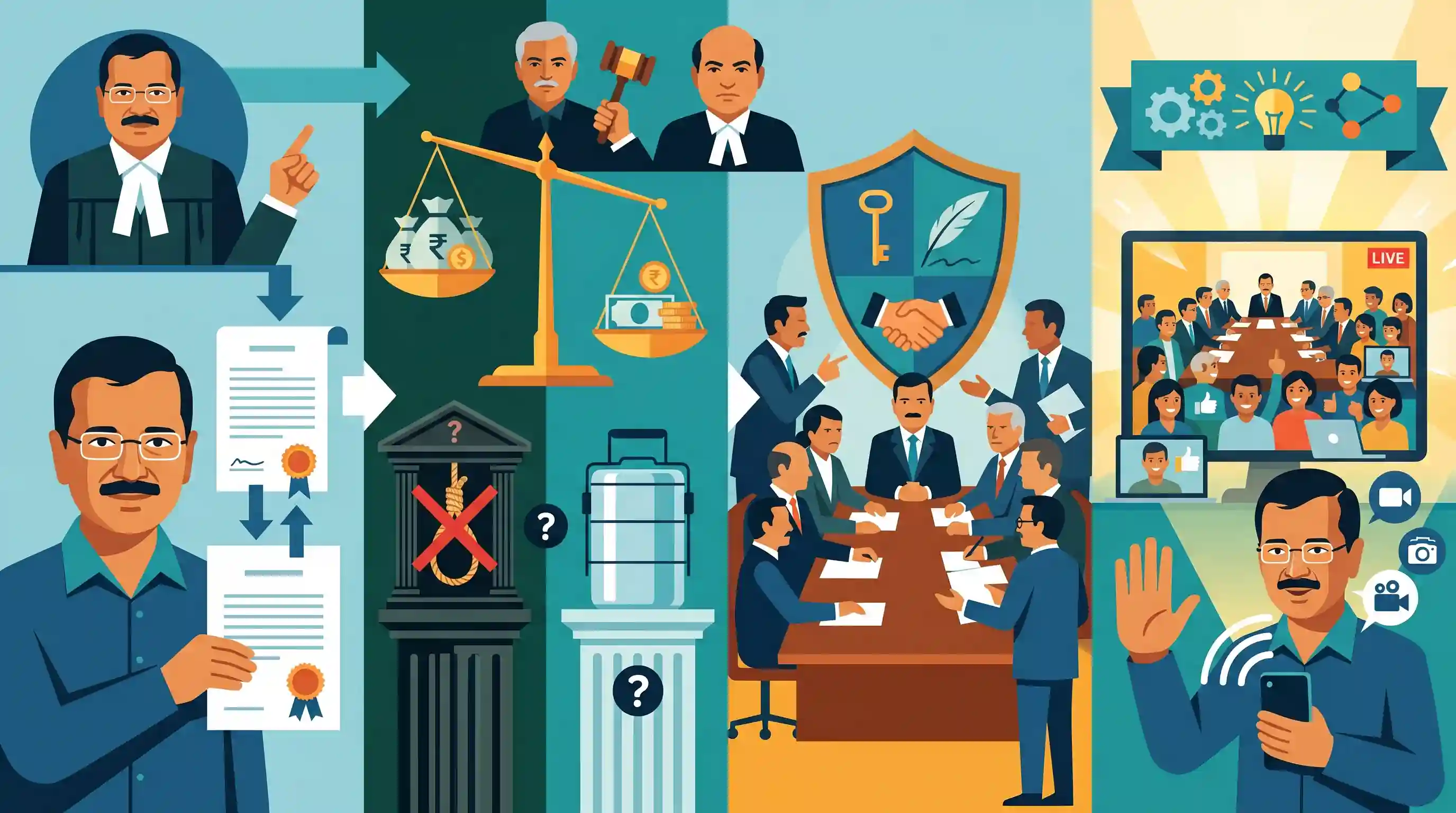
Former Delhi CM Arvind Kejriwal is scheduled to appear before the Delhi Assembly's Privileges Committee in connection with the 'Phansi Ghar' controversy. The dispute involves the expenditure of Rs 1.4 crore by the previous government to renovate an alleged British-era execution chamber, which current Speaker Vijender Gupta claims was merely a tiffin room. While agreeing to comply with the summons, Kejriwal has formally requested the live-streaming of the proceedings to uphold transparency and public accountability. The issue highlights the enforcement powers of legislative committees, the scope of parliamentary privileges, and the emerging debate around digital transparency in legislative oversight.
Key Points
- Arvind Kejriwal has agreed to appear before the Delhi Assembly's Privileges Committee regarding the 'Phansi Ghar' controversy.
- The issue revolves around the previous AAP government spending Rs 1.4 crore to renovate an alleged British-era execution chamber, which the current Speaker claims was actually a "tiffin room".
- Kejriwal requested the live-streaming of the committee's proceedings to ensure transparency and public accountability.
- The committee had previously recommended action against Kejriwal and three other AAP leaders for repeatedly failing to answer summons.
Important Terms
Privileges Committee

A quasi-judicial standing committee of the legislature that investigates alleged violations of the rights and immunities of the House or its members and recommends punitive actions.
UPSC context
GS II: State Legislatures—Structure and functioning. Tests knowledge of internal accountability and legislative committee powers.
Parliamentary Privileges
Legal rights and immunities enjoyed by legislators (MPs/MLAs) to ensure they perform their duties without fear of external interference or legal repercussions.
UPSC context
GS II: Separation of Powers and Constitutional provisions (Articles 105 & 194) protecting legislative independence.
Breach of Privilege
An act that violates the rights, immunities, or dignity of a legislative house, such as disobeying a committee summons or obstructing a member's duties.
UPSC context
GS II: Legislative procedures and executive-legislature relations. Tests understanding of the boundaries of legislative authority.
Article 194
The constitutional provision defining the powers, privileges, and immunities of State Legislatures and their members, mirroring Article 105 for the Union Parliament.
UPSC context
GS II: Indian Constitution—Significant provisions regarding the functioning of State Assemblies.
Legislative Oversight
The monitoring and review of government policies and expenditures by the legislature to ensure executive accountability and transparency.
UPSC context
GS II: Governance and the principle of checks and balances in a parliamentary system.
Public Works Department (PWD)
A premier government agency responsible for the planning, construction, and maintenance of public infrastructure and government buildings.
UPSC context
GS II: Structure and functioning of the Executive and government departments involved in public expenditure.
Prelims Trap
"The Privileges Committee holds the final authority to penalize or imprison individuals for breach of privilege."
The Committee operates as a quasi-judicial body that only investigates and recommends disciplinary action. The final punitive authority rests entirely with the House itself.
Static Concepts Connected
What is the composition and mandate of the Privileges Committee?
- Composition: Lok Sabha has 15 members; Rajya Sabha has 10 members. Both are nominated by their respective Presiding Officers.
- Quasi-judicial role: It acts as a quasi-judicial body to investigate alleged breaches of privileges of the House, its committees, or its members.
- Advisory nature: It lacks final punitive power, only recommending actions like admonition, reprimand, or imprisonment to the House.
Why are legislative committee meetings traditionally held in-camera?
- Frank discussions: Shielding proceedings from public view allows members to debate and examine evidence openly across party lines without political posturing.
- Breach of Privilege: Unauthorized disclosure or broadcasting of committee proceedings before a final report is officially tabled in the House constitutes a breach of privilege.
Cross-Topic Patterns
Privileges vs Freedom of Speech
The demand for live-streaming highlights the recurring constitutional friction between uncodified legislative privileges (Article 105/194) and the citizen's right to information under Article 19(1)(a).
Delhi Assembly's Subpoena Powers
In the 2021 Ajit Mohan case, the Supreme Court affirmed that despite Delhi's limited statehood, its Assembly committees possess privileges to summon non-members to ensure executive accountability.

Conflict between digital transparency (live-streaming) and parliamentary committee privileges (in-camera rules) is a prime 2026 Mains theme.
Linked PYQs · 4
Linked PYQs · 4
- 2014MainsGS2
The 'Powers, Privileges and Immunities of Parliament and its Members' as envisaged in Article 105 of the Constitution leave room for a large number of un-codified and un-enumerated privileges to continue. Assess the reasons for the absence of legal codification of the 'parliamentary privileges'. How can this problem be addressed ?
- 2021MainsGS2
To what extent, in your view, the Parliament is able to ensure accountability of the executive in India?
- 2023MainsGS2
Discuss the role of Presiding Officers of state legislatures in maintaining order and impartiality in conducting legislative work and in facilitating best democratic practices.
- 2023MainsGS2
Explain the structure of the Parliamentary Committee system. How far have the financial committees helped in the institutionalisation of Indian Parliament?
