Delhi Excise Policy Case Discharge and PMLA Legal Framework
Source:Indian Express ↗
Why It Matters
The event provides a practical case study for GS-2 (Federalism, functioning of investigative agencies, L-G's powers) and GS-3 (Money Laundering). It underscores the tension between the Union and the NCT of Delhi, as well as the debate over the weaponization of stringent laws like the PMLA and prolonged pre-trial detention.
Summary
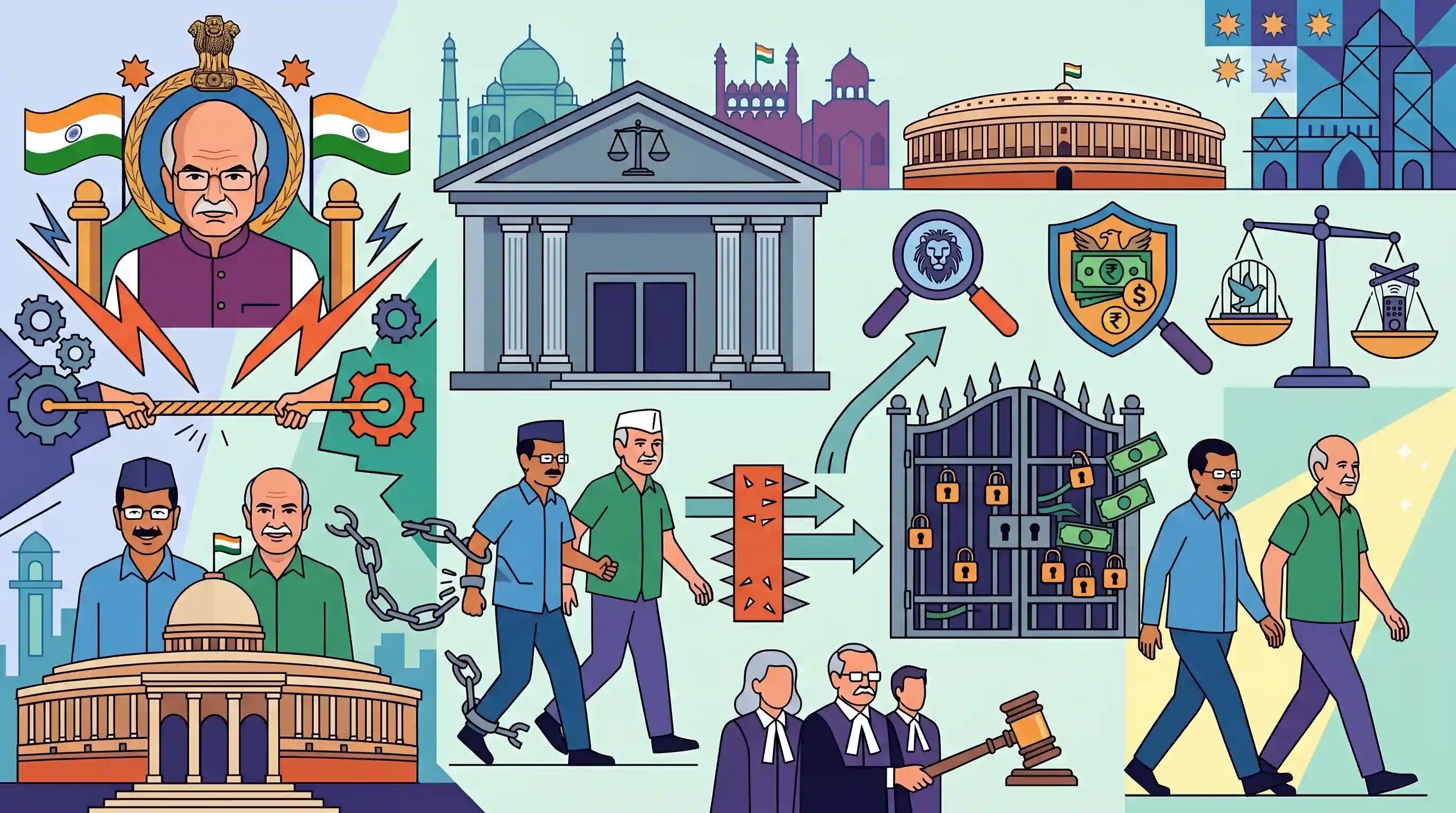
Delhi Chief Minister Arvind Kejriwal and former Deputy CM Manish Sisodia were discharged by a trial court in the alleged Delhi liquor policy scam. The controversy revolved around the drafting and execution of the Delhi Excise Policy 2021-22, which was investigated by the CBI for corruption and the ED for money laundering under the PMLA. Their discharge underscores the lack of sufficient prima facie evidence to warrant a trial. From a UPSC perspective, the case spotlights the rigorous provisions and burden of proof under the PMLA, the autonomy and potential political misuse of central investigative agencies, and the enduring constitutional friction between the elected government of Delhi and the Lieutenant Governor under Article 239AA.
Key Points
- The case stemmed from allegations of corruption and procedural lapses in the drafting and implementation of the now-scrapped Delhi Excise Policy 2021-22.
- The discharge by the trial court indicates that there was insufficient prima facie evidence to frame charges and proceed to trial, which is legally distinct from an acquittal (which happens after a full trial).
- The investigation was dual-pronged: the CBI investigated the predicate offence (corruption and irregularities) while the ED probed the alleged money trail under the Prevention of Money Laundering Act (PMLA).
- The broader political context involves the persistent administrative friction between the elected Delhi government and the Union Government, acting through the Lieutenant Governor under Article 239AA.
- The case highlights issues regarding pre-trial incarceration, the stringent bail conditions under PMLA Section 45, and allegations of political misuse of central investigative agencies.
Important Terms
Delhi Excise Policy 2021-22

A regulatory reform (later scrapped) intended to privatize Delhi's liquor trade and boost revenue. Allegations of kickbacks and procedural lapses led to major investigations by central agencies.
UPSC context
GS II: Governance and Federalism. Tests understanding of policy formulation, executive discretion, and legal accountability in public administration.
Prevention of Money Laundering Act (PMLA)
Legislation enacted to combat money laundering. Its Section 24 controversially shifts the 'burden of proof' to the accused, requiring them to prove that property is untainted.
UPSC context
GS II & III: Judicial Review and Internal Security. Focuses on due process, individual rights, and state powers.
Article 239AA of the Indian Constitution
A constitutional provision granting 'special status' to Delhi. It provides a Legislative Assembly but excludes 'Police, Public Order, and Land' from its jurisdiction.
UPSC context
GS II: Indian Constitution. Essential for understanding Delhi’s unique federal structure and Center-State power struggles.
Enforcement Directorate (ED)
A specialized financial investigation agency under the Ministry of Finance. It enforces the PMLA and FEMA, primarily focusing on money laundering and foreign exchange violations.
UPSC context
GS II: Statutory and Regulatory Bodies. Tests knowledge of agency autonomy and its role in enforcing economic laws.
Central Bureau of Investigation (CBI)
India's premier anti-corruption agency. It derives powers from the DSPE Act, 1946, to investigate corruption, bribery, and major criminal cases involving public officials.
UPSC context
GS II: Executive and Judiciary. Important for debates on investigative autonomy and federal police cooperation.
Discharge (Legal)
A judicial decision to drop charges before a trial begins. It occurs when the court finds insufficient prima facie evidence to justify a formal trial.
UPSC context
GS II: Indian Judiciary. Distinguishes between procedural stages of criminal justice (Discharge vs. Acquittal vs. Bail).
Prelims Trap
"The Enforcement Directorate can pursue PMLA charges even if the accused is discharged in the predicate offence."
Under the PMLA, money laundering charges rely entirely on a 'predicate offence'. The Supreme Court has ruled that if discharged or acquitted of the primary crime, PMLA charges collapse.
Static Concepts Connected
What distinguishes a 'discharge' from an 'acquittal' in Indian criminal law?
- Discharge Stage: Occurs pre-trial when the magistrate finds insufficient prima facie evidence to even frame charges against the accused.
- Acquittal Stage: Occurs post-trial. It is a formal verdict of 'not guilty' pronounced only after the completion of the entire trial and examination of evidence.
- Double Jeopardy: Acquittal triggers protection against retrial (Article 20(2)), whereas a discharge does not bar investigative agencies from filing a fresh charge sheet if new evidence emerges.
What are the constitutional limitations on the Delhi government under Article 239AA?
- Reserved Subjects: The elected legislative assembly cannot make laws concerning Public Order, Police, and Land; these remain strictly under the Union Government's domain.
- LG Discretion: The Lieutenant Governor is empowered to refer any difference of opinion with the elected Council of Ministers to the President, effectively stalling implementation.
- Parliamentary Supremacy: Parliament retains absolute power to legislate on any subject for Delhi, overriding state assembly laws in case of a constitutional or legislative conflict.
Cross-Topic Patterns
PMLA Bail vs Article 21
The rigorous 'twin conditions' for bail under PMLA Section 45 constantly clash with the fundamental right to liberty, making the balance between investigation and personal freedom a core constitutional debate.
Federalism and CBI Jurisdiction
CBI's unfettered power in Union Territories like Delhi sharply contrasts with states invoking Section 6 of the DSPE Act to withdraw general consent, underscoring asymmetric federalism fault lines.

Expect a Prelims statement confusing 'discharge' with 'acquittal' or testing the dependency of PMLA cases on the CBI's predicate offence.
Linked PYQs · 5
Linked PYQs · 5
- 2021MainsGS2
The jurisdiction of the Central Bureau of Investigation (CBI) regarding lodging an FIR and conducting probe within a particular State is being questioned by various States. However, the power of the States to withhold consent to the CBI is not absolute. Explain with special reference to the federal character of India.
- 2016MainsGS2
Discuss the essentials of the 69th Constitutional Amendment Act and anomalies, if any, that have led to recent reported conflicts between the elected representatives and the institution of the Lieutenant Governor in the administration of Delhi. Do you think that this will give rise to a new trend in the functioning of the Indian federal politics?
- 2018MainsGS2
Whether the Supreme Court Judgement (July 2018) can settle the political tussle between the Lt. Governor and elected government of Delhi? Examine.
- 2021MainsGS3
Discuss how emerging technologies and globalisation contribute to money laundering. Elaborate measures to tackle the problem of money laundering both at national and international levels.
- 2013MainsGS3
Money laundering poses a serious security threat to a country's economic sovereignty. What is its significance for India and what steps are required to be taken to control this menace?
