Political Instability and Resignation of UK Prime Minister
Source:Indian Express ↗
Why It Matters
The political instability in the UK, a major global power and crucial partner for India, impacts bilateral trade agreements, diaspora relations, and global economic dynamics. Understanding the post-Brexit fallout and the rise of populism provides essential context for GS2 International Relations and Comparative Politics.
Summary
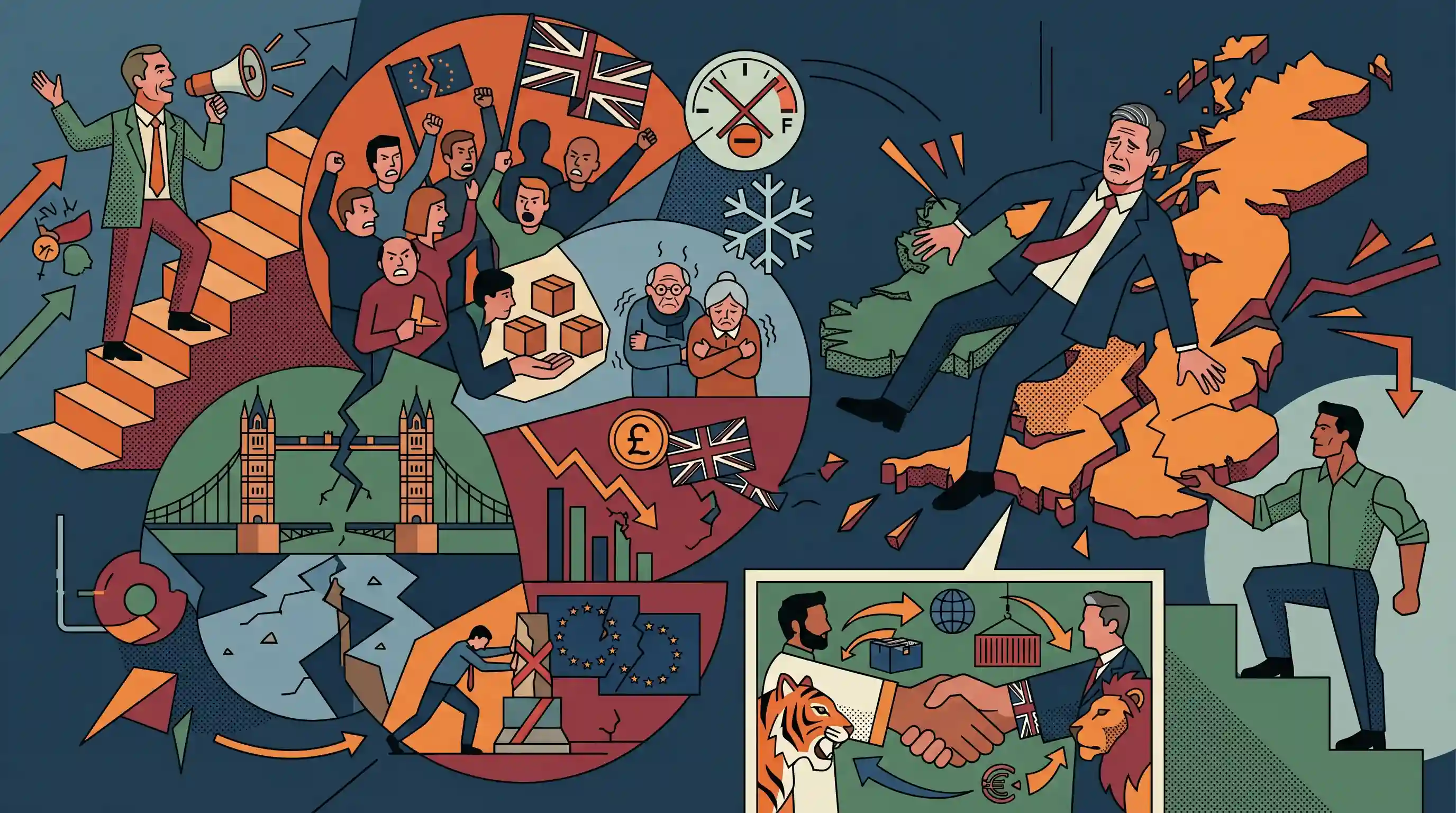
Keir Starmer has resigned as the UK Prime Minister and leader of the Labour Party, citing unmanageable domestic crises and a party revolt following disastrous local election results. His brief two-year tenure was undermined by early scandals like "freebies gate," controversial decisions such as cutting pensioner fuel subsidies, and the overarching economic struggles of a post-Brexit UK. The failure to reset relations with the European Union, coupled with the rising popularity of populist right-wing leader Nigel Farage and internal party challengers like Andy Burnham, ultimately led to Starmer's downfall, despite some progress in foreign policy such as the India-UK trade deal.
Key Points
- Keir Starmer resigned as UK Prime Minister and leader of the Labour Party two years after his 2024 election, following poor local election results and internal party revolt.
- His tenure was marred by controversies like the "freebies gate", cutting winter fuel subsidies for pensioners, and the early release of 1,700 prisoners.
- The UK economy continues to struggle with the post-Brexit reality, and Labour failed to deliver a promised reset in relations with the European Union.
- The political vacuum and dissatisfaction have fueled the rise of populist movements, notably Nigel Farage's right-wing Reform UK party and the left-wing Green Party.
- Despite domestic failures, Starmer's government achieved some foreign policy successes, including building relations with Donald Trump's administration and advancing a major trade deal with India.
Important Terms
India-UK Free Trade Agreement

A comprehensive bilateral trade deal signed to reduce tariffs, improve market access, and boost trade in sectors like automobiles, textiles, and services. It is set to enter into force on July 15, 2026.
UPSC context
GS Paper II: Bilateral agreements involving India; GS Paper III: Effects of liberalization on the economy and international trade.
Brexit
The process of the United Kingdom's withdrawal from the European Union, which has significantly altered its economic landscape, trade relations, and domestic political stability.
UPSC context
GS Paper II: Effect of policies and politics of developed countries on India's interests and the Indian diaspora.
Labour Party
The current governing center-left political party in the UK. Its leadership transition and domestic policy shifts directly impact the continuity of bilateral agreements like the India-UK FTA.
UPSC context
GS Paper II: Comparison of the Indian constitutional scheme with that of other countries; political systems of developed nations.
Reform UK
A right-wing populist and anti-establishment political party in the UK, led by Nigel Farage, which has seen a significant rise in popularity, challenging traditional two-party dominance.
UPSC context
GS Paper II: Global political trends, the rise of populism, and its impact on international stability and bilateral relations.
European Union
An economic and political union of 27 European countries. The UK's failure to reset relations with this bloc remains a central challenge for its post-Brexit economic recovery.
UPSC context
GS Paper II: Regional and global groupings and agreements involving or affecting India's interests.
Prelims Trap
"The resignation of a UK Prime Minister mandates the dissolution of Parliament and a snap general election."
In the UK system, a ruling party can replace its leader internally to appoint a new PM; a general election is not constitutionally mandated upon resignation.
Static Concepts Connected
How do UK and Indian parliamentary systems differ on party revolts?
- Internal leadership change: UK ruling parties can remove their leader and install a new PM without dissolving parliament or triggering a general election.
- Anti-Defection Law: India's 10th Schedule (Anti-Defection Law) heavily restricts MPs from voting against party leadership, making internal executive coups highly difficult.
What are the core components of comprehensive FTAs like India-UK?
- Tariff reduction: Securing zero-duty or significantly reduced tariff access for the vast majority of bilateral goods trade.
- Services mobility: Easing visa norms and facilitating the movement of skilled professionals, often categorized under Mode 4 of GATS.
- Beyond border rules: Modern FTAs increasingly cover non-tariff domains like intellectual property rights, labor standards, and environmental regulations.
Cross-Topic Patterns
UK Instability + India FTA
Frequent UK leadership changes threaten the India-UK FTA timeline, particularly stalling sensitive negotiations on visa mobility for Indian professionals and students.
Fiscal Consolidation vs Welfare
Labour's fuel subsidy cut reflects a global macroeconomic dilemma: balancing strict fiscal deficit targets with sustaining essential welfare schemes for vulnerable populations.

Mains GS2 could test the contrast between UK internal party revolts and India's rigid Anti-Defection Law in stabilizing the executive.
Linked PYQs · 3
Linked PYQs · 3
- 2023MainsGS2
Compare and contrast the British and Indian approaches to Parliamentary sovereignty.
- 2022MainsGS2
Besides the welfare schemes, India needs deft management of inflation and unemployment to serve the poor and the underprivileged sections of the society. Discuss.
- 2023PrelimsGS1
Consider the following statements: Statement-I: Recently, the United States of America (USA) and the European Union (EU) have launched the 'Trade and Technology Council'. Statement-II: The USA and the EU claim that through this they are trying to bring technological progress and physical productivity under their control. Which one of the following is correct in respect of the above statements?
