Domestic Carbon Pricing and CBAM: Retaining Climate Finance
Source:The Hindu ↗
Why It Matters
The intersection of climate policy and international trade is a highly probable area for UPSC questions. CBAM represents a major shift in global trade rules, directly impacting India's exports and necessitating complex domestic policy responses (like CCTS). Understanding how carbon pricing works, how it affects international trade (WTO compatibility, CBDR), and how India can leverage it for climate finance is crucial for GS-3 (Economy and Environment) and GS-2 (International Relations).
Summary
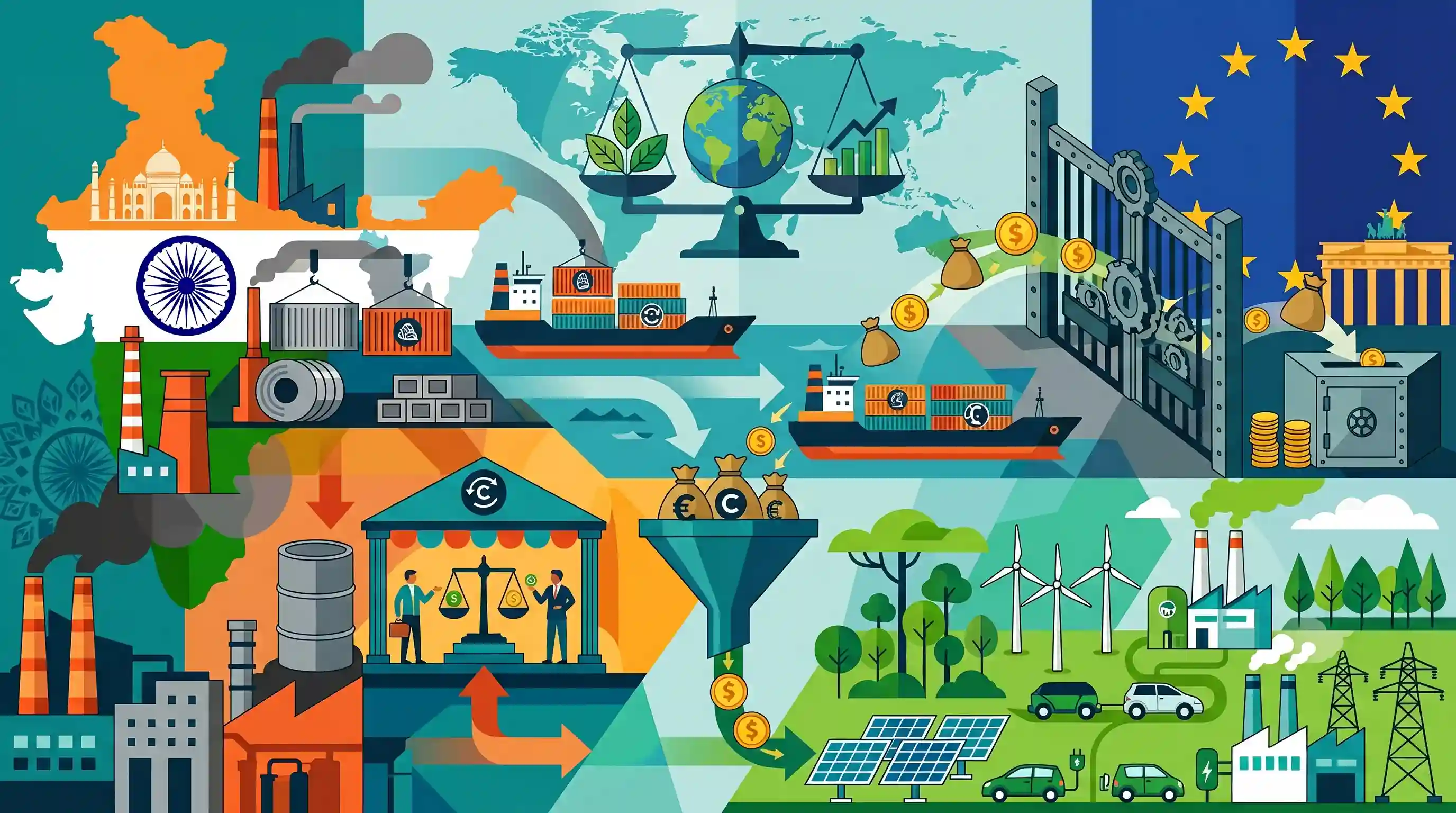
The article analyzes the implications of the European Union's Carbon Border Adjustment Mechanism (CBAM) on India's export economy and emphasizes the strategic need for domestic carbon pricing. It argues that without a robust internal carbon market—such as the Carbon Credit Trading Scheme (CCTS) or a carbon tax—Indian exporters of carbon-intensive goods will be forced to pay carbon tariffs to the EU. By establishing its own carbon pricing, India can retain these financial resources at home. This "carbon money" can then be reinvested into domestic climate finance to accelerate the country's green transition, thereby countering the protectionist trade policies of developed nations while meeting global climate commitments.
Key Points
- The EU's Carbon Border Adjustment Mechanism (CBAM) will impose a carbon tariff on carbon-intensive imports like steel and aluminum, potentially harming Indian exporters.
- If India lacks an equivalent domestic carbon pricing mechanism, Indian industries will end up paying the carbon tax to the EU, transferring vital financial resources abroad.
- By implementing a robust domestic carbon tax or fully operationalizing the Carbon Credit Trading Scheme (CCTS), India can ensure this 'carbon money' is collected and retained domestically.
- The retained funds can be redirected as climate finance to support India's domestic transition to green energy and low-carbon manufacturing technologies.
- This strategy helps India navigate the protectionist trends of developed nations under the guise of climate action while safeguarding its economic interests and adhering to CBDR principles.
Important Terms
Carbon Border Adjustment Mechanism (CBAM)

An EU-imposed levy on carbon-intensive imports (e.g., steel, cement) ensuring they pay a carbon price equivalent to domestic producers to prevent industrial relocation to countries with weaker regulations.
UPSC context
GS3: Environment/Economy. Tests impact of global 'green protectionism' on India's export competitiveness and international trade diplomacy.
Carbon Credit Trading Scheme (CCTS)
India's domestic framework established under the Energy Conservation (Amendment) Act 2022 to trade carbon credit certificates, incentivizing industries to reduce greenhouse gas emissions via a market-based mechanism.
UPSC context
GS3: Environment. Essential for understanding India's policy response to global carbon pricing and its internal transition to a low-carbon economy.
United Nations Framework Convention on Climate Change (UNFCCC)
The 1992 foundational international treaty for climate action, which established the principle of 'Common But Differentiated Responsibilities' (CBDR), ensuring developed nations lead mitigation efforts while supporting developing ones.
UPSC context
GS3: Environment. Primary framework for global climate governance and the legal basis for India’s demands for climate justice and equity.
Paris Agreement
The 2015 global climate treaty aiming to limit warming to well below 2°C through Nationally Determined Contributions (NDCs), forming the basis for India’s 'Net Zero 2070' goal.
UPSC context
GS3: Environment. Fundamental for understanding India’s international commitments and the evolution of domestic emission reduction targets.
World Trade Organization (WTO)
The global body governing trade rules; it serves as the primary forum for resolving disputes regarding environmental taxes as potential non-tariff barriers to trade.
UPSC context
GS2: International Relations. Analyzes trade-climate conflicts and India’s stance against unilateral trade measures disguised as environmental policies.
Carbon Leakage
The shift of carbon-intensive production from countries with strict climate policies to those with weaker ones, potentially resulting in no net global emission reduction.
UPSC context
GS3: Environment. The central technical justification used by developed nations for imposing carbon border taxes on developing economies.
Prelims Trap
India's Carbon Credit Trading Scheme (CCTS) is administered by the Ministry of Environment, Forest and Climate Change.
CCTS was established under the Energy Conservation (Amendment) Act, 2022. Its nodal administrative agency is the Bureau of Energy Efficiency (BEE) under the Ministry of Power, not the MoEFCC.
Static Concepts Connected
What are the primary mechanisms for Carbon Pricing?
- Carbon Tax: A direct, fixed fee set by the government on greenhouse gas emissions, providing price certainty but no hard cap on total emissions.
- Cap-and-Trade (ETS): A market system where total emissions are capped, and entities trade allowances. It ensures emission reduction certainty but prices fluctuate based on market demand.
What is the principle of CBDR-RC under the UNFCCC?
- Core Principle: Acknowledges that all states share an obligation to address climate change, but have unequal historical contributions and differing economic capacities to act.
- Historical Responsibility: Dictates that developed nations, responsible for most historical emissions, must bear a greater burden in mitigation and provide climate finance to developing nations.
Cross-Topic Patterns
Carbon Tariffs & WTO Trade Barriers
Environmental measures like CBAM increasingly intersect with WTO rules. Developing nations argue these act as disguised protectionist non-tariff barriers, violating the Most-Favored-Nation principle under international trade law.
Climate Finance & Sovereign Green Bonds
Retaining domestic 'carbon money' aligns with India's broader climate finance strategy, linking directly to the mobilization of resources via Sovereign Green Bonds for low-carbon infrastructure.

Expect a Prelims question linking CBAM's impact on Indian exports with the BEE's statutory role in India's Carbon Credit Trading Scheme.
Linked PYQs · 5
Linked PYQs · 5
- 2023PrelimsGS1
Consider the following statements: Statement-I: Carbon markets are likely to be one of the most widespread tools in the fight against climate change. Statement-II: Carbon markets transfer resources from the private sector to the State. Which one of the following is correct in respect of the above statements?
- 2025MainsGS3
Write a review on India's climate commitments under the Paris Agreement (2015) and mention how these have been further strengthened in COP26 (2021). In this direction, how has the first Nationally Determined Contribution intended by India been updated in 2022?
- 2016MainsGS2
The broader aims and objectives of WTO are to manage and promote international trade in the era of globalization. But the Doha round of negotiations seem doomed due to differences between the developed and the developing countries." Discuss in the Indian perspective.
- 2018MainsGS2
What are the key areas of reform if the WTO has to survive in the present context of "Trade War', especially keeping in mind the interest of India?
- 2022MainsGS3
Discuss global warming and mention its effects on the global climate. Explain the control measures to bring down the level of greenhouse gases which cause global warming, in the light of the Kyoto Protocol, 1997.
