Human-Centric Approach Needed for AI Governance
Source:The Hindu ↗
Why It Matters
AI and its ethical, socio-economic, and security implications are highly relevant for UPSC Mains. The topic intersects GS3 (awareness in IT, computers, robotics) and GS4 (ethics in emerging technologies, decision-making). Understanding the human-centric approach is vital for addressing policy and regulatory questions.
Summary
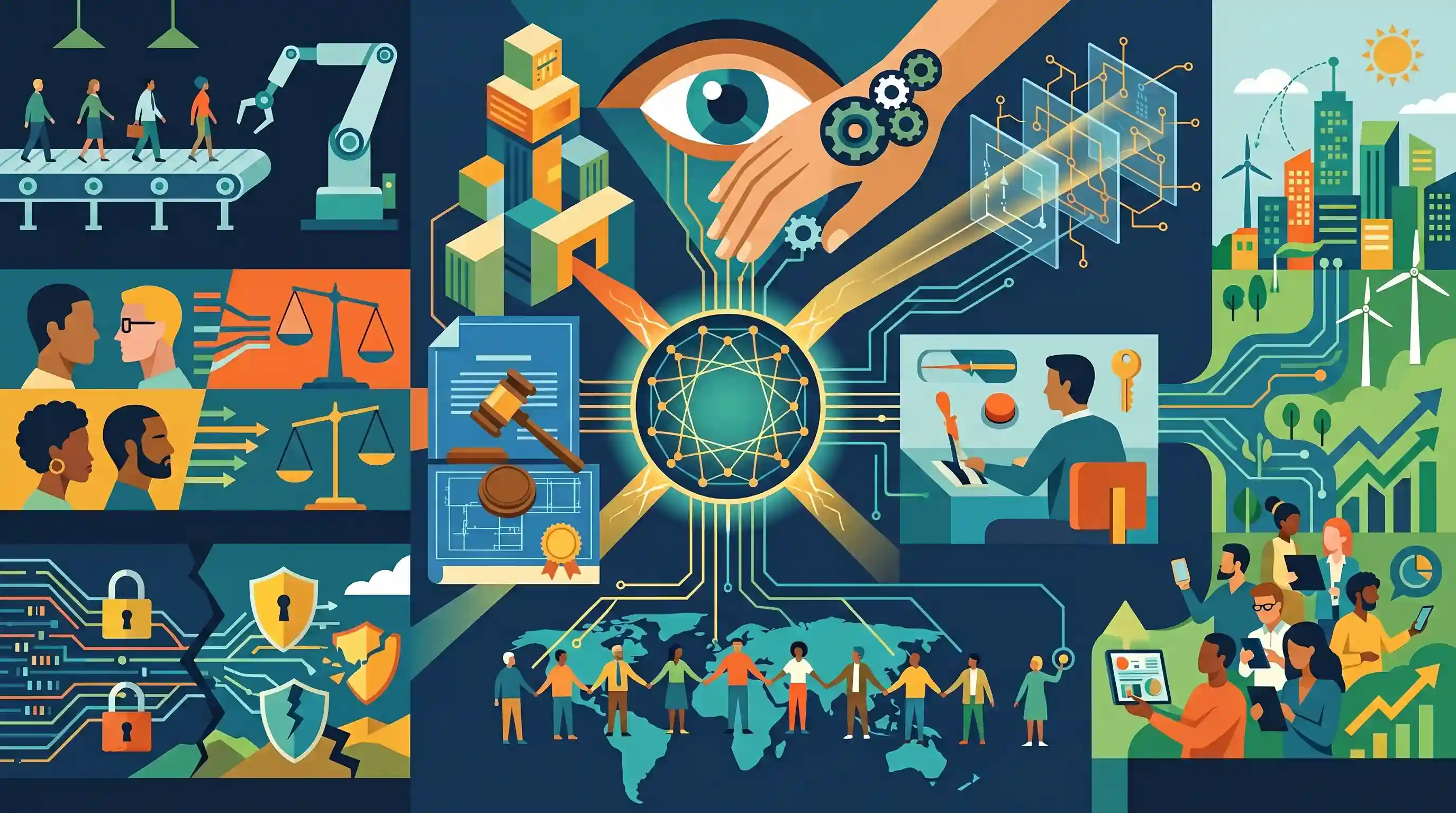
The article emphasizes the critical need to maintain a human-centric focus amidst the rapid advancements of the Artificial Intelligence (AI) revolution. While AI offers transformative potential across sectors, it also brings significant challenges such as ethical dilemmas, algorithmic bias, data privacy risks, and workforce displacement. The author advocates for proactive governance and ethical frameworks that ensure technology serves humanity's best interests. By fostering transparency, demanding accountability, and keeping humans in the loop during AI decision-making processes, policymakers and technologists can mitigate inherent risks. The piece argues that collaborative international efforts are essential to build a regulatory environment where AI acts as a tool for inclusive socio-economic development rather than a disruptive force.
Key Points
- The exponential growth of Artificial Intelligence (AI) necessitates an ethical and human-centric governance model to prevent adverse socio-economic consequences.
- Key concerns surrounding the AI revolution include algorithmic bias, data privacy violations, and the potential displacement of human labor.
- A robust, inclusive regulatory framework is required to ensure that AI acts as a complement to human intelligence rather than a replacement.
- Prioritizing transparency, accountability, and a "human-in-the-loop" approach in AI deployment will help build trust and mitigate risks in critical sectors.
Important Terms
EU AI Act

The world’s first comprehensive legislation for regulating artificial intelligence, employing a risk-based approach to categorize systems from "unacceptable" to "minimal" risk. It aims to protect fundamental rights and safety.
UPSC context
GS Paper 2/3: Regulatory benchmarks and comparative analysis for Indian digital legislation.
Bletchley Declaration
A landmark international agreement signed by 28 nations, including India, at the 2023 UK AI Safety Summit. It establishes a shared understanding of risks associated with "frontier AI."
UPSC context
GS Paper 3: International consensus on AI safety and technology-led diplomacy.
Global Partnership on Artificial Intelligence (GPAI)
A 29-member multilateral initiative (India is a founding member) established to guide the responsible development of AI. It bridges the gap between AI theory and practical, human-centric application.
UPSC context
GS Paper 2/3: India’s leadership in global technology governance and standard-setting.
NITI Aayog
India’s premier policy think tank that formulated the 2018 National Strategy for Artificial Intelligence. Its "AI for All" vision prioritizes inclusive growth in healthcare, agriculture, and education.
UPSC context
GS Paper 3: Domestic policy frameworks for technological adoption and social inclusion.
UN High-Level Advisory Body on AI
A multi-stakeholder expert group established by the UN Secretary-General in 2023 to advance recommendations for international AI governance aligned with human rights and sustainability.
UPSC context
GS Paper 2: Multilateral efforts and institutional gaps in global emerging technology governance.
Prelims Trap
The Bletchley Declaration is a legally binding UN treaty on AI governance.
The Bletchley Declaration is a voluntary diplomatic pact identifying safety risks associated with advanced 'frontier AI'. It is not a legally binding UN treaty.
Static Concepts Connected
What is the Global Partnership on Artificial Intelligence (GPAI)?
- Core mandate: An international initiative established in 2020 to guide the responsible development and use of AI, grounded in human rights and democratic values.
- Origin & Secretariat: Originally proposed by Canada and France within the G7; its secretariat is hosted by the OECD.
- India's role: India is a founding member and recently served as the Lead Chair, facilitating the 'New Delhi Declaration' on AI innovation and risk mitigation.
What are the major global models for Artificial Intelligence regulation?
- Risk-based (EU): The EU AI Act categorizes AI systems into distinct risk tiers (unacceptable, high, limited, minimal), enforcing strict compliance for high-risk applications.
- Market-driven (US): Focuses on fostering innovation through voluntary industry guidelines, standard-setting (NIST), and sector-specific rules rather than sweeping horizontal legislation.
- Developmental (India): NITI Aayog's strategy focuses on using AI for inclusive societal development (healthcare, agriculture) while beginning to formulate comprehensive domestic guardrails.
Cross-Topic Patterns
Data privacy vs. AI model training
Cross-border data flows are essential for training AI models, creating friction between rapid AI development, India's data privacy laws (DPDP Act), and WTO digital trade negotiations.
Administrative ethics and algorithmic bias
GS4 frequently tests administrative accountability. Delegating public welfare decisions to algorithms without a 'human-in-the-loop' raises constitutional questions regarding natural justice and algorithmic bias.

Expect a Prelims pair-matching question linking AI frameworks (Bletchley, GPAI, EU AI Act) with their specific mandates or lead agencies.
Linked PYQs · 3
Linked PYQs · 3
- 2023MainsGS3
Introduce the concept of Artificial Intelligence (AI). How does Al help clinical diagnosis? Do you perceive any threat to privacy of the individual in the use of Al in healthcare?
- 2024MainsGS4
The application of Artificial Intelligence as a dependable source of input for administrative rational decision-making is a debatable issue. Critically examine the statement from the ethical point of view.
- 2024MainsGS4
ABC Incorporated is a technological company named which is the second largest worldwide, situated in the Third World. You are the Chief Executive Officer and the majority shareholder of this company. The fast technological improvements have raised worries among environmental activists, regulatory authorities, and the general public over the sustainability of this scenario. You confront substantial issues about the business's environmental footprint. In 2023, your organization had a significant increase of 48% in greenhouse gas emissions compared to the levels recorded in 2019. The significant rise in energy consumption is mainly due to the surging energy requirements of your data centers, fuelled by the exponential expansion of Artificial Intelligence (AI). AI-powered services need much more computational resources and electrical energy compared to conventional online activities, notwithstanding their notable gains. The technology's proliferation has led to a growing concern over the environmental repercussions, resulting in an increase in warnings. Al models, especially those used in extensive machine learning and data processing, exhibit much greater energy consumption than conventional computer tasks, with an exponential increase. Although there is already a commitment and goal to achieve net zero emissions by 2030, the challenge of lowering emissions seems overwhelming as the integration of Al continues to increase. To achieve this goal, substantial investments in renewable energy use would be necessary. The difficulty is exacerbated by the competitive environment of the technology sector, where rapid innovation is essential for preserving market standing and shareholders' worth. To achieve a balance between innovation, profitability and sustainability, a strategic move is necessary that is in line with both, business objectives and ethical obligations. (a) What is your immediate response to the challenges posed in the above case? (b) Discuss the ethical issues involved in the above case. (c) Your company has been identified to be penalized by technological giants. What logical and ethical arguments will you put forth to convince about its necessity? (d) Being a conscience being, what measures would you adopt to maintain balance between AI innovation and environmental footprint?
