Ethics and Human-Centric Governance in AI Revolution
Source:The Hindu ↗
Why It Matters
AI regulation and ethics have become core topics for UPSC, explicitly appearing in recent GS3 and GS4 mains papers. Understanding the human-centric dimension provides critical fodder for essays, ethics case studies on technology deployment, and governance answers.
Summary
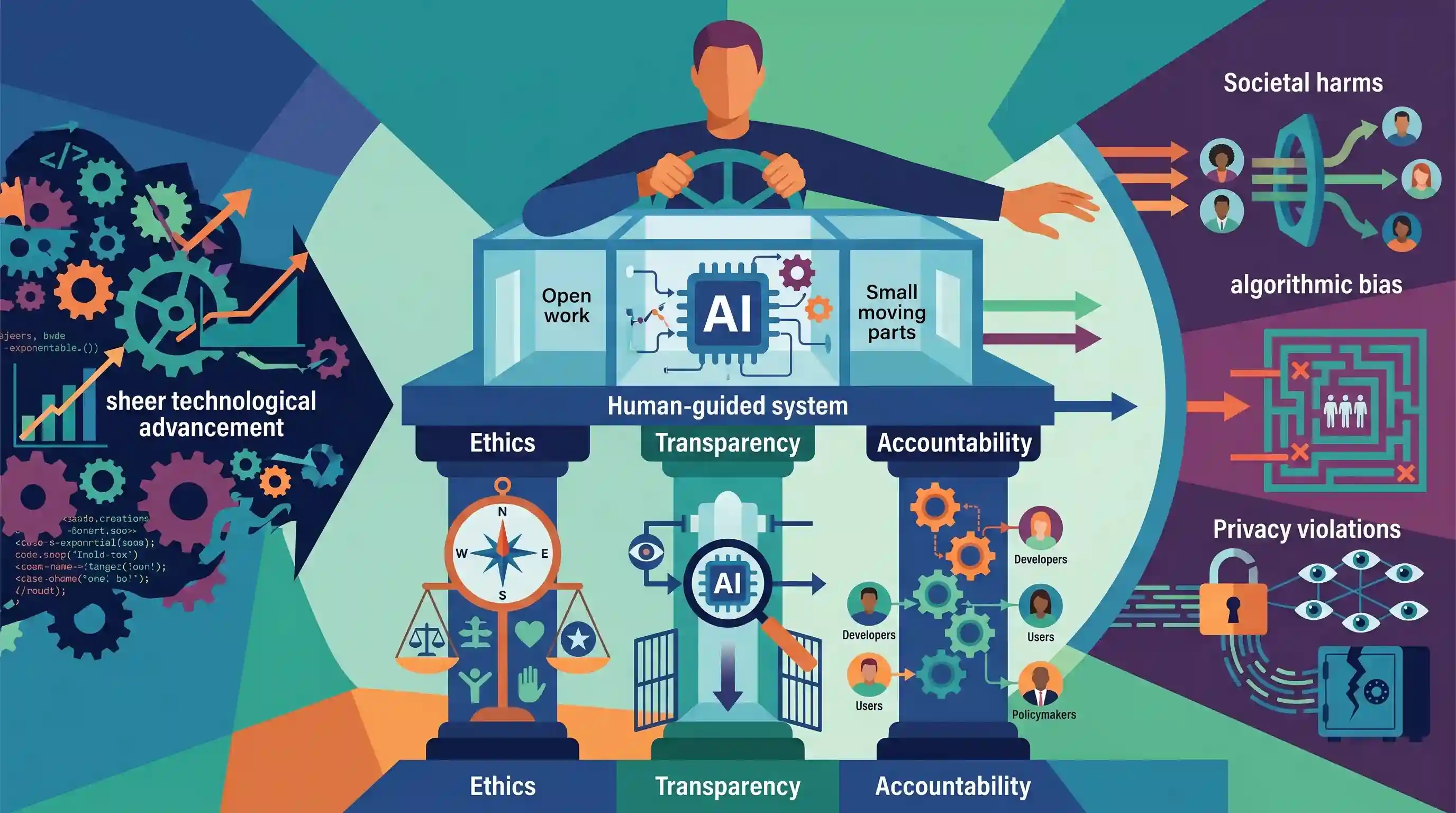
The article emphasizes the necessity of developing and deploying Artificial Intelligence (AI) in a human-centric manner, prioritizing ethical considerations, transparency, and accountability over sheer technological advancement to prevent societal harms like algorithmic bias and privacy violations.
Key Points
- Rapid advancement in AI models necessitates robust ethical guidelines to prevent biases, discrimination, and privacy breaches.
- A human-centric approach to AI focuses on augmenting human capabilities rather than replacing them, mitigating the risk of widespread job displacement and loss of human agency.
- Global cooperation and comprehensive regulatory frameworks are essential to manage AI's existential and societal risks while maximizing its developmental benefits.
- AI systems deployed in public administration and critical sectors must ensure transparency and accountability to maintain public trust and ethical decision-making.
Important Terms
Global Partnership on Artificial Intelligence (GPAI)

A multi-stakeholder international initiative (founded by G7) to guide responsible AI development consistent with human rights. India served as the 2024 Chair and hosted the New Delhi Summit.
UPSC context
GS-II/III (International Relations/S&T); tests India’s leadership in global digital governance and the "New Delhi Declaration" on trustworthy AI.
EU AI Act
The world’s first comprehensive, horizontal law to regulate AI using a risk-based approach, categorizing systems from "minimal" to "unacceptable" risk. It has significant extraterritorial impact.
UPSC context
GS-II/III (Governance/S&T); tests awareness of global regulatory standards and their influence on India’s emerging "Digital India Act."
Bletchley Declaration
A historic 2023 agreement signed by 28 nations (including India) at the first AI Safety Summit, establishing global consensus on managing risks from advanced "Frontier AI" models.
UPSC context
GS-II (International Agreements); tests knowledge of multilateral cooperation for technological safety and outcomes of the UK AI Safety Summit.
UN High-level Advisory Body on AI
A panel established by the UN Secretary-General to provide recommendations for international AI governance, focusing on human rights, scientific consensus, and bridging the global digital divide.
UPSC context
GS-II (Global Institutions); tests the UN’s role in setting universal ethical guardrails and inclusive development for the Global South.
AI Governance Alliance (WEF)
A World Economic Forum initiative uniting leaders from business, government, and academia to foster responsible stewardship and global cooperation in the development of generative AI.
UPSC context
GS-II/III (International Groupings/S&T); relevant for multi-stakeholder approaches to balancing innovation with ethical safeguards in technology.
Algorithmic Bias
Systematic, repeatable errors in AI systems that create unfair outcomes, often disadvantaging specific groups based on race, gender, or caste due to flawed training data.
UPSC context
GS-III/IV (S&T/Ethics); tests understanding of socio-technical harms and the ethical necessity for "Responsible AI" frameworks in governance.
Frontier AI
Highly advanced, general-purpose AI models that operate at the cutting edge and possess "emergent" capabilities with significant potential for both progress and large-scale safety risks.
UPSC context
GS-III (S&T/Security); tests awareness of "dual-use" technologies and the focus of international safety protocols like the Bletchley process.
Prelims Trap
"The Bletchley Declaration on Frontier AI was a Western-led initiative that excluded China from its signatories."
Despite geopolitical tensions, China was among the 28 countries that signed the Bletchley Declaration in 2023 alongside the US, UK, and India.
Static Concepts Connected
What is the Global Partnership on Artificial Intelligence (GPAI)?
- Genesis: Launched in 2020, it is an international multi-stakeholder initiative whose secretariat is hosted by the OECD.
- Mandate: It aims to bridge the gap between theory and practice on AI by supporting cutting-edge research and applied activities on AI-related priorities.
- India's Role: India is a founding member of GPAI and served as the Lead Chair for 2024, adopting the New Delhi Declaration on responsible AI.
What are the core ethical concerns in public sector AI deployment?
- Algorithmic Bias: Models trained on historical data can perpetuate and amplify societal prejudices, leading to discrimination in welfare delivery and law enforcement.
- Black-Box Effect: Deep learning algorithms often lack transparency, making it impossible to adequately explain automated administrative decisions to citizens.
- Data Privacy: Large-scale data ingestion for AI training threatens individual privacy, clashing with constitutional protections recognized under the Puttaswamy judgment.
Cross-Topic Patterns
AI Governance + Right to Privacy
The push for human-centric AI intersects directly with the DPDP Act 2023 and the Puttaswamy judgment, cementing privacy as a prerequisite for advanced digital public infrastructure.
Tech Diplomacy + Multi-alignment
India's active role in GPAI, the G20 AI consensus, and the Bletchley Declaration showcases its broader diplomatic strategy of multi-alignment in global technology standard-setting.

Prelims 2026 is highly likely to feature a multi-statement question comparing the mandates of GPAI, Bletchley Declaration, and EU AI Act.
Linked PYQs · 3
Linked PYQs · 3
- 2024MainsGS4
The application of Artificial Intelligence as a dependable source of input for administrative rational decision-making is a debatable issue. Critically examine the statement from the ethical point of view.
- 2023MainsGS3
Introduce the concept of Artificial Intelligence (AI). How does Al help clinical diagnosis? Do you perceive any threat to privacy of the individual in the use of Al in healthcare?
- 2025MainsGS2
e-governance projects have a built-in bias towards technology and back-end integration than user-centric designs. Examine.
