Kedarnath Yatra Resumes Following Temporary Weather Suspension
Source:tirthayatra ↗
Why It Matters
Managing high-altitude religious tourism under volatile weather conditions is one of the most critical disaster management and policy execution challenges for the Uttarakhand government. This intersection of regional geography, economic dependence on tourism, and climate-induced vulnerabilities is a core theme in the UKPSC PCS Prelims.
Summary
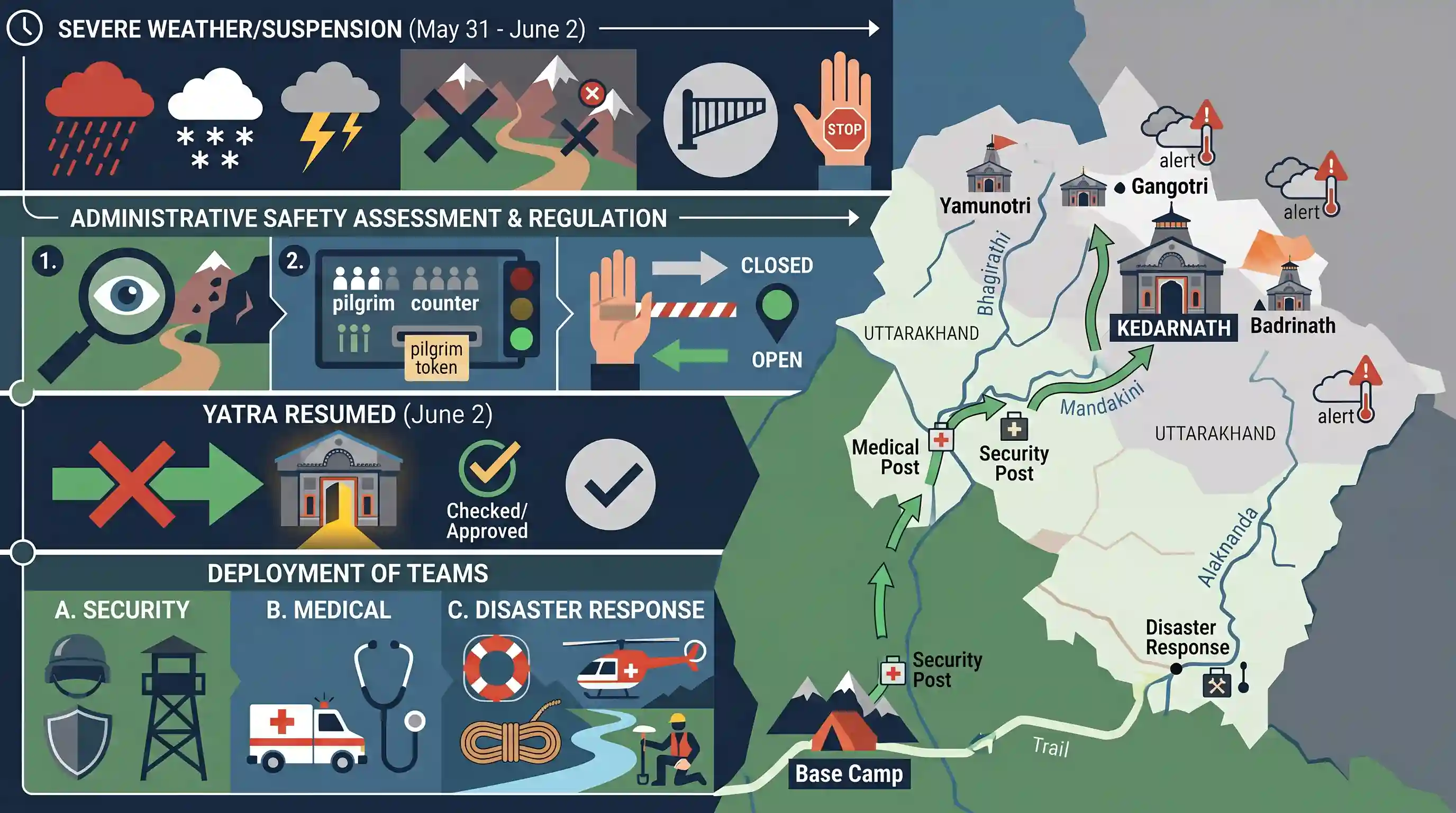
The Kedarnath Yatra 2026 successfully resumed on June 2, 2026, following a temporary suspension beginning on May 31, 2026, due to severe weather in Uttarakhand's higher Himalayan terrains. Reopening after thorough administrative safety assessments, pilgrim flows are now regulated with security, medical, and disaster response teams actively deployed to manage route safety and emergencies.
Key Points
- The Kedarnath Yatra 2026 was resumed on June 2, 2026, after a temporary suspension forced by heavy rainfall and unstable weather conditions in the higher Himalayan region.
- The pilgrimage had been temporarily halted on May 31, 2026, as a precautionary safety measure for trekking pilgrims.
- Local administration and disaster management units executed thorough safety checks and routes are now operating under strictly regulated conditions.
- Pilgrims have been issued safety advisories, emphasizing the need to carry warm clothing, essential medicines, and rain gear, while adhering strictly to permitted travel hours.
Important Terms
Char Dham Yatra

A sacred Hindu pilgrimage circuit in the Indian Himalayas, specifically in Uttarakhand, comprising four holy shrines: Yamunotri, Gangotri, Kedarnath, and Badrinath.
UPSC context
GS Paper I (Art & Culture) and GS Paper III (Disaster Management, climate vulnerability of high-altitude Himalayan routes).
Uttarakhand Tourism Development Board
The apex statutory body chaired by the Tourism Minister of Uttarakhand, responsible for advising the state government on tourism policies, regulation, licensing, and promoting sustainable tourism.
UPSC context
GS Paper II (Government Policies) and GS Paper III (Infrastructure vs. Environmental Conservation in fragile mountain ecosystems).
State Disaster Response Force (SDRF)
A specialized state-level disaster response force established under the Disaster Management Act, 2005, designed to quickly respond to natural and man-made disasters in ecologically sensitive terrains.
UPSC context
GS Paper III (Disaster Management, institutional frameworks, and search-and-rescue operations in fragile terrains).
Chota Char Dham
The specific smaller Himalayan pilgrimage circuit within Uttarakhand consisting of Yamunotri, Gangotri, Kedarnath, and Badrinath, distinct from India's larger national Char Dham circuit.
UPSC context
GS Paper I (Sacred Geography, Indian Culture) and GS Paper III (Environmental impact of religious mass tourism in eco-sensitive zones).
Prelims Trap
The winter seat of the Kedarnath deity is Joshimath, while Badrinath's deity is relocated to Ukhimath during winters.
UPSC often swaps geographical pairs. Joshimath is the winter abode for Badrinath, whereas Omkareshwar Temple in Ukhimath hosts the Kedarnath deity.
Static Concepts Connected
What are the five sacred confluences (Panch Prayag) of the Alaknanda river system?
- Vishnuprayag: Alaknanda meets the Dhauliganga River.
- Nandaprayag & Karnaprayag: Alaknanda merges with the Nandakini and Pindar rivers respectively.
- Rudraprayag: Mandakini River (originating from Chorabari Glacier) confluences with the Alaknanda River.
- Devprayag: Bhagirathi meets the Alaknanda River to officially form the Ganga River.
What are the geographic districts and winter seats of the Chota Char Dham shrines?
- Shrine Locations: Yamunotri and Gangotri are located in Uttarkashi; Kedarnath in Rudraprayag; Badrinath in Chamoli district.
- Winter Abodes: Kedarnath's winter seat is Omkareshwar Temple (Ukhimath); Badrinath's is at Pandukeshwar/Joshimath; Gangotri's is at Mukhba; Yamunotri's is at Kharsali.
Cross-Topic Patterns
Carrying capacity vs. religious tourism
The ecological vulnerability of the Main Central Thrust zone requires strict carrying-capacity regulations to balance booming religious tourism with active disaster mitigation.
DPI in disaster health governance
Integrating the eSwasthya Dham portal with the Ayushman Bharat Digital Mission (ABDM) illustrates how Digital Public Infrastructure manages high-altitude medical risks during disasters.

Panch Prayag confluences and winter deity seats are highly likely to be matched in a 2026 Prelims physical-cultural geography question.
Linked PYQs · 3
Linked PYQs · 3
- 2016UKPSC_PRELIMSGS1
Which one of the following shrines of Uttarakhand was visited by maximum number of tourists in the year 2015?
- 2025UKPSC_PRELIMSGS1
Consider the following statements and select the correct answer from the options given below : Statement 1 : Uttarakhand is highly vulnerable to climate change. Statement 2 : Climate change is causing water stress and depleting biodiversity in Uttarakhand.
- 2025UKPSC_PRELIMSGS1
Consider the following statements and select the correct answer from the options given below : Statement 1 : The State Council for Climate Change (SCCC) of Uttarakhand was established in the year 2011. Statement 2 : The responsibility of preparing Uttarakhand Action Plan on Climate Change (UAPCC) was given to the State Revenue Department.
