Kedarnath trek route blocked following heavy rainfall and boulder fall
Source:etvbharat ↗
Why It Matters
The event serves as a practical example of the ecological fragility and vulnerability of the Himalayan region to landslides and extreme weather events. It is highly relevant for UKPSC Prelims regarding Uttarakhand's geography, disaster management protocols, and the impact of natural disasters on the state's vital religious tourism sector (Char Dham Yatra).
Summary
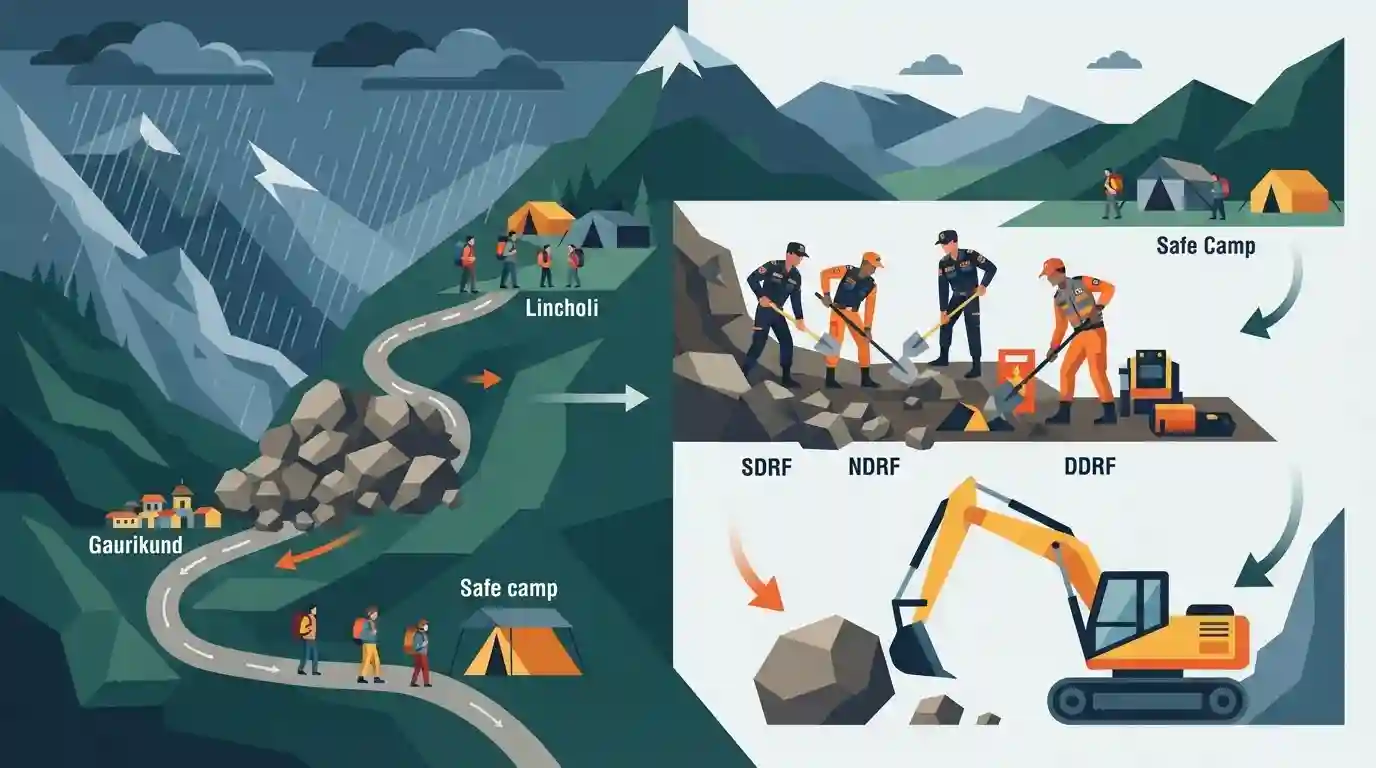
The Kedarnath trek route in Uttarakhand's Rudraprayag district was blocked once again after heavy rainfall caused a massive boulder fall near Gaurikund. The incident disrupted the ongoing pilgrimage, forcing authorities to halt returning devotees at safe camps in Lincholi and Bhimbali. Disaster response teams, including the SDRF, NDRF, and DDRF, were deployed to clear the debris and restore connectivity. The repeated occurrence of such landslides highlights the extreme vulnerability of the Himalayan terrain to weather-induced disasters, posing constant challenges to the Char Dham Yatra infrastructure.
Key Points
- Heavy rainfall triggered a massive boulder fall near the Chhaudi area of Gaurikund, blocking the crucial Kedarnath trek route.
- Pilgrims returning from the Kedarnath shrine were halted at safe locations like Lincholi and Bhimbali by the district administration.
- Teams from SDRF, NDRF, and DDRF were immediately deployed to clear the debris and restore the pathway on a war footing.
- The incident highlights the recurring issue of landslides in Rudraprayag and underscores Uttarakhand's high vulnerability to climate-induced natural disasters in fragile terrains.
Important Terms
National Disaster Response Force (NDRF)

A specialized Indian force constituted under the Disaster Management Act, 2005, tasked with providing rapid, expert rescue operations during natural and man-made disasters, including chemical and nuclear emergencies.
UPSC context
GS Paper III (Disaster Management); tests institutional framework, specialized response capabilities, and emergency preparedness in India.
State Disaster Response Force (SDRF)
A state-level specialized rescue force in India, modeled after the NDRF, acting as the first organized line of defense to respond swiftly to regional disasters and local emergencies.
UPSC context
GS Paper III (Disaster Management); tests state-level disaster response mechanisms, federal disaster structures, and decentralized governance.
District Disaster Response Force (DDRF)
A localized, district-level emergency unit comprising trained local police or municipal personnel, established to provide immediate, grassroots rescue operations before state or national forces arrive.
UPSC context
GS Paper III (Disaster Management); evaluates decentralized emergency response, local administration, and community-level disaster preparedness.
Prelims Trap
The Mandakini River, flowing along Kedarnath, originates from Gangotri and joins Alaknanda at Devprayag.
Mandakini originates from Chorabari Glacier and confluences with Alaknanda at Rudraprayag. Bhagirathi originates from Gangotri and meets Alaknanda at Devprayag.
Static Concepts Connected
What are the five sacred confluences (Panch Prayags) of the Alaknanda system?
- Vishnuprayag: Alaknanda meets the Dhauliganga River.
- Nandaprayag & Karnaprayag: Alaknanda meets Nandakini and Pindar rivers respectively.
- Rudraprayag & Devprayag: Rudraprayag links Alaknanda and Mandakini; Devprayag joins Alaknanda and Bhagirathi to form the Ganga.
What is 'Ecological Carrying Capacity' in fragile mountain ecosystems?
- Core definition: The maximum threshold of human activity and infrastructure an ecosystem can support without causing irreversible environmental degradation.
- Key parameters: Assesses rock slope stability, water availability, solid waste processing limits, and seismic vulnerability.
- Policy utility: Serves as a legal and planning tool to restrict tourist footfall and concrete construction in high-altitude zones.
Cross-Topic Patterns
Tourism vs. Ecologically Sensitive Zones
Balancing massive pilgrimage tourism with Ecologically Sensitive Zone (ESZ) regulations under the EPA 1986 highlights the conflict between regional economy and fragile mountain conservation.
Infrastructure and Sendai Framework alignment
Integrating climate-resilient engineering in Himalayan corridors directly aligns with India's commitments to Sendai Framework disaster-resilient infrastructure targets.

Mains 2026: Evaluating ecological carrying capacity versus infrastructure expansion in young fold mountains under high seismic risks.
Linked PYQs · 2
Linked PYQs · 2
- 2025UKPSC_PRELIMSGS1
Consider the following statements and select the correct answer from the options given below : Statement 1 : Uttarakhand is highly vulnerable to climate change. Statement 2 : Climate change is causing water stress and depleting biodiversity in Uttarakhand.
- 2016UKPSC_PRELIMSGS1
Which one of the following shrines of Uttarakhand was visited by maximum number of tourists in the year 2015?
