Kedarnath Priests Protest and Controversy over Temple Replica
Source:Indian Express ↗
ఇది ఎందుకు ముఖ్యం
The controversy raises important GS1 (Art & Culture) and GS4 (Ethics) themes regarding the commercialization of ancient religious sites, the geographical uniqueness of heritage (like GI tags but for sacred geography), and the ethical bounds of replicating deeply revered structures for cultural promotion or fundraising.
సారాంశం
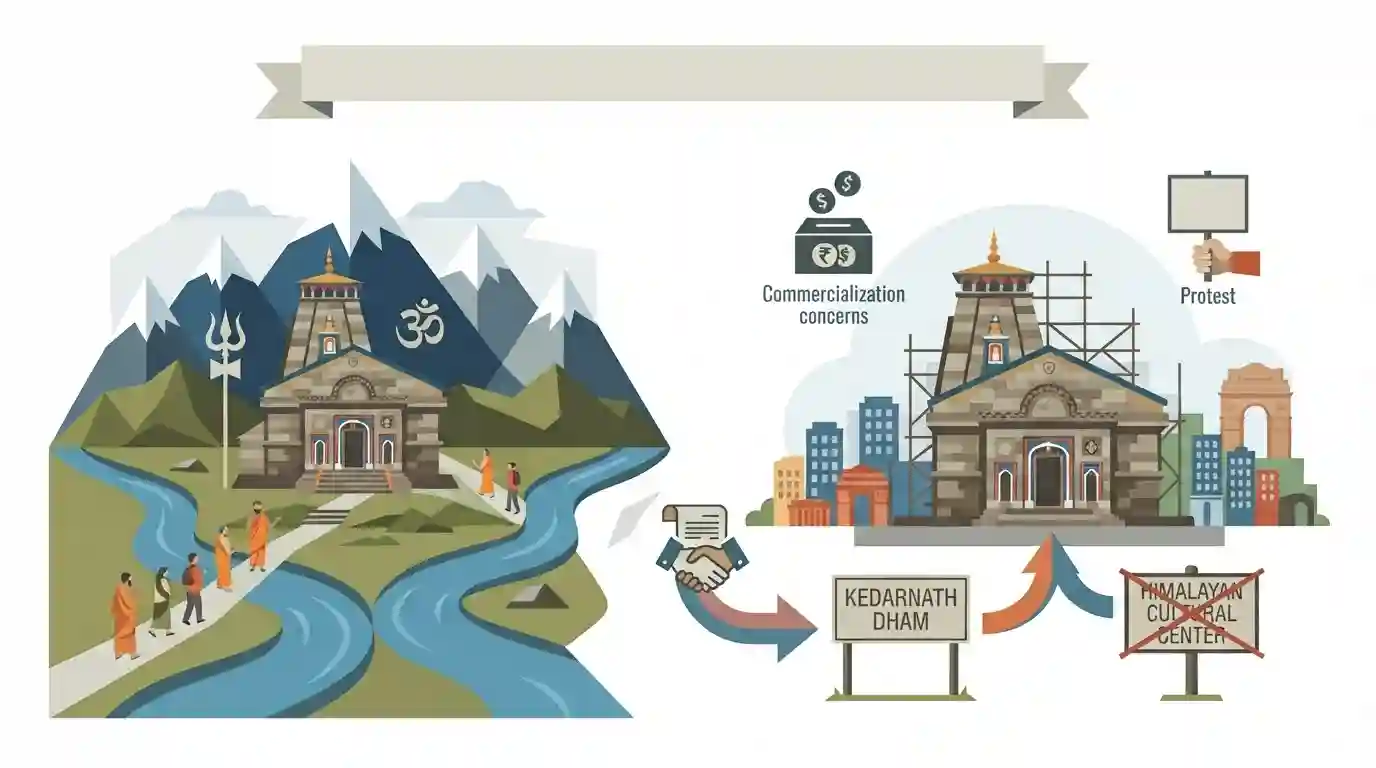
Priests in Kedarnath have paused their protests against the construction of a replica temple in Delhi following an agreement that the new structure and its trust will drop the 'Kedarnath Dham' name. The agitation, led by the Kedar Sabha, centered on concerns that replicating the sacred Jyotirlinga for potential donation collection amounts to the commercialization of religion and violates the geographic and spiritual sanctity of the original site. Uttarakhand Chief Minister Pushkar Singh Dhami intervened, affirming that true Kedarnath exists only between the Mandakini and Saraswati rivers in the Himalayas. The Delhi-based trust stated their goal was cultural promotion but agreed to change the temple's name and appearance to respect the priests' sentiments.
ముఖ్య అంశాలు
- Kedarnath priests (Kedar Sabha) halted their agitation after an assurance that a proposed Kedarnath replica temple in Delhi will change its name and trust name to drop 'Kedarnath Dham'.
- Priests protested the replica, arguing that using the Kedarnath name to collect donations commercializes the sacred Jyotirlinga and diminishes the sanctity of the original pilgrimage.
- Uttarakhand CM Pushkar Singh Dhami supported the priests, stating that Kedarnath Dham is geographically unique and can only exist between the Mandakini and Saraswati rivers.
- The trust building the replica argued the intent was merely to promote Uttarakhand's culture in Delhi, though they have now agreed to alter the structure's look and name to respect sentiments.
ముఖ్యమైన పదాలు
Kedar Sabha

The traditional organization of Teerth Purohits (priests) at the Kedarnath shrine. They safeguard ancient rituals, manage priestly rights, and oppose actions they perceive as undermining the temple's spiritual and geographical sanctity.
UPSC context
Relevant to GS1 (Art & Culture), illustrating the influence of traditional associations in preserving the authenticity of pilgrimage heritage.
Shri Badrinath-Shri Kedarnath Temple Committee (BKTC)
A statutory body constituted under the UP Shri Badrinath and Shri Kedarnath Temples Act, 1939. It is responsible for the administration, fund management, and governance of the sacred Badrinath and Kedarnath shrines in Uttarakhand.
UPSC context
Important for GS2 (Polity/Governance), highlighting statutory management of religious endowments and the balance of state control and religion.
Jyotirlinga
A highly revered devotional shrine where Lord Shiva is worshipped as a supreme "pillar of light." The Shiva Purana lists 12 principal Jyotirlingas geographically distributed across India, with Kedarnath being the northernmost.
UPSC context
Essential for GS1 (Art and Culture), testing knowledge of India's sacred geography, temple locations, and traditional pilgrimage circuits.
Mandakini River
A Himalayan river originating from the Chorabari Glacier near the Kedarnath temple. It flows through Uttarakhand's steep valleys before merging with the Alaknanda River at Rudraprayag, forming one of the sacred Panch Prayags.
UPSC context
Crucial for GS1 (Geography); tests knowledge of the Ganga river basin tributaries, Himalayan drainage, and fragile eco-sensitive zones.
ప్రిలిమ్స్ ఉచ్చు
Kedarnath is situated on the banks of the Alaknanda river.
Kedarnath is on the Mandakini river (Chorabari glacier). Badrinath is on the Alaknanda (Satopanth glacier). UPSC frequently swaps these locations in matching pairs.
అనుసంధానమైన స్థిర భావనలు
How does the Mandakini river fit into the Panch Prayag system?
- Origin: Emerges from the Chorabari glacier in the Garhwal Himalayas, flowing directly past the Kedarnath shrine.
- Confluence: Merges with the Alaknanda river at Rudraprayag, forming a crucial upper-catchment tributary network for the Ganga.
What defines the architectural resilience of the Kedarnath shrine?
- Himalayan Nagara: Built in a localized Katyuri adaptation of the Nagara style, specifically designed to withstand harsh alpine weather.
- Mortarless Assembly: Constructed using massive interlocking grey stone slabs without traditional mortar, allowing flexibility to survive major seismic events and avalanches.
అంతర-అంశ నమూనాలు
Himalayan ecology & Carrying Capacity
The commercial drive to replicate or expand temples highlights ongoing debates around the ecological carrying capacity of fragile Himalayan circuits like the Char Dham.
Spatial Sanctity vs Trademark
The priests' defense of Kedarnath's geographic uniqueness parallels the legal logic of Geographical Indications (GI), aiming to protect the authenticity of culturally sacred spaces.

Expect a Prelims matching-pair question aligning Char Dham shrines with their respective rivers (Mandakini/Alaknanda) and glaciers.
అనుసంధాన PYQలు · 2
అనుసంధాన PYQలు · 2
- 2018MainsGS1
Safeguarding the Indian art heritage is the need of the moment. Discuss.
- 2019MainsGS1
How can the mountain ecosystem be restored from the negative impact of development initiatives and tourism?
