Kaziranga patrol elephant Joymala passes away at sixty-six
Source:Indian Express ↗
Why It Matters
The article highlights the practical, field-level realities of wildlife management and conservation in India. Trained 'kunki' elephants play an irreplaceable role in navigating flood-prone ecosystems like Kaziranga to combat poaching, manage human-wildlife conflict, and monitor species. This intersects with UPSC syllabus areas concerning biodiversity conservation, protected area networks, animal welfare, and statutory conservation frameworks like Project Elephant and the Wildlife Protection Act.
Summary
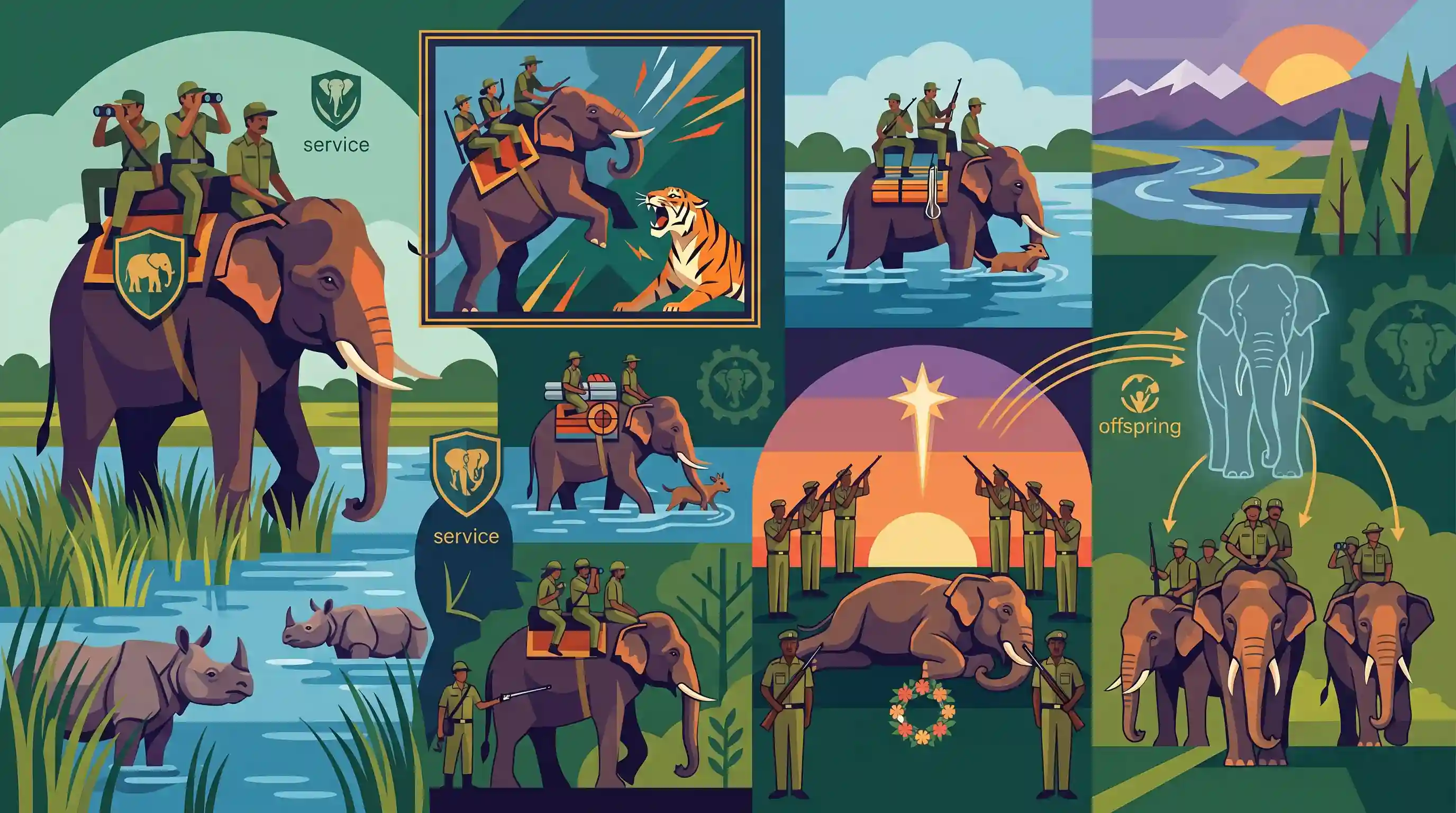
A legendary 66-year-old patrol elephant named Joymala, who served Kaziranga National Park for over three decades, passed away and was laid to rest with a guard of honor. Known for her courage—most notably facing off against a tigress in 2004 to protect her riders and mahout—she was a vital asset in anti-poaching, rescue, and forest protection. Her legacy continues through three of her calves who currently serve as patrol elephants in the park. Her passing highlights the indispensable role of trained captive (kunki) elephants in navigating flood-prone, difficult terrains for wildlife conservation in India.
Key Points
- A celebrated 66-year-old patrol elephant named Joymala, who dedicated over 30 years to forest protection in Kaziranga National Park, passed away and was honored with a guard of honor.
- Joymala was vital to anti-poaching operations, wildlife monitoring, flood rescue missions, and patrolling challenging terrains that are inaccessible to motorized vehicles.
- In 2004, Joymala famously protected forest officials, a veterinarian, and her mahout Satyaban Pegu (who lost three fingers) by facing off with an aggressive tigress that leaped at them, eventually forcing the big cat to retreat.
- After retiring at 60, she remained in the camp as a maternal figure, and three of her calves continue her legacy as patrol elephants in the park.
- Patrol (kunki) elephants are critical assets for forest departments in dense, flood-prone grasslands, representing a unique animal-assisted model of ecological conservation and human-wildlife conflict management.
Important Terms
Kaziranga National Park

A national park in Assam situated on the Brahmaputra floodplain, declared a UNESCO World Heritage Site in 1985 and a Tiger Reserve in 2006. It hosts two-thirds of the world’s greater one-horned rhinoceroses.
UPSC context
GS Paper 3 (Environment); tests floodplain ecosystems, protected area management, and conservation of endangered species like the one-horned rhino.
Project Elephant
A Centrally Sponsored Scheme launched in 1992 by the MoEFCC to ensure the long-term survival of wild Asian elephants, protect their habitats and corridors, mitigate human-elephant conflicts, and address captive elephant welfare.
UPSC context
GS Paper 3 (Environment & Biodiversity); tests species-specific conservation schemes, animal migration corridors, and biodiversity protection policies.
Wildlife Protection Act 1972
India's primary statutory framework enacted to safeguard wild animal, plant, and bird species, establish protected areas like national parks, and regulate trade in wildlife and animal derivatives.
UPSC context
GS Paper 3 (Environment); tests environmental legislation, statutory conservation bodies, and legal schedules of protected species.
Kunki Elephants
Trained captive Asian elephants deployed by state forest departments for essential conservation operations, including patrolling difficult terrains, tracking poachers, rescuing wild animals, and managing human-elephant conflicts.
UPSC context
GS Paper 3 (Environment); tests human-wildlife conflict mitigation, modern forest management techniques, and captive animal welfare.
Wildlife Trust of India
A prominent Indian non-governmental conservation organization founded in 1998, dedicated to protecting endangered species, securing wildlife corridors, mitigating conflict, and supporting forest frontline staff.
UPSC context
GS Paper 3 (Environment); tests the role of civil society organizations and community-led initiatives in wildlife conservation.
Prelims Trap
Female Asian elephants stop calving and lose their reproductive capability after reaching 40 years of age.
UPSC previously tested this biological detail in Prelims 2020. Female elephants can successfully reproduce well into their 50s and even early 60s, contrary to the common misconception that reproduction ceases at 40.
Static Concepts Connected
What are the geographical and ecological features of Kaziranga National Park?
- River boundaries: Bounded by the Brahmaputra and Mora Diphlu, and crossed internally by the Diphlu and Mora Dhansiri rivers.
- Wetland ecology: Features dynamic alluvial floodplains and 'beels' (oxbow lakes) replenished annually by Brahmaputra monsoon flooding.
- Flagship megafauna: Home to the 'Big Five' including the world's largest population of the Great Indian One-Horned Rhinoceros.
What is the conservation and biological status of the Asian Elephant in India?
- Legal status: Designated as India's National Heritage Animal and protected under Schedule I of the Wildlife (Protection) Act, 1972.
- Global protection: Classified as Endangered on the IUCN Red List, and listed under Appendix I of both CITES and CMS.
- Social biology: Organized in strict matriarchal herds, with the longest mammalian gestation period of 18 to 22 months.
Cross-Topic Patterns
Captive Elephants: Conservation vs. Welfare
Using trained "Kumki" elephants for patrol exemplifies the policy tightrope between active forest management and growing global animal-rights/captivity concerns.
Hydrology and Wetland Conservation
Kaziranga's "beels" (oxbow lakes) demonstrate how river morphology and annual flooding cycles are essential for preventing ecological stagnation in protected grasslands.

UPSC 2026 may pair Asian elephant maternal/gestational biology with geographical features of Brahmaputra floodplains like 'beels'.
Linked PYQs · 1
Linked PYQs · 1
- 2020PrelimsGS1
With reference to Indian elephants, consider the following statements: 1. The leader of an elephant group is a female. 2. The maximum gestation period can be 22 months. 3. An elephant can normally go on calving till the age of 40 years only. 4. Among the States in India, the highest elephant population is in Kerala. Which of the statements given above is/are correct?
