Kazipet Rail Unit Nears Completion for Intercity Trains
Source:Indian Express ↗
Why It Matters
The development of indigenous rail manufacturing infrastructure highlights India's push towards self-reliance (Aatmanirbhar Bharat). By introducing modern, energy-efficient trains with regenerative braking, the initiative addresses both urban congestion and environmental sustainability, which are critical themes in GS3 (Infrastructure and Environment) and GS1 (Urbanization).
Summary
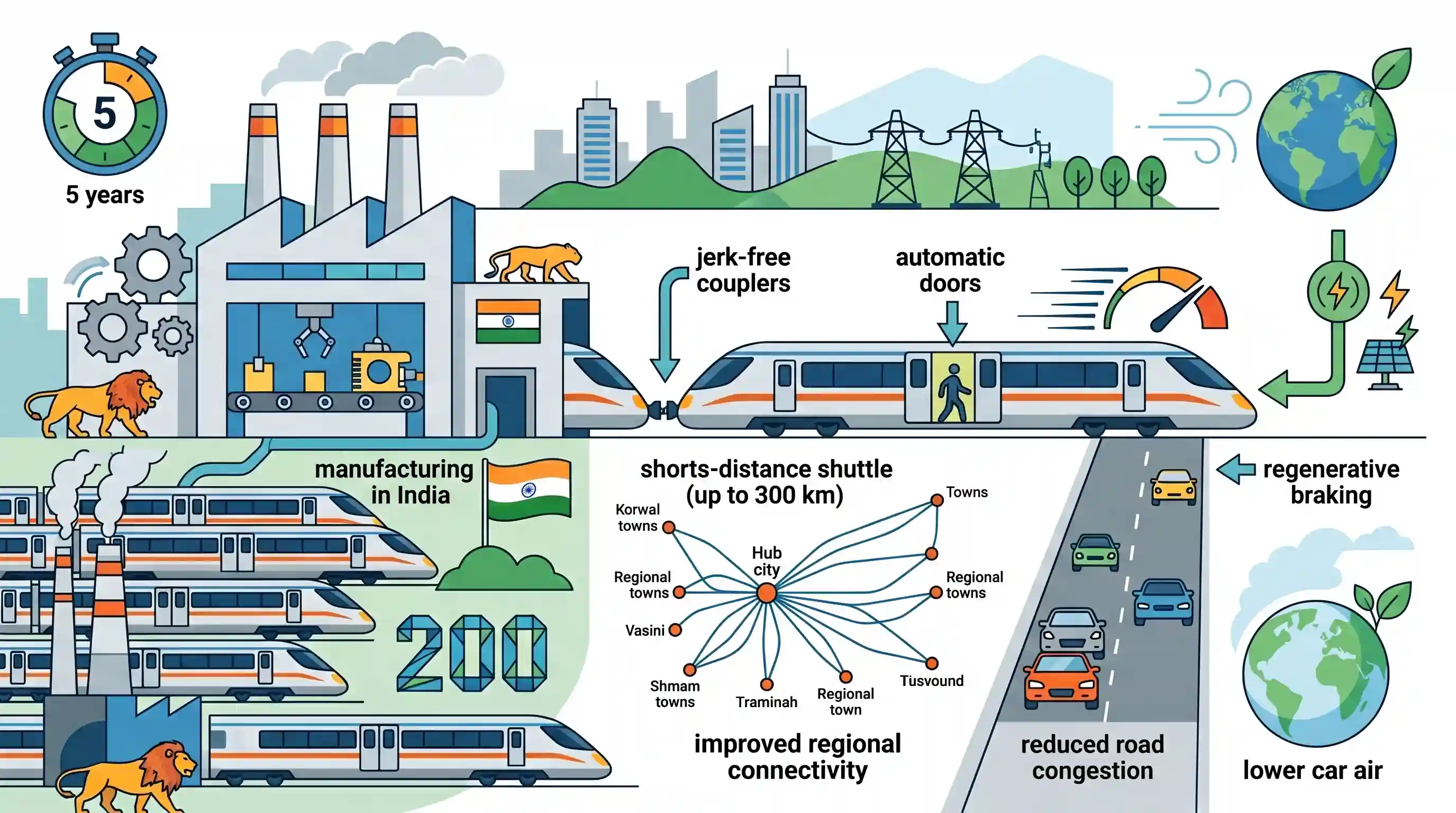
The Kazipet Rail Manufacturing Unit in Telangana is set to begin operations, with plans to produce 200 modern intercity trains over the next five years. These trains are designed to improve regional connectivity and reduce road congestion by offering affordable, short-distance shuttle services up to 300 km. Featuring advanced technologies like jerk-free couplers, automatic doors, and a top speed of 130 kmph, the trains will also incorporate regenerative braking to enhance energy efficiency and lower carbon emissions.
Key Points
- The Kazipet Rail Manufacturing Unit in Telangana, a Rs 500 crore project initiated in 2023, is nearing completion and aims to manufacture 200 intercity trains over the next five years.
- These trains will function as regional shuttles for distances up to 300 km, providing a cost-effective alternative to road travel and helping ease highway congestion.
- The new rolling stock will feature modern amenities including automatic doors, jerk-free couplers, advanced bogies, and speeds of up to 130 kmph.
- The trains will utilize regenerative braking technology, which converts kinetic energy during braking into electricity that is fed back into the grid, significantly reducing the carbon footprint.
Important Terms
Kazipet Rail Manufacturing Unit

A major railway production facility in Telangana's Warangal district, established to manufacture wagons and modern coach sets, marking the first such unit in the state under the Make in India initiative.
UPSC context
GS Paper III: Infrastructure (Railways). Focus on indigenous manufacturing and regional economic development.
Regenerative Braking
An energy-recovery mechanism that converts a train's kinetic energy into electrical energy during braking, feeding it back into the power grid or storage, thereby enhancing energy efficiency.
UPSC context
GS Paper III: Science & Technology and Environment. Relevant for energy conservation and climate goals.
Centre Buffer Coupler (CBC)
A high-capacity coupling system used by Indian Railways to connect coaches, featuring balanced draft gears that act as shock absorbers to ensure smoother, jerk-free travel and enhanced safety.
UPSC context
GS Paper III: Infrastructure and Science. Relates to railway safety and modernization of passenger amenities.
Regional Rail Connectivity
A transport strategy focusing on high-frequency, short-distance (up to 300 km) train services designed to link urban hubs with semi-urban towns, reducing road congestion and supporting daily commuters.
UPSC context
GS Paper I: Urbanization and GS Paper III: Infrastructure. Important for decentralized growth.
Rolling Stock
A collective term for all railway vehicles, including locomotives, freight wagons, and passenger coaches, used on a railway network.
UPSC context
GS Paper III: Indian Economy and Infrastructure. Core terminology for railway logistics and manufacturing.
Make in India (Railways)
The national initiative to transform India into a global manufacturing hub, which in the railway sector aims for high localization of advanced train technology and components.
UPSC context
GS Paper III: Economic Development. Tests understanding of indigenization and import substitution.
Prelims Trap
Regenerative braking systems can independently halt a train, completely eliminating the need for conventional friction brakes.
Regenerative braking recovers less energy at lower speeds and cannot completely stop a vehicle. It must be integrated with traditional friction brakes for full halting and safety.
Static Concepts Connected
What is the mechanism of regenerative braking in electric transport?
- Motor as Generator: During deceleration, the electric traction motor reverses its role to act as a generator rather than a consumer of power.
- Kinetic Conversion: It converts the vehicle's kinetic energy back into electrical energy, feeding it into the power grid or a battery storage system.
- Speed Limitation: Efficiency drops significantly at low speeds, necessitating conventional friction brakes to bring the vehicle to a complete stop.
What are India's major railway rolling stock manufacturing hubs?
- Legacy Factories: Integral Coach Factory (Chennai) and Rail Coach Factory (Kapurthala) are the traditional, long-standing manufacturing hubs.
- Modern Units: Newer units focusing on advanced stock include Modern Coach Factory (Raebareli), Marathwada Rail Coach Factory (Latur), and Kazipet (Telangana).
Cross-Topic Patterns
Transport infra + Tier-2 urban expansion
Intercity 300-km shuttles act as catalysts for dispersed regional economic growth, aligning with the PM Gati Shakti master plan to decongest major urban centers by linking them to Tier-2 satellite cities.
S&T + Net Zero targets
Regenerative braking feeding electricity back into the grid perfectly links railway modernization (Make in India) to India's COP26 Panchamrit commitment, specifically the Net Zero by 2070 target.

Expect a composite 2026 Prelims question mixing the physics of regenerative braking with the geographic mapping of railway manufacturing hubs.
Linked PYQs · 3
Linked PYQs · 3
- 2019MainsGS1
How is efficient and affordable urban mass transport key to the rapid economic development of India?
- 2022MainsGS3
Why is Public Private Partnership (PPP) required in infrastructural projects ? Examine the role of PPP model in the redevelopment of Railway Stations in India.
- 2025PrelimsGS1
Consider the following types of vehicles : I. Full battery electric vehicles II. Hydrogen fuel cell vehicles III. Fuel cell-electric hybrid vehicles How many of the above are considered as alternative powertrain vehicles?
