Kerala Agricultural University Budget for Climate Resilient Research
Source:The Hindu ↗
Why It Matters
This budget serves as a practical, state-level case study for multiple GS3 syllabus topics, including the application of e-technology for farmers, climate change adaptation in agriculture, and the use of emerging technologies like AI, IoT, and nanotechnology for sustainable farming practices (e.g., alternate wetting and drying).
Summary
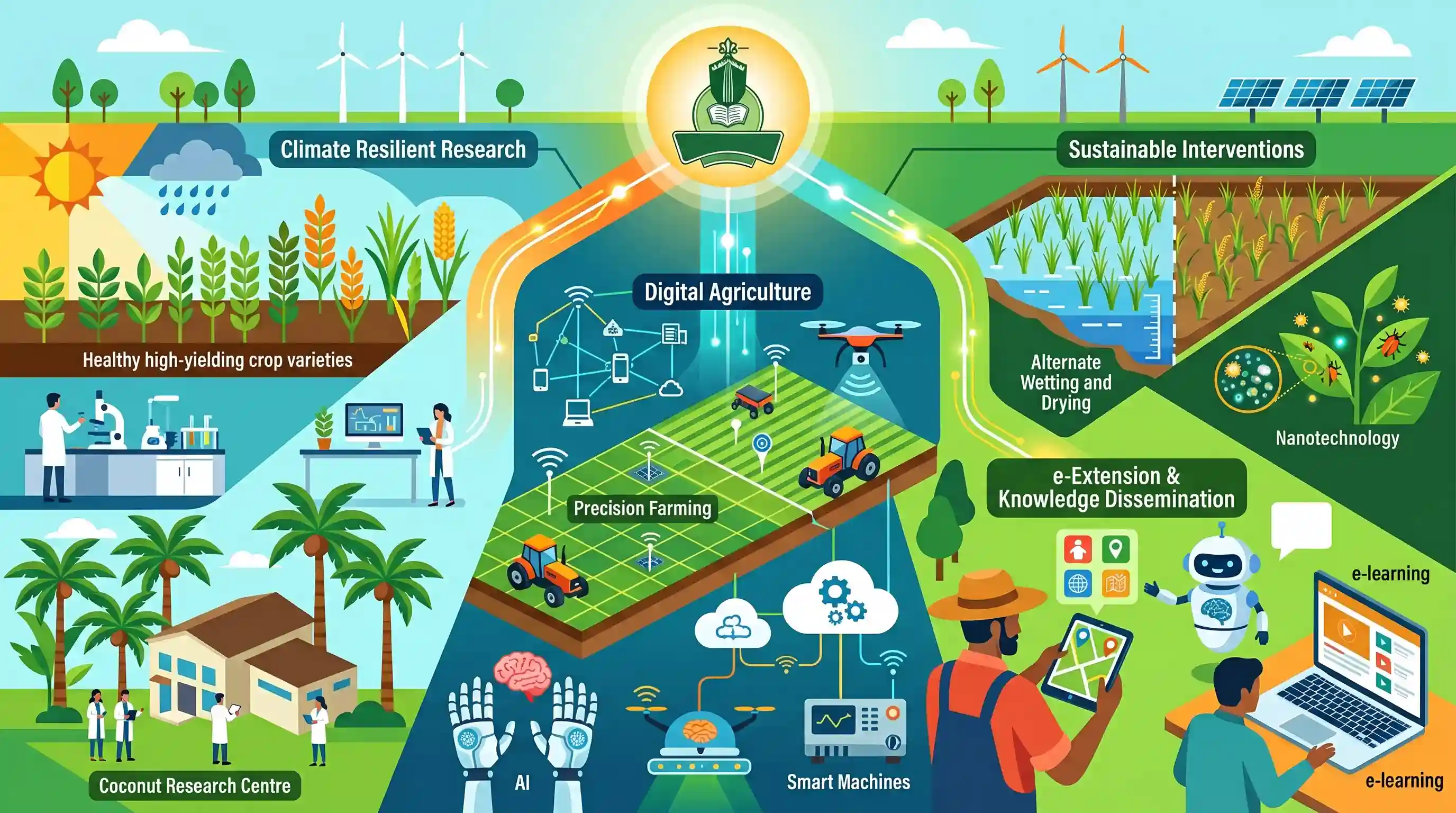
The Kerala Agricultural University (KAU) has unveiled its Budget for 2026–27, with a strong emphasis on modernizing agriculture through climate-resilient research and digital technology. Presented by Agriculture Minister P. Prasad, the budget allocates significant funds to research addressing the impact of climate change on major crops, developing high-yielding varieties, and establishing a new Centre of Excellence in Coconut Research at Pilicode. Crucially, the plan highlights the integration of Artificial Intelligence (AI), Internet of Things (IoT), and precision farming into agricultural operations. Sustainable interventions like alternate wetting and drying for rice to conserve water and nano-products for eco-friendly plant protection are key focal areas. Furthermore, the university aims to boost e-extension and knowledge dissemination to farmers via AI-based advisory bots, mobile apps, and e-learning modules, reflecting a targeted approach toward tech-driven, resilient farming.
Key Points
- The Kerala Agricultural University (KAU) Budget for 2026–27 prioritizes climate-resilient research and integrating digital technology into agricultural practices.
- Research initiatives will focus on mitigating climate change impacts on crops and introducing sustainable methods like alternate wetting and drying for rice cultivation.
- The university plans to integrate Artificial Intelligence, IoT, and precision farming protocols, along with developing nano-products for eco-friendly plant protection.
- Digital outreach to farmers will be expanded using AI-based advisory bot systems, e-learning modules, and mobile applications.
- A new Centre of Excellence in Coconut Research is slated for establishment at Pilicode.
Important Terms
Indian Council of Agricultural Research (ICAR)

The apex autonomous organization in India for coordinating and managing research and education in agriculture, horticulture, fisheries, and animal sciences.
UPSC context
GS Paper 3: Science and Technology and Agriculture. Important for understanding India's national agricultural research framework and food security.
All India Coordinated Research Project (AICRP)
A multi-disciplinary, multi-location collaborative research system under ICAR that tests crop varieties and technologies across diverse agro-climatic conditions.
UPSC context
GS Paper 3: Agriculture and Technology. Tests knowledge of collaborative research models and crop improvement strategies.
Rural Agricultural Work Experience (RAWE)
A compulsory experiential learning program for undergraduate agricultural students to gain practical knowledge of rural life, farming conditions, and extension services.
UPSC context
GS Paper 3: Agriculture and Education. Relevant for extension education and bridging the gap between research and practice.
Kerala Agricultural University (KAU)
The primary institution in Kerala responsible for agricultural education, research, and extension, playing a key role in state-specific resilient farming.
UPSC context
GS Paper 3: State-level agricultural initiatives. Demonstrates the role of State Agricultural Universities (SAUs) in localizing climate-resilient research.
Project Selection and Monitoring Committee (PSMC)
A specialized committee within KAU that evaluates and finalizes research projects based on recommendations from agricultural experts and planning bodies.
UPSC context
GS Paper 3: Agricultural Governance. Illustrates transparency and multidisciplinary oversight in public research funding.
Kerala State Planning Board
An advisory body that assists the Kerala government in formulating Five-Year Plans and annual state budgets for sectors like agriculture.
UPSC context
GS Paper 2: Governance/Planning. Highlighted for its role in sub-national planning and fiscal allocation for developmental sectors.
Department of Agriculture (Kerala)
The state agency responsible for implementing agricultural policies, distributing subsidies, and coordinating with research universities for technology transfer.
UPSC context
GS Paper 2/3: Policy Implementation. Central to understanding the executive's role in delivering agricultural services to farmers.
Prelims Trap
"Alternate Wetting and Drying (AWD) in rice cultivation increases methane emissions."
AWD actually reduces methane emissions by 30-70% compared to continuous flooding, as periodic aeration interrupts the anaerobic conditions required by methanogenic bacteria.
Static Concepts Connected
What is the significance of Alternate Wetting and Drying (AWD) in rice cultivation?
- Water Conservation: Reduces irrigation water consumption by up to 30% without yielding loss compared to continuously flooded paddies.
- Methane Reduction: Periodic soil aeration breaks anaerobic conditions, significantly curbing the activity of methane-producing bacteria.
- Root Health: Promotes deeper, stronger root systems and reduces the incidence of certain water-borne diseases and pests.
How is Nanotechnology applied for sustainable agriculture?
- Targeted Delivery: Nanoscale particles like liquid Nano Urea ensure higher nutrient use efficiency and direct absorption through plant stomata.
- Reduced Runoff: Significantly lowers soil and groundwater pollution by reducing the bulk requirement and preventing excess chemical leaching.
- Eco-friendly Protection: Nano-pesticides and herbicides allow for controlled release, reducing toxicity to non-target organisms and improving ecological safety.
Cross-Topic Patterns
AWD + National Mission on Sustainable Agriculture
State-level initiatives for AWD and precision farming align perfectly with the National Mission on Sustainable Agriculture (NMSA), directly bridging local university research with India's national climate commitments (NDCs).
Digital Agriculture + AgriStack Integration
KAU's AI-based advisory bots represent the grassroots implementation of Digital Public Infrastructure (DPI) in farming, serving as localized nodes that can integrate with the national AgriStack initiative.

Expect a multi-statement Prelims question in 2026 linking Alternate Wetting and Drying (AWD) to methane reduction and water efficiency.
Linked PYQs · 3
Linked PYQs · 3
- 2022PrelimsGS1
"System of Rice Intensification" of cultivation, in which alternate wetting and drying of rice fields is practised, results in : 1. Reduced seed requirement 2. Reduced methane production 3. Reduced electricity consumption Select the correct answer using the code given below:
- 2023MainsGS3
How does e-Technology help farmers in production and marketing of agricultural produce? Explain it.
- 2025MainsGS3
How does nanotechnology offer significant advancements in the field of agriculture? How can this technology help to uplift the socio-economic status of farmers?
