Western Ghats Ecology and Kasturirangan Committee Recommendations
Source:The Hindu ↗
Why It Matters
The Western Ghats is a UNESCO World Heritage site and a global biodiversity hotspot. The debate between the Madhav Gadgil and Kasturirangan committee recommendations is a quintessential UPSC case study on the conflict between ecological conservation and the livelihood needs of local communities.
Summary
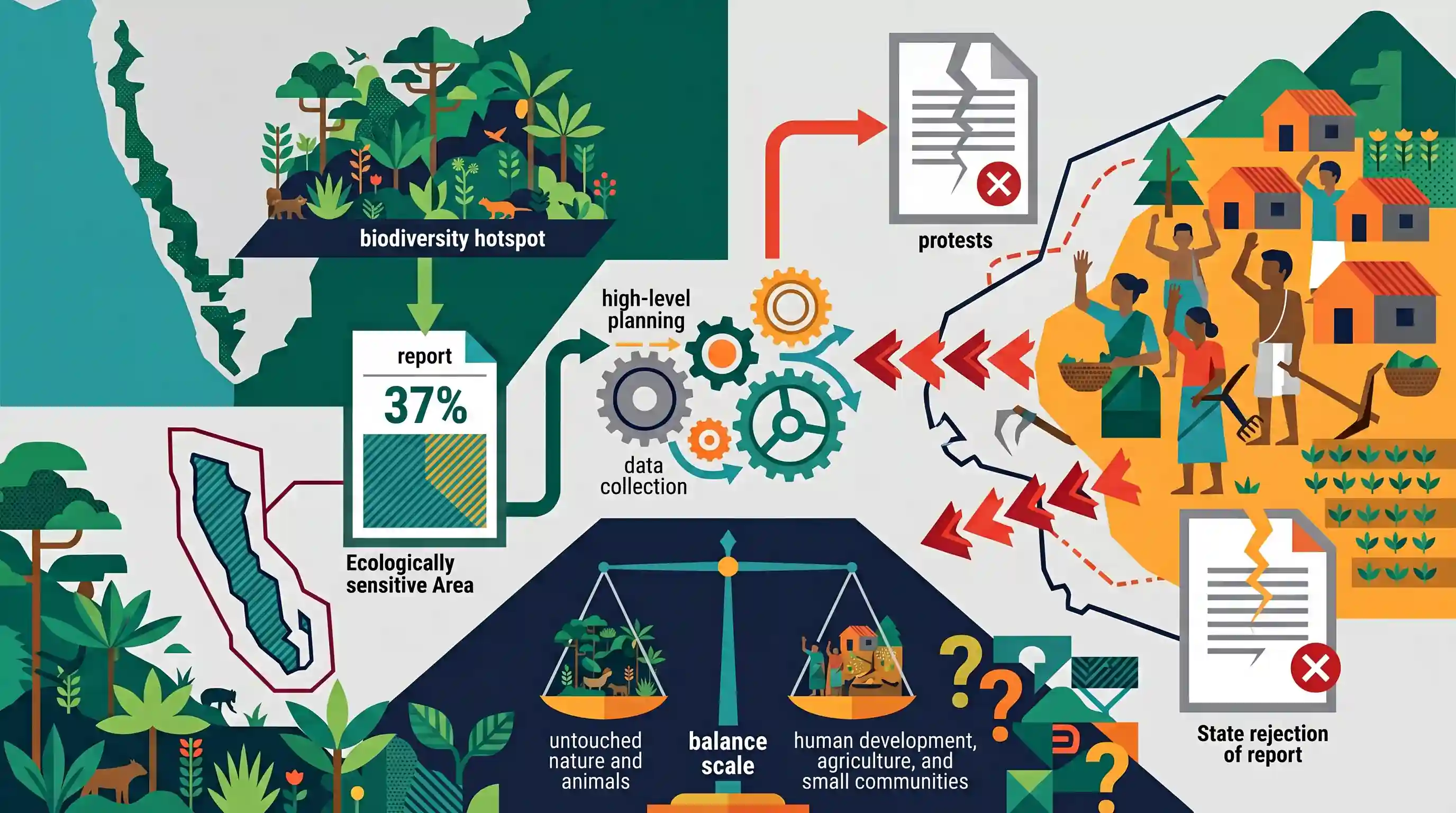
Following the passing of former ISRO Chairman K. Kasturirangan, his significant connection to the Malnad region through his leadership of the High-Level Working Group on the Western Ghats is remembered. The committee's 2013 report recommended declaring 37% of the Western Ghats as an Ecologically Sensitive Area (ESA) to protect the biodiversity hotspot. Despite adopting a softer approach than the preceding Madhav Gadgil report, it faced intense protests from locals in Karnataka fearing displacement and livelihood loss, leading to the state government rejecting the report. This underscores the complex policy challenges of balancing ecological preservation with socio-economic development.
Key Points
- The late space scientist K. Kasturirangan headed the High-Level Working Group (HLWG) on the Western Ghats, tasked with advising the government on its conservation.
- The HLWG was formed after the preceding Madhav Gadgil committee report met with severe resistance from local stakeholders and state governments.
- The Kasturirangan report, submitted in 2013, recommended designating 37% of the Western Ghats as an Ecologically Sensitive Area (ESA), restricting mining, thermal power plants, and highly polluting industries.
- Despite being viewed as a diluted version of the Gadgil report by environmentalists, the Kasturirangan report also faced massive protests in the Malnad region due to fears of eviction and livelihood loss among farmers and forest dwellers.
- The Karnataka state government ultimately rejected the Kasturirangan report following the severe backlash, highlighting the ongoing conflict between environmental conservation and development imperatives.
Important Terms
Kasturirangan Committee Report

A 2013 report that recommended declaring 37% of the Western Ghats as an Ecologically Sensitive Area (ESA). It sought to balance biodiversity conservation with sustainable development and local livelihoods.
UPSC context
GS-III (Environment); significant for topics on environmental governance, biodiversity conservation, and the development-conservation debate in India.
Madhav Gadgil Committee Report
A 2011 report by the Western Ghats Ecology Expert Panel (WGEEP) that recommended designating the entire Western Ghats as ecologically sensitive, proposing a bottom-up conservation model involving gram sabhas.
UPSC context
GS-III (Environment); key for understanding stringent conservation frameworks and community-led ecological management versus top-down policies.
Ecologically Sensitive Area (ESA)
Fragile regions notified under the Environment (Protection) Act, 1986, where developmental activities are regulated to minimize environmental degradation and protect high levels of biological richness.
UPSC context
GS-III (Environment); essential concept for protected area management and legal frameworks for environmental preservation.
Western Ghats
A 1,600 km mountain range along India's west coast, recognized as a global biodiversity hotspot and UNESCO World Heritage site, crucial for regulating the Indian monsoon.
UPSC context
GS-I (Geography) and GS-III (Environment); tested for biodiversity, endemism, and hydrological significance to Peninsular India.
Biodiversity Hotspot
A biogeographic region with significant levels of biodiversity that is under threat from human habitation. Criteria include having at least 1,500 endemic vascular plants and losing 70% of original habitat.
UPSC context
GS-III (Environment); foundational concept for identifying global conservation priorities and India's biological heritage.
Environment (Protection) Act, 1986
India's primary environmental law empowering the central government to protect and improve environmental quality, coordinate state actions, and notify Ecologically Sensitive Areas (ESAs).
UPSC context
GS-II (Governance) and GS-III (Environment); the legal bedrock for most environmental regulations and notifications in India.
Prelims Trap
"Eco-Sensitive Zones are explicitly defined and mandated under the Wildlife (Protection) Act, 1972."
ESZs are notified under the Environment (Protection) Act, 1986, not the WPA. Furthermore, the term "Eco-Sensitive Zone" is not explicitly mentioned in the EPA but derives from clauses restricting industries.
Static Concepts Connected
How did the Kasturirangan report differ from the Madhav Gadgil report?
- Gadgil (WGEEP): Designated the entire Western Ghats as an ESA, dividing it into three zones with blanket bans on mining and large dams in Zone 1.
- Kasturirangan (HLWG): Adopted a moderate approach, splitting the region into 'cultural' and 'natural' landscapes, proposing only 37% (the natural landscape) as an ESA.
- Governance approach: Gadgil heavily empowered local Gram Sabhas for project approvals; Kasturirangan relied more on bureaucratic and existing state environmental frameworks.
What criteria qualify the Western Ghats as a global Biodiversity Hotspot?
- Endemism criterion: A region must contain at least 1,500 species of vascular plants (> 0.5% of the world's total) as endemics.
- Threat criterion: The region must have lost at least 70% of its original native habitat, making it highly threatened.
- Indian context: The Western Ghats spans six states (GJ, MH, GOA, KA, KL, TN) and is a UNESCO World Heritage site due to this immense biodiversity.
Cross-Topic Patterns
Federalism in Environmental Governance
The rejection of the report by states like Karnataka highlights friction between Central ecological mandates and State socio-economic pressures, a recurring theme in Concurrent List environmental governance.
FRA 2006 vs. Eco-Sensitive Areas
Protests in the Malnad region underscore the enduring tension between creating inviolate ecological zones (ESAs) and ensuring land and livelihood security for forest dwellers under the Forest Rights Act (FRA), 2006.

Expect a 2026 question on Western Ghats covering Gadgil/Kasturirangan criteria, states spanned, and the EPA 1986 legal backing for ESZs.
Linked PYQs · 2
Linked PYQs · 2
- 2016PrelimsGS1
'Gadgil Committee Report' and 'Kasturirangan Committee Report', sometimes seen in the news, are related to
- 2017PrelimsGS1
From the ecological point of view, which one of the following assumes importance in being a good link between the Eastern Ghats and the Western Ghats?
