Kasol Garbage Crisis Exposes Eco Sensitive Carrying Capacity Limits
Source:Indian Express ↗
Why It Matters
Provides a prime case study for GS-3 (Environment) regarding the ecological impact of unregulated tourism in the Himalayas. It illustrates the practical challenges of implementing Solid Waste Management Rules, 2016 at the local level and highlights the vital oversight role of the National Green Tribunal in holding executive bodies accountable for environmental governance.
Summary
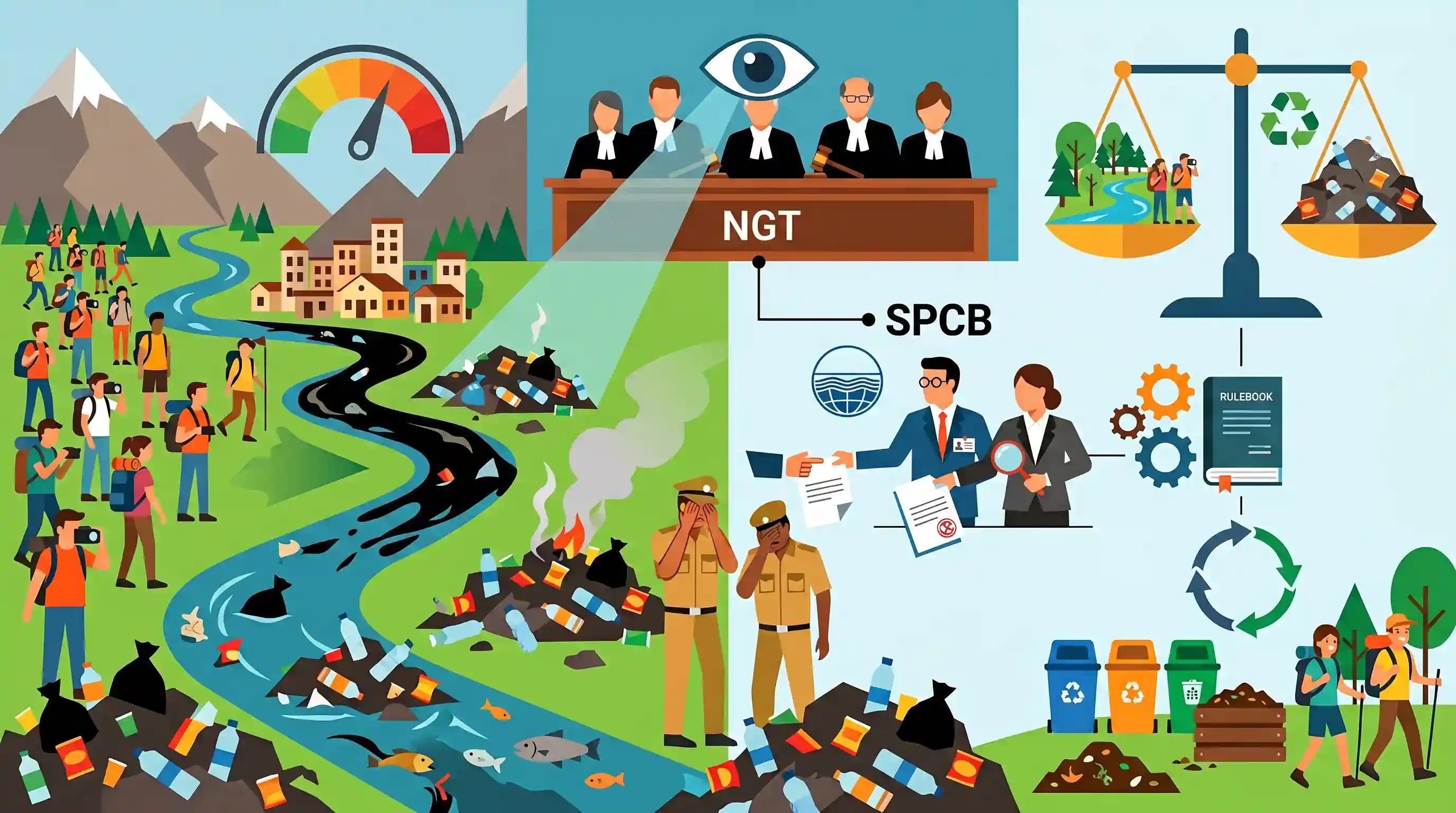
Following a severe garbage crisis in the tourist hub of Kasol, the Himachal Pradesh State Pollution Control Board has filed complaints against local officers for failing to manage solid waste. The action was prompted by a National Green Tribunal (NGT) probe into the unchecked dumping of untreated waste in the fragile Parvati Valley. The crisis underscores the ecological toll of unregulated tourism, which has far exceeded the region's carrying capacity, and highlights the institutional challenges in enforcing Solid Waste Management Rules in eco-sensitive hill areas.
Key Points
- The Himachal Pradesh State Pollution Control Board has initiated legal action against local officers in Kasol for negligence in managing municipal waste.
- The action comes amid an ongoing National Green Tribunal (NGT) probe into the rampant dumping of untreated garbage in the eco-sensitive Parvati Valley.
- Massive influx of tourists has overwhelmed the local waste management infrastructure, highlighting a failure to adhere to the Solid Waste Management Rules, 2016.
- The crisis emphasizes the urgent need to assess and respect the carrying capacity of Himalayan hill stations to prevent ecological degradation.
- Demonstrates the role of statutory bodies like the NGT in enforcing environmental accountability on local administrative authorities.
Important Terms
National Green Tribunal (NGT)

A statutory body established under the NGT Act, 2010 for the expeditious disposal of cases related to environmental protection, forest conservation, and the enforcement of legal rights pertaining to the environment.
UPSC context
GS Paper 3: Environmental governance. Tests understanding of statutory bodies and their role in environmental justice and judicial activism.
Solid Waste Management Rules, 2016
Mandates source segregation of waste into biodegradable, dry, and domestic hazardous categories. It includes specific provisions for hilly areas, such as avoiding landfill construction on hills.
UPSC context
GS Paper 3: Environmental pollution. Essential for questions on urban waste management and decentralised governance.
Environment (Protection) Act, 1986
Enacted under Article 253 following the Bhopal Gas Tragedy, this "umbrella" legislation empowers the Central Government to coordinate activities of various authorities and set national environmental standards.
UPSC context
GS Paper 3: Environment. A core legislative framework often tested in Prelims and used for legal context in Mains.
Himachal Pradesh State Pollution Control Board
A statutory body responsible for enforcing environmental laws, monitoring pollution, and issuing authorizations for waste management in Himachal Pradesh to ensure sustainable development in the Himalayan region.
UPSC context
GS Paper 3: Statutory bodies. Illustrates the implementation of environmental laws at the state level in eco-sensitive zones.
Prelims Trap
The Solid Waste Management Rules, 2016 are applicable only to notified municipal areas.
The 2016 rules explicitly expanded jurisdiction far beyond municipal limits to include census towns, industrial townships, and religious or eco-sensitive tourist sites.
Static Concepts Connected
What are the key provisions of the Solid Waste Management Rules, 2016?
- Source Segregation: Mandates waste generators to segregate waste at source into Biodegradable (wet), Non-biodegradable (dry), and Domestic Hazardous waste.
- Extended Coverage: Expanded beyond municipal bounds to cover census towns, SEZs, industrial townships, and tourist/historical sites.
- EPR Integration: Introduces strict Extended Producer Responsibility (EPR) for manufacturers of packaging materials and sanitary products.
What are the statutory origins of SPCBs vs the NGT?
- SPCB Origins: Central and State Pollution Control Boards were originally constituted under the Water (Prevention and Control of Pollution) Act, 1974.
- NGT Mandate: Established under the NGT Act, 2010, specifically to handle environmental disputes and enforce strict compliance across civil cases.
Cross-Topic Patterns
Carrying capacity vs. Hill tourism
The Kasol crisis mirrors Joshimath subsidence, shifting the focus in UPSC Mains from general pollution to evaluating the "carrying capacity" of fragile Himalayan ecosystems.
Statutory oversight on local bodies
Highlights a recurring governance theme: statutory bodies (NGT/SPCBs) overriding or penalizing local administrative units (ULBs/PRIs) for failing their constitutional environmental duties.

Expect a Mains question linking Himalayan carrying capacity to SWM Rules, or a Prelims statement comparing SPCB vs NGT jurisdictions.
Linked PYQs · 4
Linked PYQs · 4
- 2018PrelimsGS1
How is the National Green Tribunal (NGT) different from the Central Pollution Control Board (CPCB)? 1. The NGT has been established by an Act whereas the CPCB has been created by an executive order of the Government. 2. The NGT provides environmental justice and helps reduce the burden of litigation in the higher courts whereas the CPCB promotes cleanliness of streams and wells, and aims to improve the quality of air in the country. Which of the statements given above is/are correct?
- 2019PrelimsGS1
As per the Solid Waste Management Rules, 2016 in India, which one of the following statements is correct?
- 2018MainsGS3
What are the impediments in disposing the huge quantities of discarded solid wastes which are continuously being generated? How do we remove safely the toxic wastes that have been accumulating in our habitable environment?
- 2019MainsGS3
Define the concept of carrying capacity of an ecosystem as relevant to an environment. Explain how understanding this concept is vital while planning for sustainable development of a region.
