Security Restrictions Imposed in Kashmir Amid West Asia Tensions
Source:The Hindu ↗
Why It Matters
The article is relevant for understanding internal security management in Jammu and Kashmir, specifically how global geopolitical events (like the West Asia conflict) can trigger localized law and order challenges. It also touches upon the balance between public order and the freedom of religious assembly.
Summary
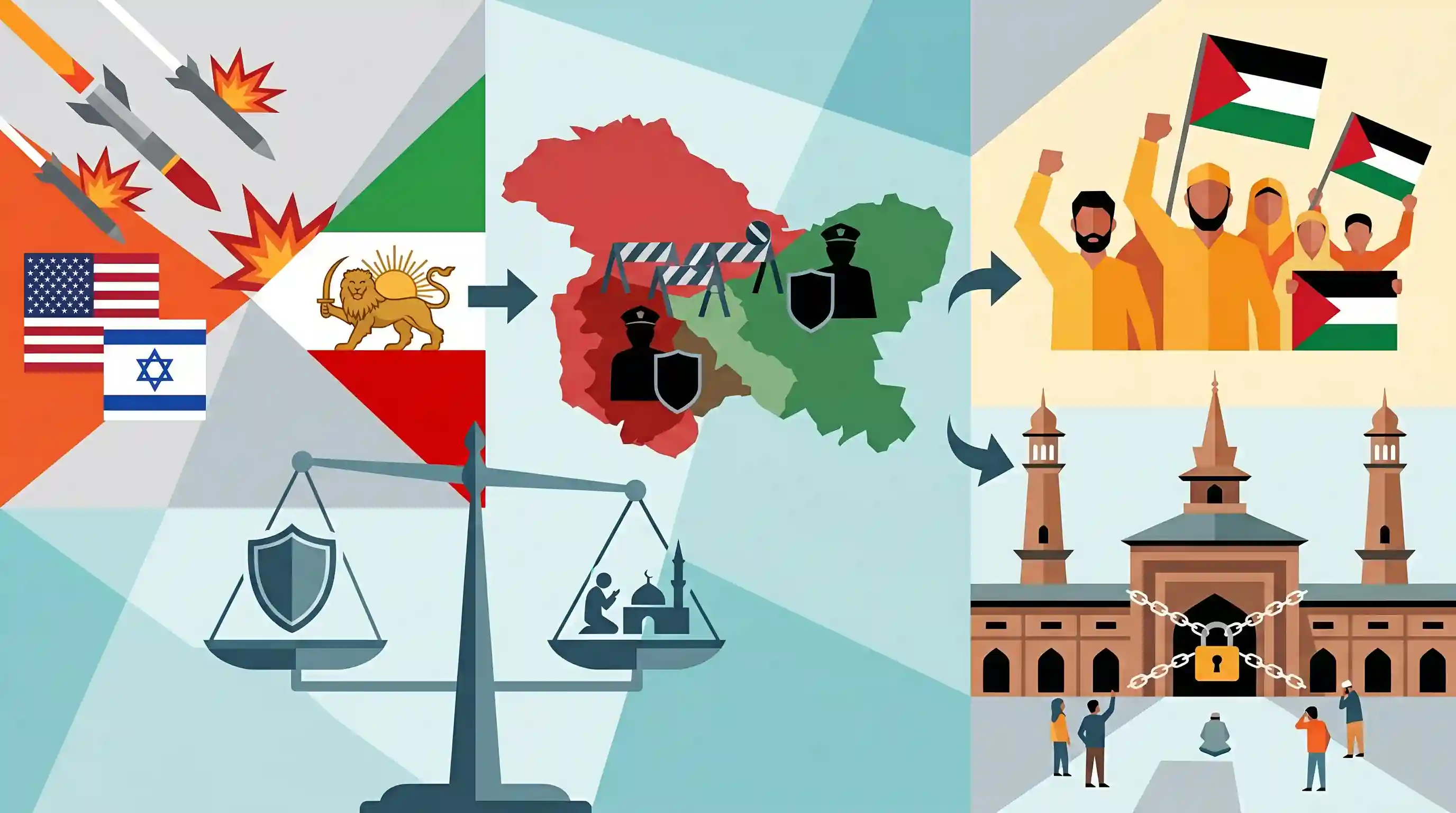
Restrictions were enforced in parts of Kashmir, particularly in Shia-majority regions, to curb potential protests following Friday prayers in response to escalating US-Israel military strikes on Iran. Despite the curbs, protests erupted in Budgam, where demonstrators voiced solidarity with Palestine and condemned US and Israeli actions. Additionally, the historic Jamia Masjid in Srinagar was shut down by authorities to maintain public order, marking the seventh consecutive year of restricted access during Jumat-ul-Vida and Youm-ul-Quds. This highlights the ongoing administrative challenges in balancing public order, internal security, and religious assembly in Jammu and Kashmir.
Key Points
- Authorities imposed restrictions in several Shia-dominated areas of Kashmir, including Budgam, to prevent protests against US-Israel strikes on Iran following Friday prayers.
- Despite the curbs, protests erupted in areas like Magam, where demonstrators marched in solidarity with Palestine and raised anti-US and anti-Israel slogans.
- The historic Jamia Masjid in Srinagar's Nowhatta was shut down to maintain law and order.
- This marked the seventh consecutive year that prayers at Jamia Masjid were restricted on Jumat-ul-Vida (the last Friday of Ramzan) and Youm-ul-Quds.
Important Terms
Anjuman Auqaf Jamia Masjid

The administrative body managing Srinagar's historic Jamia Masjid. It oversees religious activities, mosque maintenance, and is traditionally headed by the Mirwaiz of Kashmir.
UPSC context
GS Paper 3 (Internal Security); tests knowledge of local socio-religious institutions and their role in regional stability.
Jumat-ul-Vida
The final Friday of Ramadan, observed with significant congregational prayers. In Kashmir, it often requires extensive administrative coordination to manage large crowds and maintain order.
UPSC context
GS Paper 1 (Society/Culture); focuses on the intersection of religious practice and civil administration in sensitive zones.
Youm-ul-Quds
An annual day of solidarity with Palestine observed on the last Friday of Ramadan. In Kashmir, it frequently triggers protests against West Asian military conflicts.
UPSC context
GS Paper 2 (International Relations) and GS Paper 3; examines how global geopolitical issues influence domestic security.
Public Order
A state of peace and safety affecting the community at large. It is a constitutional ground for the State to impose restrictions on fundamental rights.
UPSC context
GS Paper 2 (Polity); tests understanding of the legal limits placed on individual liberties for collective safety.
Reasonable Restrictions
Legal limits the State can place on fundamental rights (Articles 19 and 25) for reasons like national security, public order, or morality.
UPSC context
GS Paper 2 (Polity); key for questions on the balance between executive power and citizen rights.
Internal Security
Maintaining peace within national borders by addressing threats like civil unrest, militancy, or radicalization, particularly in sensitive regions like Jammu and Kashmir.
UPSC context
GS Paper 3 (Security); focuses on the challenges of managing secessionist movements and religious extremism.
Prelims Trap
Freedom of religion under Article 25 cannot be restricted pre-emptively by the State.
Article 25 rights are explicitly subject to 'public order'. Authorities can legally impose preemptive curbs on religious assemblies to prevent potential disruptions.
Static Concepts Connected
What are the constitutional grounds for restricting freedom of religion under Article 25?
- Public Order: The State can restrict religious practices to prevent riots, clashes, or unrest arising from gatherings or protests.
- Health & Morality: Religious freedoms must not violate public health standards or established constitutional morality.
- Other Part III Rights: Freedom of religion is subordinated to other fundamental rights, such as the right to equality and life.
What is the 'Winning Hearts and Minds' (WHAM) doctrine in counter-insurgency?
- Civic Action Programs: Deploying military and paramilitary resources for local development and infrastructure, such as Operation Sadbhavana in J&K.
- Alienation Mitigation: Balancing hard security measures (like assembly curbs) with efforts to minimize local alienation and build trust.
- Psychological Operations: Countering radicalization and external geopolitical propaganda by engaging directly with community and religious leaders.
Cross-Topic Patterns
West Asian geopolitics + J&K Internal Security
Developments involving Iran or Palestine directly trigger security mobilizations in specific demographic pockets like Budgam, linking international relations directly to domestic law and order.
Assembly Curbs vs Article 25 & 26
The repetitive use of preemptive assembly curbs at historic sites tests the constitutional balance between preserving public order and ensuring the freedom to manage religious affairs.

Expect a Mains GS3 question linking West Asian geopolitical volatility to internal security challenges and radicalization risks in J&K.
Linked PYQs · 2
Linked PYQs · 2
- 2023MainsGS3
Winning of 'Hearts and Minds' in terrorism-affected areas is an essential step in restoring the trust of the population. Discuss the measures adopted by the Government in this respect as part of the conflict resolution in Jammu and Kashmir.
- 2018MainsGS2
In what ways would the ongoing US-Iran Nuclear Pact Controversy affect the national interest of India? How should India respond to this situation?
