Jammu and Kashmir July 13 Holiday Controversy and Historical Narrative
Source:Indian Express ↗
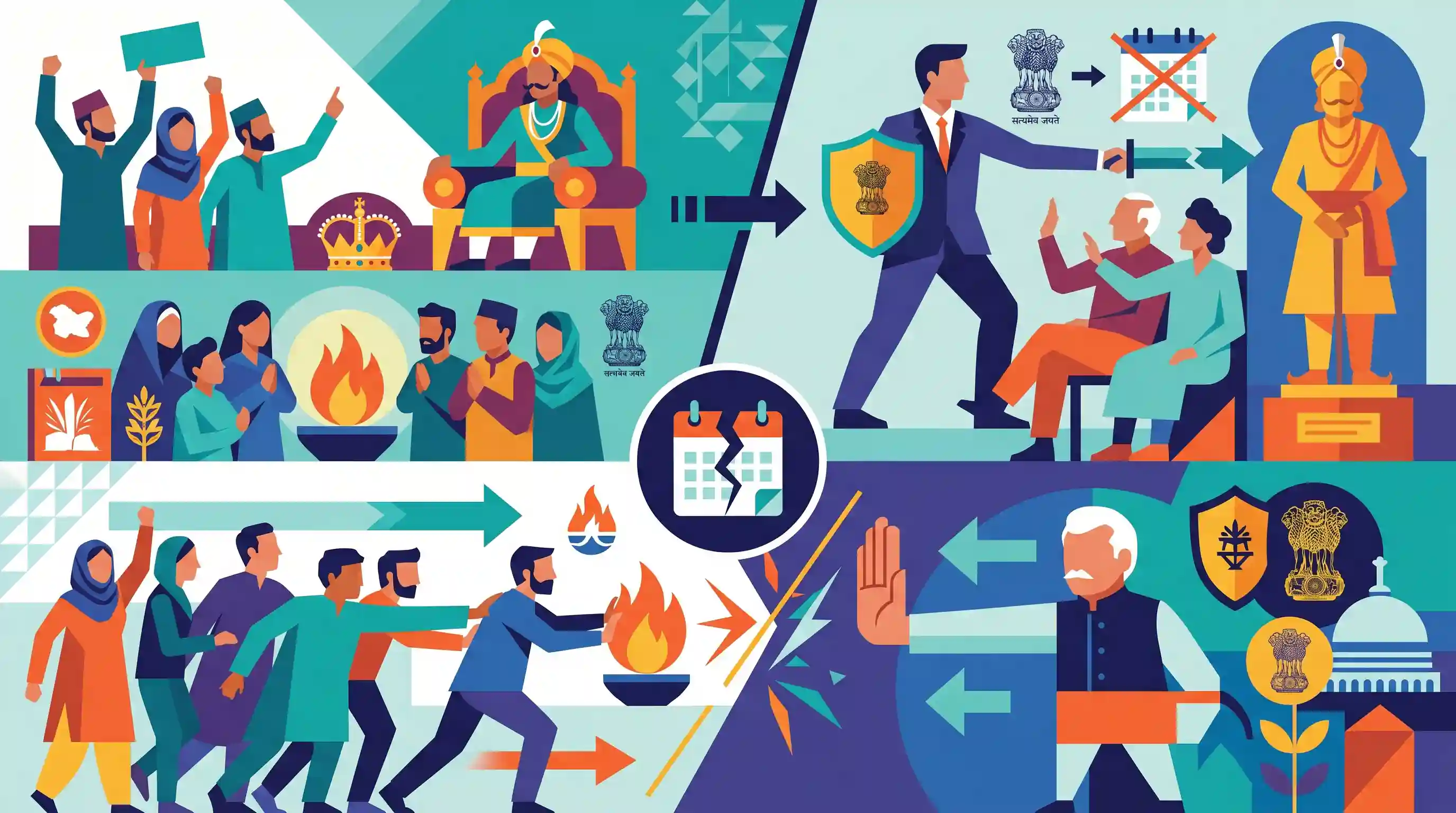
Why It Matters
The controversy highlights the tension between competing historical narratives (popular anti-monarchy movements vs integration by princely rulers) in the context of post-independence consolidation, as well as contemporary federal friction in Union Territories.
Summary
The article discusses the controversy surrounding the observance of July 13 as Martyrs' Day in Jammu & Kashmir. Historically, this day commemorated the Kashmiris who died protesting against the Dogra ruler Maharaja Hari Singh in 1931. The holiday was scrapped by the Union Territory administration in 2019 following the abrogation of Article 370, reflecting a shift in historical narrative that favors the Dogra legacy. The recent push by the newly elected J&K government to reinstate this holiday highlights an ongoing political and ideological battle over Kashmir's history, showcasing the friction between the elected government and the Centre-appointed Lieutenant Governor, as well as the broader struggle for control over regional identity and historical memory.
Key Points
- July 13 was historically observed in J&K as Martyrs' Day, marking the 1931 deaths of Kashmiri protesters fighting against the autocratic Dogra rule.
- The UT administration abolished the holiday in 2019 post-Article 370 abrogation, instead introducing a holiday on Maharaja Hari Singh's birth anniversary.
- The push by the newly elected local government to reinstate the July 13 holiday highlights the friction between the elected representatives and the Lieutenant Governor's administration.
- The debate reflects a broader clash over J&K's historical narrative: honoring democratic struggles against autocracy versus celebrating the Dogra legacy linked to J&K's accession to India.
- This controversy underscores the complexities of federalism in a Union Territory context and the use of historical symbols to shape contemporary political identities.
Important Terms
Article 370

A constitutional provision that formerly granted Jammu and Kashmir special autonomous status, allowing its own constitution and laws until its effective abrogation by the Indian government on August 5, 2019.
UPSC context
GS-II: Indian Constitution, Federalism. Tests understanding of special provisions, asymmetric federalism, and the legal process of constitutional integration.
Jammu and Kashmir Reorganisation Act, 2019
Legislation passed by the Indian Parliament that reconstituted the state of Jammu and Kashmir into two separate Union Territories: Jammu & Kashmir (with a legislature) and Ladakh (without a legislature).
UPSC context
GS-II: Statutory Bodies, Governance. Tests knowledge of state bifurcation, UT administration, and Parliament's powers under Article 3.
Martyrs' Day (July 13)
Historically observed in J&K on July 13 to commemorate 22 Kashmiris killed by the Dogra police in 1931; it was removed from the official holiday calendar in 2019.
UPSC context
GS-I: Modern Indian History. Relates to the 1931 agitation, political awakening in Kashmir, and the role of regional identity in historiography.
Lieutenant Governor (LG)
The constitutional head of the Union Territory of Jammu and Kashmir, appointed by the President, who holds extensive executive and legislative powers over the elected government.
UPSC context
GS-II: Structure, Organization and Functioning of the Executive. Tests the power dynamics between appointed representatives and elected local governments.
Dogra Dynasty
The ruling dynasty of the princely state of Jammu and Kashmir (1846–1947), established by Maharaja Gulab Singh after the Treaty of Amritsar with the British.
UPSC context
GS-I: Post-Independence Consolidation. Essential for understanding the historical context of Kashmir's accession and subsequent political movements.
Instrument of Accession
A legal document signed by Maharaja Hari Singh in October 1947, by which the princely state of Jammu and Kashmir acceded to the Dominion of India.
UPSC context
GS-I/II: Post-Independence Consolidation, Constitutional History. Tests knowledge of the legal basis of J&K's integration into the Indian Union.
Prelims Trap
"Under the J&K Reorganisation Act 2019, the J&K Legislative Assembly lacks jurisdiction over Public Order, Police, and Land."
The J&K Assembly cannot legislate on 'Public Order' and 'Police'. However, unlike Delhi (Article 239AA), it retains the power to legislate on 'Land'. This is a frequent point of confusion.
Static Concepts Connected
What was the role of popular movements in India's princely states?
- Praja Mandals: Formed in the 1920s to resist autocratic rule and demand democratic and civil rights in princely territories like Kashmir, Rajkot, and Hyderabad.
- AISPC integration: The All India States Peoples' Conference (1927) united these fragmented movements, later aligning deeply with the Indian National Congress.
- Haripura Session (1938): The INC officially extended its support to popular movements in princely states, declaring them an integral part of the broader national freedom struggle.
How do legislative powers in J&K differ from standard Indian States?
- Article 239A: Under the J&K Reorganisation Act 2019, J&K was made a UT with a legislature under Article 239A of the Constitution.
- Reserved subjects: Unlike standard states (State List), the J&K Legislative Assembly has no jurisdiction over 'Public Order' and 'Police', which are administered directly by the Centre.
- LG's discretion: The Lieutenant Governor possesses wider overriding executive powers compared to a State Governor, acting on the President's behalf for matters outside the Assembly's purview.
Cross-Topic Patterns
Princely states & post-independence integration
The historical 1931 Kashmir protests link to the GS1 theme of post-independence consolidation, showing how internal democratic pressures shaped the political landscape before the Instrument of Accession.
Asymmetric federalism and UT administration
The clash over holiday notifications mirrors recurrent governance friction in Delhi, highlighting structural GS2 themes regarding representative governance versus Centre-appointed Lieutenant Governors in Union Territories.

Expect Prelims statements comparing legislative constraints of the J&K Assembly (excluding Police/Public Order) with Delhi (excluding Land).
Linked PYQs · 2
Linked PYQs · 2
- 2021MainsGS1
Assess the main administrative issues and socio-cultural problems in the integration process of Indian Princely States.
- 2024MainsGS2
What changes has the Union Government recently introduced in the domain of Centre-State relations ? Suggest measures to be adopted to build the trust between the Centre and the States and for strengthening federalism.
