Modi Inaugurates Seva Teerth and Kartavya Bhavan Complex
Source:Indian Express ↗
Why It Matters
The modernization of the PMO and the broader Central Vista is a critical administrative reform aimed at improving executive efficiency and inter-ministerial coordination. Furthermore, the ideological shift in renaming and redesigning public spaces is relevant to India's post-independence cultural and political narrative, reflecting a transition away from colonial legacy towards indigenous values.
Summary
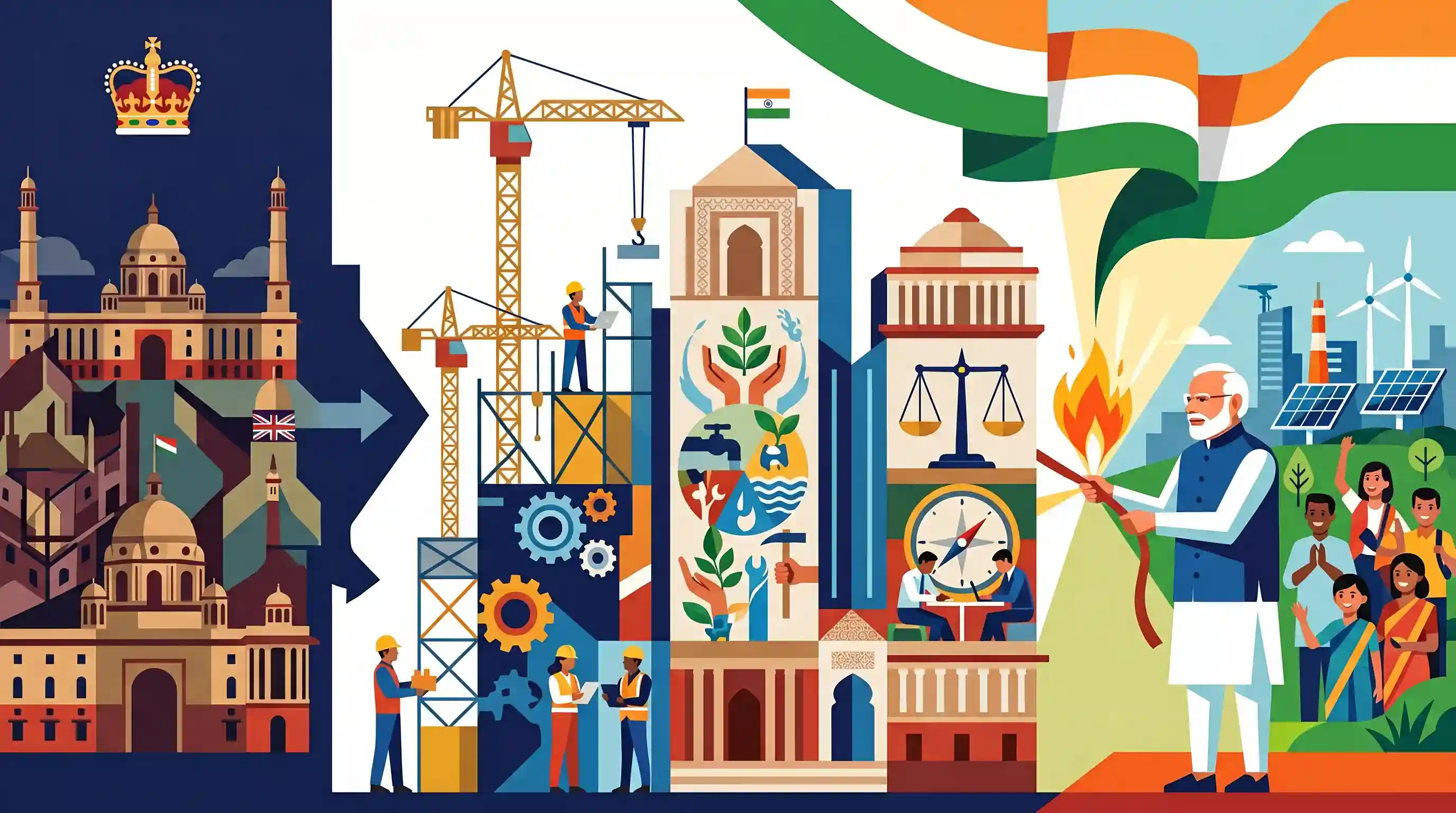
Prime Minister Narendra Modi inaugurated 'Seva Teerth', the new Prime Minister's Office (PMO), alongside 'Kartavya Bhavan' in New Delhi. As part of the ongoing Central Vista Redevelopment Project, these new structures aim to modernize the country's central administrative infrastructure for greater efficiency. The indigenous naming of these buildings highlights a symbolic shift from colonial-era legacies to a governance model rooted in Indian philosophical ideals of duty ('kartavya') and service ('seva').
Key Points
- PM Modi inaugurated the new Prime Minister's Office (PMO) complex, named 'Seva Teerth' (Pilgrimage of Service), underscoring a governance ethos focused on public service.
- The newly built 'Kartavya Bhavan' was also dedicated, symbolizing a commitment to civic duty and fulfilling the modern aspirations of India.
- These inaugurations are a significant milestone in the Central Vista Redevelopment Project, which seeks to modernize administrative infrastructure and consolidate central ministries.
- The indigenous nomenclature reflects the government's ongoing effort to de-colonize public spaces and infuse Indian philosophical traditions into state architecture.
Important Terms
Central Vista Redevelopment Project

A massive infrastructure initiative to modernize New Delhi's central administrative area, including the new Parliament, common secretariat buildings, and revamped public spaces, replacing colonial-era structures with functional, sustainable facilities.
UPSC context
GS Paper 2 (Governance) and GS Paper 1 (Art and Architecture). Tests understanding of administrative reforms and modernization.
Prime Minister's Office (PMO)
An extra-constitutional body that provides secretarial assistance and policy support to the Prime Minister. It is a 'department' under the Government of India Allocation of Business Rules, 1961.
UPSC context
GS Paper 2 (Executive/Governance). Tests knowledge of the institutional machinery and decision-making processes in India.
Seva Teerth
The newly inaugurated complex housing the PMO, Cabinet Secretariat, and National Security Council Secretariat. The name symbolizes a transition to a 'service-oriented' governance model rooted in Indian philosophical ideals.
UPSC context
GS Paper 2 (Governance) and Ethics. Relevant for symbolic shifts in administration and 'Viksit Bharat' aspirations.
Kartavya Path
The 3.2 km boulevard in New Delhi (formerly Rajpath) connecting Rashtrapati Bhavan to India Gate. Renamed to emphasize a duty-based relationship between the state and its citizens.
UPSC context
GS Paper 1 (History/Culture) and GS Paper 2. Focuses on the de-colonization of public spaces and symbolic naming.
Kartavya Bhavan
Two newly constructed Central Secretariat buildings designed to consolidate various Union Ministries into a single efficient complex, improving inter-ministerial coordination and reducing operational costs.
UPSC context
GS Paper 2 (Governance/Administrative Reforms). Tests understanding of bureaucratic efficiency and institutional consolidation.
Cabinet Secretariat
An administrative body providing secretarial assistance to the Union Cabinet, ensuring inter-ministerial coordination and monitoring policy implementation. It is headed by the Cabinet Secretary.
UPSC context
GS Paper 2 (Executive). Tests understanding of the highest-level coordination mechanism in the Indian government.
Prelims Trap
"The Prime Minister's Office (PMO) is a constitutional body functioning under the mandate of Article 74."
The PMO is an extra-constitutional, non-statutory body. It acquired the status of a department under the Government of India (Allocation of Business) Rules, 1961.
Static Concepts Connected
What are the distinct roles of the PMO and the Cabinet Secretariat?
- PMO Status: It is an extra-constitutional, non-statutory staff agency advising the PM, operating under the Allocation of Business Rules, 1961.
- Cabinet Secretariat: Also extra-constitutional, it coordinates inter-ministerial disputes and ensures adherence to the Transaction of Business Rules, 1961.
- Administrative Heads: The PMO is headed by the Principal Secretary, whereas the Cabinet Secretariat is headed by the Cabinet Secretary (the highest ranking civil servant).
What is the constitutional standing of 'Kartavya' (Duty) in India?
- Part IVA Insertion: Fundamental Duties were added to Part IVA via the 42nd Amendment Act (1976) based on the Swaran Singh Committee's recommendations.
- Legal Status: They are non-justiciable and cannot be enforced via writs, but courts use them to examine the constitutional validity of parliamentary laws.
- Article 51A(j): Mandates striving towards excellence in all spheres, mirroring the state's structural push for administrative modernization and efficiency.
Cross-Topic Patterns
Urban Redesign + Decolonization
The shift from colonial spatial layouts to Kartavya Bhavan connects GS1 urban planning with GS2 governance reforms aimed at shedding imperial administrative legacies.
Spatial Consolidation + E-governance
Unifying 51 ministries into one Common Central Secretariat physically complements the digital integration goals of the e-Office initiative for faster inter-ministerial decision-making.

Expect a Prelims question testing the extra-constitutional status of the PMO and Cabinet Secretariat under Allocation of Business Rules.
Linked PYQs · 2
Linked PYQs · 2
- 2024MainsGS2
“The growth of cabinet system has practically resulted in the marginalisation of the parliamentary supremacy.” Elucidate.
- 2020MainsGS1
Indian philosophy and tradition played a significant role in conceiving and shaping the monuments and their art in India. Discuss.
