POCSO Enforcement Deficits and Crimes Against Minors in Karnataka
Source:The Hindu ↗
Why It Matters
The article sheds light on the ground-level challenges in enforcing child protection laws (like POCSO) and checking child marriage. It provides contemporary examples of the dual challenges in social justice (crimes against women/minors) and public healthcare (shortage of staff and facilities), which are recurring themes in GS Paper 2.
Summary
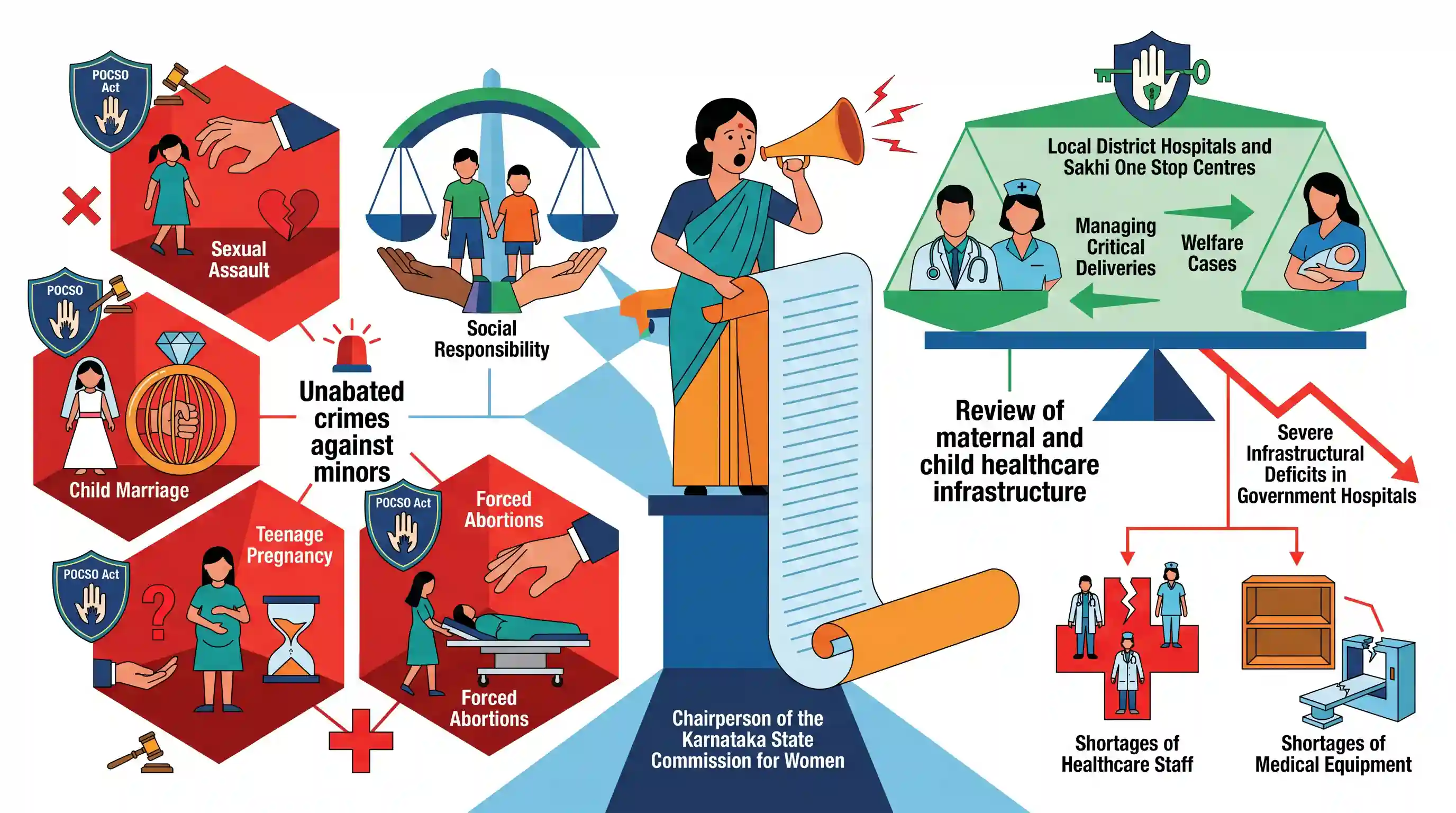
The Chairperson of the Karnataka State Commission for Women has raised an alarm over the unabated crimes against minors, citing multiple cases of sexual assault, child marriage, teenage pregnancy, and forced abortions under the POCSO Act. Calling for greater social responsibility, she also reviewed the state of maternal and child healthcare in the region. While praising the dedicated efforts of local district hospitals and Sakhi One Stop Centres in managing critical deliveries and welfare cases, she flagged severe infrastructural deficits, including shortages of healthcare staff and medical equipment in government hospitals.
Key Points
- Despite legal frameworks like the POCSO Act, crimes against minors persist, with Dharwad district recording 83 such cases over three years, including incidents of child marriage and teenage pregnancy.
- Numerous cases involved minor girls becoming mothers after sexual assault or undergoing abortions due to social stigma, highlighting a need for collective social responsibility.
- The Karnataka State Women's Commission commended the local district hospital for conducting around 550 safe deliveries a month and efficiently handling critical maternity and infant cases.
- The Sakhi One Stop Centre plays a key role within the hospital in managing cases related to women and child welfare.
- Critical gaps in public health infrastructure were identified, notably shortages in doctors, nurses, Group-D staff, and diagnostic facilities like MRI scanners.
Important Terms
POCSO Act, 2012

A gender-neutral law protecting minors from sexual assault, harassment, and pornography, mandating special courts for trials and prioritizing the child's best interests.
UPSC context
GS-2 (Social Justice); tests legal safeguards for vulnerable sections and India’s adherence to international child rights conventions.
Sakhi One Stop Centre (OSC)
A centrally sponsored scheme providing integrated support (medical, legal, and psychological) and temporary shelter to women affected by violence under one roof.
UPSC context
GS-2 (Welfare Schemes); examines institutional interventions for women’s safety and the implementation of the Nirbhaya Fund.
State Commission for Women
A statutory body established under state legislation to safeguard women's rights, investigate complaints, and advise the government on policy matters related to gender justice.
UPSC context
GS-2 (Statutory Bodies); tests the role of quasi-judicial institutions in monitoring constitutional safeguards and addressing social grievances.
Prohibition of Child Marriage Act (PCMA), 2006
Legislation prohibiting marriages where the bride is under 18 or groom under 21, making such unions voidable and penalizing those who perform or abet them.
UPSC context
GS-2 (Social Justice); focuses on social reform laws, gender equality (SDG 5), and legal age requirements for marriage.
Statutory Body
An organization established by an Act of Parliament or State Legislature, empowered with specific legal authority to perform functions like regulation or rights protection.
UPSC context
GS-2 (Polity); essential for distinguishing between constitutional, executive, and legislative-mandated government institutions.
Prelims Trap
The POCSO Act is specifically formulated to protect minor girls from sexual offences and exploitation.
The POCSO Act, 2012 is strictly gender-neutral. It defines a 'child' as any person below the age of 18 years, providing equal protection to both minor boys and minor girls from sexual offences.
Static Concepts Connected
What is the Sakhi One Stop Centre (OSC) scheme?
- Nodal Ministry: Implemented by the Ministry of Women and Child Development (MWCD).
- Funding mechanism: It is a 100% centrally sponsored scheme funded exclusively through the Nirbhaya Fund.
- Core mandate: Provides integrated medical, legal, police, and psychological support under one roof for women affected by violence.
What are the core provisions of the POCSO Act, 2012?
- Gender-neutral law: Defines a 'child' as any person below 18 years of age, protecting both boys and girls equally.
- Burden of proof: Shifts the burden of proof to the accused for certain serious offences, presuming culpable mental state.
- Speedy justice: Mandates the establishment of Special Courts and sets specific timelines for investigation and trial completion.
Cross-Topic Patterns
Intersecting vulnerabilities in minors
Child marriage directly fuels teenage pregnancies, legally triggering POCSO provisions while simultaneously driving up maternal mortality rates (MMR) and straining public health infrastructure.
Statutory bodies as health auditors
Women's Commissions increasingly conduct proactive audits of district health infrastructure, moving beyond reactive legal redressal to assessing structural capacity for safe institutional deliveries.

Expect a multi-statement question on Sakhi OSCs in 2026, combining Nirbhaya Fund financing, implementation norms, and hospital integration.
Linked PYQs · 3
Linked PYQs · 3
- 2025MainsGS2
The National Commission for Protection of Child Rights has to address the challenges faced by children in the digital era. Examine the existing policies and suggest measures the Commission can initiate to tackle the issue.
- 2020MainsGS2
In order to enhance the prospects of social development, sound and adequate health care policies are needed particularly in the fields of geriatric and maternal health care. Discuss.
- 2017MainsGS2
Is the National Commission for Women able to strategize and tackle the problems that women face at both public and private spheres? Give reasons in support of your answer.
