Karnataka Rejects Centre Eco Sensitive Area Draft for Western Ghats
Source:The Hindu ↗
কেন এটি গুরুত্বপূর্ণ
This development highlights the classic 'environment vs. development/livelihood' debate and illustrates federal friction in environmental governance. It is a vital case study for GS-3 (Conservation) regarding the implementation challenges of the Kasturirangan Committee report, and for GS-2 (Centre-State relations) concerning overlapping jurisdictions in ecological protection.
সারসংক্ষেপ
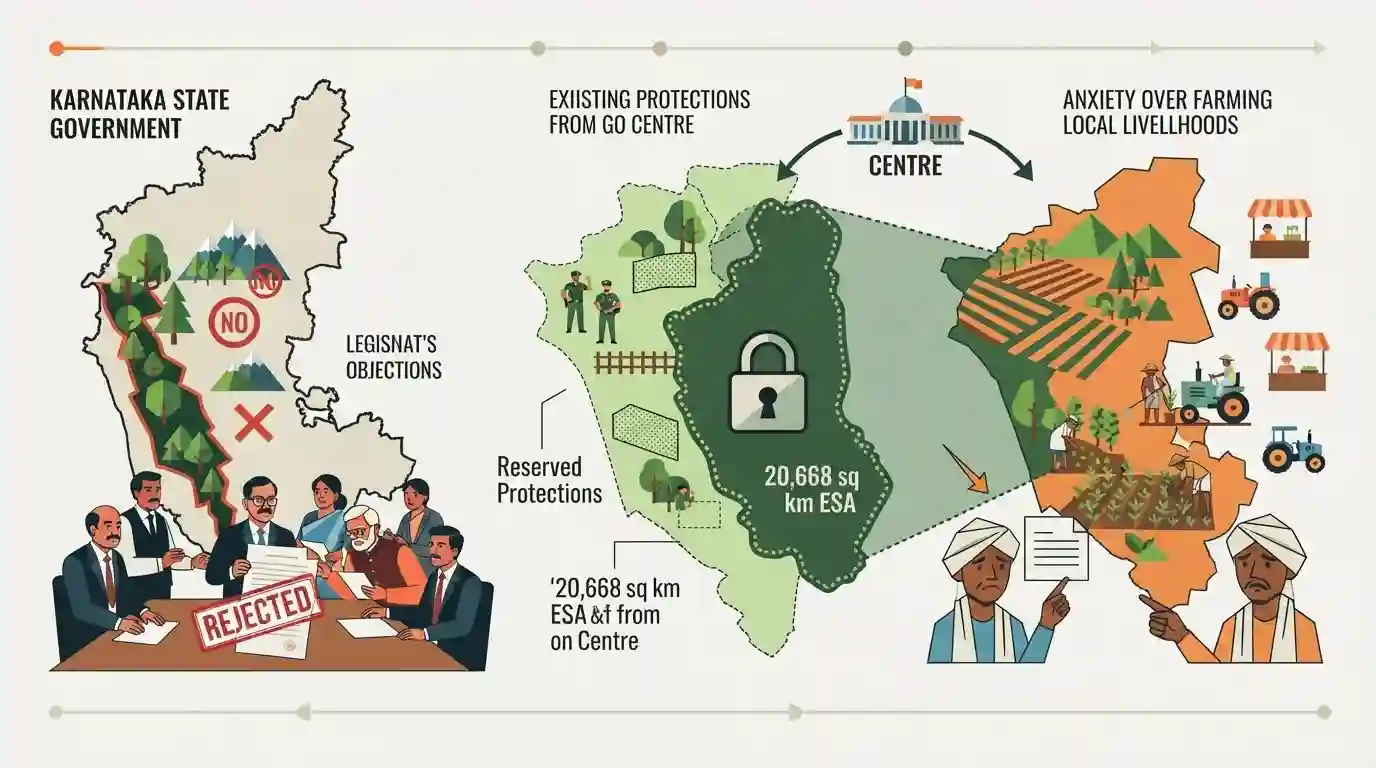
The Karnataka government has announced its decision to reject the Centre's latest draft notification proposing the declaration of 20,668 sq km of the Western Ghats in the state as an Eco-Sensitive Area (ESA), as recommended by the K. Kasturirangan committee. The state asserts that introducing ESA rules on lands already protected under state-notified Reserved Forests and Eco-Sensitive Zones would be an unnecessary double regulation. Across party lines, legislators voiced concerns that strict ESA guidelines would severly disrupt the livelihoods of local farmers, leading the State Cabinet to formally prepare its objections ahead of the September deadline.
মূল বিষয়
- The Karnataka government plans to officially reject the Union Environment Ministry's seventh draft notification on declaring 56,000 sq km of the Western Ghats as an Eco-Sensitive Area (ESA).
- Karnataka accounts for 20,668 sq km of the proposed ESA, spanning 1,449 villages across 10 districts in the state.
- State officials argue that the identified lands are already adequately protected as Reserved Forests or Eco-Sensitive Zones, making the central ESA mandate redundant and restrictive.
- Lawmakers across party lines claim the implementation of the Kasturirangan report would spell disaster for local farmers and livelihoods in the region, leading to a consensus against the notification.
- The State Cabinet has historically opposed previous iterations of the draft; a final unified decision will be taken at an all-party meeting before the September 25 objection deadline.
গুরুত্বপূর্ণ শব্দ
Eco-Sensitive Area (ESA) Draft Notification

A proposed executive declaration under the Environment (Protection) Act, 1986, designating ecologically fragile buffer zones where harmful commercial and industrial activities are restricted.
UPSC context
GS Paper III: Environment conservation; tests balance between biodiversity protection, administrative zoning, and regional livelihoods.
Kasturirangan Committee Report
A 2013 high-level working group report on Western Ghats conservation recommending designating 37% of the landscape as Eco-Sensitive Area, balancing conservation with development.
UPSC context
GS Paper III: Conservation; tests landmark committee reports on the Western Ghats and state-level developmental conflicts.
Ministry of Environment, Forest and Climate Change (MoEFCC)
The nodal Central Government ministry responsible for planning, promoting, coordinating, and overseeing the implementation of India's environmental, forestry, and climate policies.
UPSC context
GS Paper III: Environmental Governance; tests administrative structures, executive guidelines, and statutory powers of environment ministries.
Gadgil Committee Report
A 2011 report recommending the entire Western Ghats be declared an ecologically sensitive area with three graded levels of protection and decentralized governance.
UPSC context
GS Paper III: Environmental Planning; tests grassroots participation, strict versus balanced conservation frameworks, and ecological reports.
Environment (Protection) Act, 1986
An umbrella legislation enacted post-Bhopal Gas Tragedy, empowering the Central Government to protect the environment, coordinate state agencies, and regulate pollution sources.
UPSC context
GS Paper III: Environmental Legislation; tests statutory provisions, constitutional backing, and powers of environmental declaration.
প্রিলিমস ফাঁদ
Eco-Sensitive Areas (ESAs) are defined and established under the Wildlife (Protection) Act, 1972.
ESAs/ESZs are not defined in the Wildlife (Protection) Act. They are declared under the Environment (Protection) Act, 1986, using its broad protective powers.
সংযুক্ত স্থির ধারণা
What is the statutory basis and purpose of Eco-Sensitive Zones (ESZs)?
- Statutory Origin: Notified under Section 3(2)(v) of the Environment (Protection) Act, 1986, and Rule 5(1) of the Environment (Protection) Rules. The term 'ESZ' is not explicitly used in the original Act.
- Purpose: They act as transition zones or 'shock absorbers' around National Parks and Wildlife Sanctuaries, regulating high-impact commercial activities while minimizing disruption to local communities.
- Activity Categorisation: Commercial mining, stone quarrying, and highly polluting industries are prohibited; construction and hotels are regulated; organic farming and rainwater harvesting are promoted.
How did the Gadgil and Kasturirangan reports differ on Western Ghats conservation?
- Gadgil (WGEEP) Approach: Recommended classifying 64% of the Western Ghats into three graded Eco-Sensitive Zones (ESZ I, II, and III) with a strict bottom-up, Gram Sabha-led conservation model.
- Kasturirangan (HLWG) Compromise: Identified 37% of the area as Natural Landscape (Eco-Sensitive Area) and left the remaining 63% Cultural Landscape out of strict environmental regulations.
আন্তঃবিষয় প্যাটার্ন
Environmental federalism and land-use disputes
Demonstrates how Concurrent List subjects like forests trigger center-state friction, as states prioritize local developmental autonomy over federal ecological mandates.
Conservation policies vs. Tribal land rights
Highlights the recurring conflict between top-down ESA declarations and the recognition of community forest rights under the Forest Rights Act (FRA), 2006.

Expect a conceptual question contrasting Gadgil/Kasturirangan scopes alongside the exact statutory origin of ESAs under EPA 1986.
সংযুক্ত PYQ · 3
সংযুক্ত PYQ · 3
- 2016PrelimsGS1
'Gadgil Committee Report' and 'Kasturirangan Committee Report', sometimes seen in the news, are related to
- 2014PrelimsGS1
With reference to 'Eco-Sensitive Zones', which of the following statements is/are correct? 1. Eco-Sensitive Zones are the areas that are declared under the Wildlife (Protection) Act, 1972. 2. The purpose of the declaration of Eco-Sensitive Zones is to prohibit all kinds of human activities in those zones except agriculture. Select the correct answer using the code given below.
- 2018MainsGS2
“Policy contradictions among various competing sectors and stakeholders have resulted in inadequate 'protection and prevention of degradation' to environment.” Comment with relevant illustrations.
