Karnataka Rules Out Aadhaar as Valid Proof of Age for Marriage
Source:The Hindu ↗
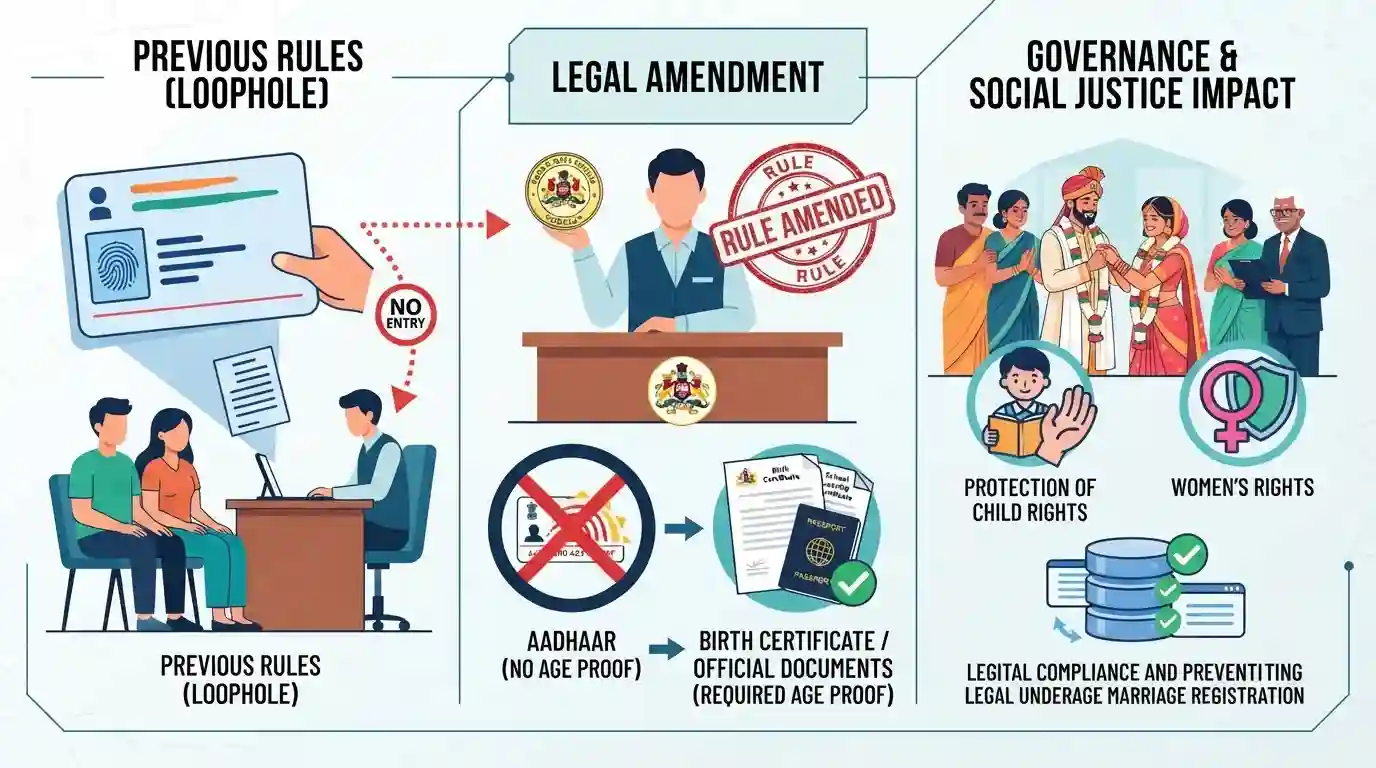
हे का महत्त्वाचे आहे
It highlights the legal limitations of digital identity documents like Aadhaar in verifying critical demographic data such as age, reinforcing the implementation of child marriage laws and protecting women's and children's rights.
सारांश
The Karnataka government has amended its marriage registration rules to clarify that Aadhaar cannot be accepted as a proof of age. Citing UIDAI guidelines and legal requirements, the state emphasized that Aadhaar is only a proof of identity and residence, not a verified proof of date of birth, thereby closing loopholes used in registering underage or child marriages.
मुख्य मुद्दे
- Karnataka has tightened its marriage registration rules by explicitly ruling out Aadhaar as a valid proof of age.
- The decision aligns with UIDAI guidelines and legal provisions stating that Aadhaar records capture declared information rather than verified birth registration data, making it prone to manipulation for age verification.
- Valid proofs of age for marriage registration include birth certificates, school transfer certificates, or passing certificates.
- This measure helps combat child marriages and ensures compliance with legal age requirements for marriage.
महत्त्वाच्या संज्ञा
Aadhaar Act 2016

A 2016 statutory enactment providing legal backing to Aadhaar for the targeted delivery of subsidies and benefits, establishing UIDAI as a statutory regulator.
UPSC context
UPSC Mains Paper II (Polity & Governance / Statutory Bodies). Tests understanding of digital identity governance, legal frameworks, and citizen rights.
Prohibition of Child Marriage Act
Central legislation enacted to prevent child marriages, defining legal marriageable ages as 21 for males and 18 for females, and penalizing perpetrators.
UPSC context
UPSC Mains Paper II (Social Justice / Women & Child Rights). Frequently tested for measures combating social evils and protecting vulnerable demographics.
Unique Identification Authority of India (UIDAI)
The statutory authority created under the Aadhaar Act 2016 to issue Aadhaar numbers and manage authentication infrastructure across India.
UPSC context
UPSC Prelims/Mains. Tests knowledge of regulatory institutions, statutory bodies, and technology-driven governance models in India.
संबंधित स्थिर संकल्पना
What are the legal limits of Aadhaar under the Aadhaar Act 2016 regarding identity and citizenship?
- Identity vs Citizenship: Identity proof only, confirming the resident's identity and address, not citizenship or lineage.
- Date of Birth: UIDAI guidelines state Aadhaar is not a conclusive proof of Date of Birth, as initial enrolments often relied on declared rather than verified documents.
- Supreme Court Ruling: Section 57 (though amended/read down) and Supreme Court rulings (Puttaswamy case) uphold its validity for targeted welfare benefits while restricting mandatory private use.
आंतर-विषय नमुने
Digital Identity vs Civil Status Records
Aadhaar's legal status as an identity document rather than proof of citizenship or birth date has recurring implications across welfare delivery, PDS authentication, and civil registration systems.

UPSC may test the statutory limits of Aadhaar under the Aadhaar Act 2016, specifically regarding identity vs. age/citizenship proof.
संबंधित PYQ · 3
संबंधित PYQ · 3
- 2018PrelimsGS1
Consider the following statements: 1. Aadhaar card can be used as a proof of citizenship or domicile. 2. Once issued, Aadhaar number cannot be deactivated or omitted by the Issuing Authority. Which of the statements given above is/are correct?
- 2020PrelimsGS1
Consider the following statements: 1. Aadhaar metadata cannot be stored for more than three months. 2. State cannot enter into any contract with private corporations for sharing of Aadhaar data. 3. Aadhaar is mandatory for obtaining insurance products. 4. Aadhaar is mandatory for getting benefits funded out of the Consolidated Fund of India. Which of the statements given above is/are correct?
- 2023MainsGS2
Explain the constitutional perspectives of Gender Justice with the help of relevant Constitutional Provisions and case laws.
