Drug Price Regulation and Extension Beyond Cancer Medicines
Source:The Hindu ↗
কেন এটি গুরুত্বপূর্ণ
This development highlights key governance challenges in public healthcare, specifically the tension between market-driven pharmaceutical costs and citizens' right to health, feeding directly into discussions on Universal Health Coverage and state intervention against catastrophic out-of-pocket expenditure.
সারসংক্ষেপ
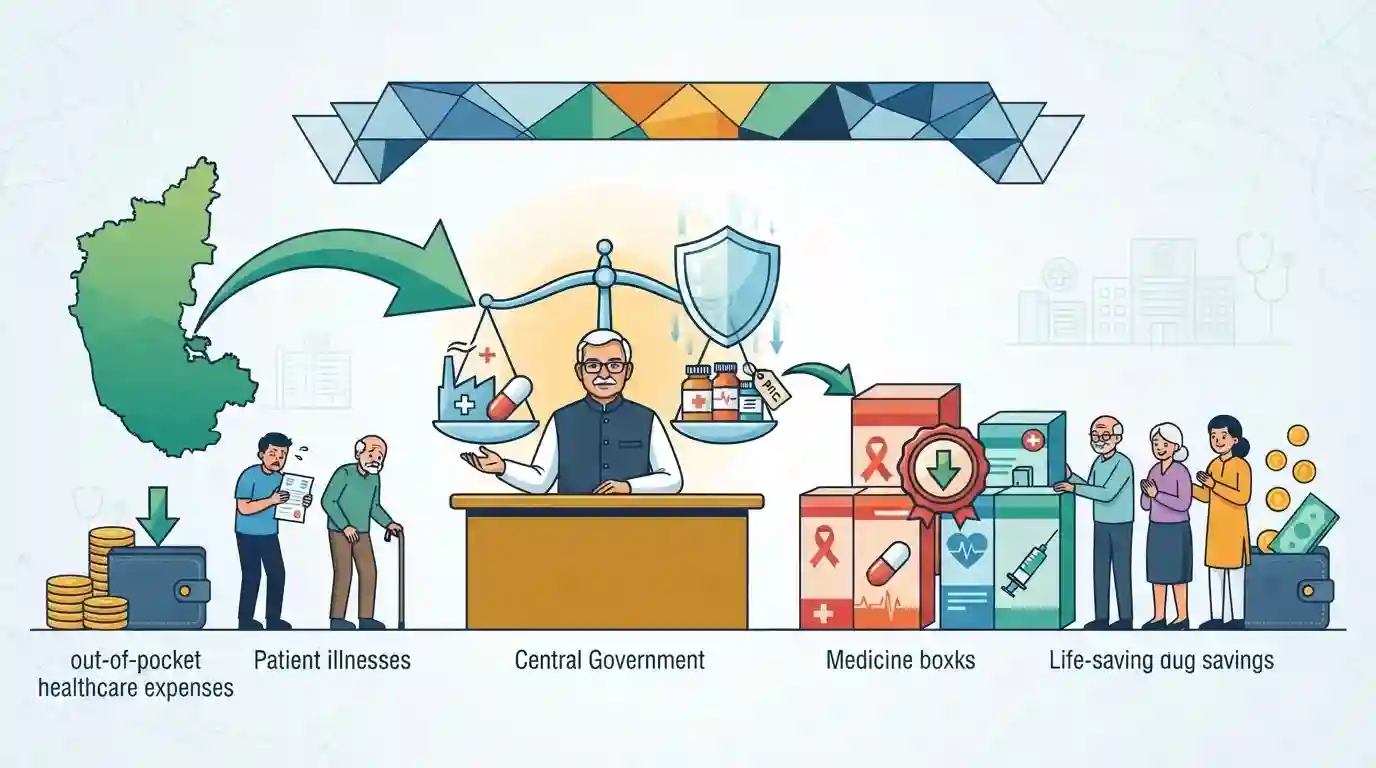
Karnataka has requested the Central government to extend price caps beyond cancer medicines to cover other high-cost, life-saving drugs. The move aims to mitigate catastrophic out-of-pocket healthcare expenses for patients suffering from critical and rare illnesses, underlining the policy debate on drug affordability and pharmaceutical price control in India.
মূল বিষয়
- Karnataka has formally urged the Union government to broaden price regulation beyond cancer drugs to include other high-cost life-saving medications.
- High costs of specialized and rare disease drugs often result in catastrophic out-of-pocket expenditure (OOPE) for households, pushing vulnerable families into poverty.
- The state's proposal highlights the limitation of current price caps which cover only a fraction of critical care therapies, emphasizing the need for wider inclusion in the National List of Essential Medicines (NLEM) or separate price ceilings.
- Addressing drug affordability is critical to achieving Universal Health Coverage (UHC) and reducing financial hardships associated with marketization of healthcare.
গুরুত্বপূর্ণ শব্দ
National Pharmaceutical Pricing Authority (NPPA)

An independent regulatory body under the Ministry of Chemicals and Fertilizers responsible for fixing and revising the prices of pharmaceutical products and enforcing the DPCO in India.
UPSC context
UPSC Prelims/Mains (GS Paper II - Health Governance): Tests regulatory bodies, price control mechanisms, and public health access.
Drug Prices Control Order (DPCO)
An order issued by the central government under the Essential Commodities Act to regulate and fix the ceiling prices of essential and life-saving drugs in India.
UPSC context
UPSC Prelims/Mains (GS Paper II/III): Tests pharmaceutical policy, consumer protection, and statutory orders under economic legislation.
National List of Essential Medicines (NLEM)
A curated list of medicines considered basic, cost-effective, and vital for the healthcare needs of the population, formulated by the Ministry of Health and Family Welfare.
UPSC context
UPSC Prelims/Mains (GS Paper II - Social Sector/Health): Tests public health policy, drug affordability, and essential healthcare provisioning.
প্রিলিমস ফাঁদ
The National Pharmaceutical Pricing Authority (NPPA) regulates and caps the prices of all pharmaceutical formulations sold in the Indian market.
The NPPA does not regulate the prices of all medicines in India. Only medicines listed under Schedule I of the DPCO (drawn from the NLEM) are subject to strict price caps. Non-scheduled drugs have only limited monitoring on annual price increases.
সংযুক্ত স্থির ধারণা
What are the key functions and statutory backing of the National Pharmaceutical Pricing Authority (NPPA)?
- Statutory Origin: Establishment year: Established in 1997 as an attached office of the Department of Pharmaceuticals, Ministry of Chemicals and Fertilizers.
- Price Control: Primary mandate: Implements and enforces price caps for scheduled formulations under the Drug Prices Control Order (DPCO) and monitors non-scheduled drug prices.
- Overcharge Recovery: Recovery role: Detects overpricing of controlled drugs and recovers overcharged amounts along with interest from defaulting pharmaceutical companies.
আন্তঃবিষয় প্যাটার্ন
NPPA Pricing vs. Pharmaceutical R&D Incentives
Drug price controls implemented by NPPA under DPCO directly balance consumer affordability with pharmaceutical sector innovation and foreign direct investment incentives.
Out-of-Pocket Expenditure vs. Inclusive Growth
High out-of-pocket medical expenditure remains a primary driver of household debt and poverty, undermining human capital development targets under inclusive growth strategies.

Expect a multi-statement prelims question on NPPA powers, DPCO scheduled/non-scheduled distinction, and NLEM revision authority.
সংযুক্ত PYQ · 1
সংযুক্ত PYQ · 1
- 2024MainsGS2
In a crucial domain like the public healthcare system the Indian State should play a vital role to contain the adverse impact of marketisation of the system. Suggest some measures through which the State can enhance the reach of public healthcare at the grassroots level.
