Bengaluru Tunnel Road Project Tender and Urban Planning Concerns
Source:Indian Express ↗
Why It Matters
This issue perfectly illustrates the challenges of urban planning and infrastructure development in Indian megacities, specifically touching upon the viability of PPPs (BOOT model), the importance of rigorous project appraisal (DPRs), and the tension between elite infrastructure (car-centric tunnel roads) and affordable mass mobility.
Summary
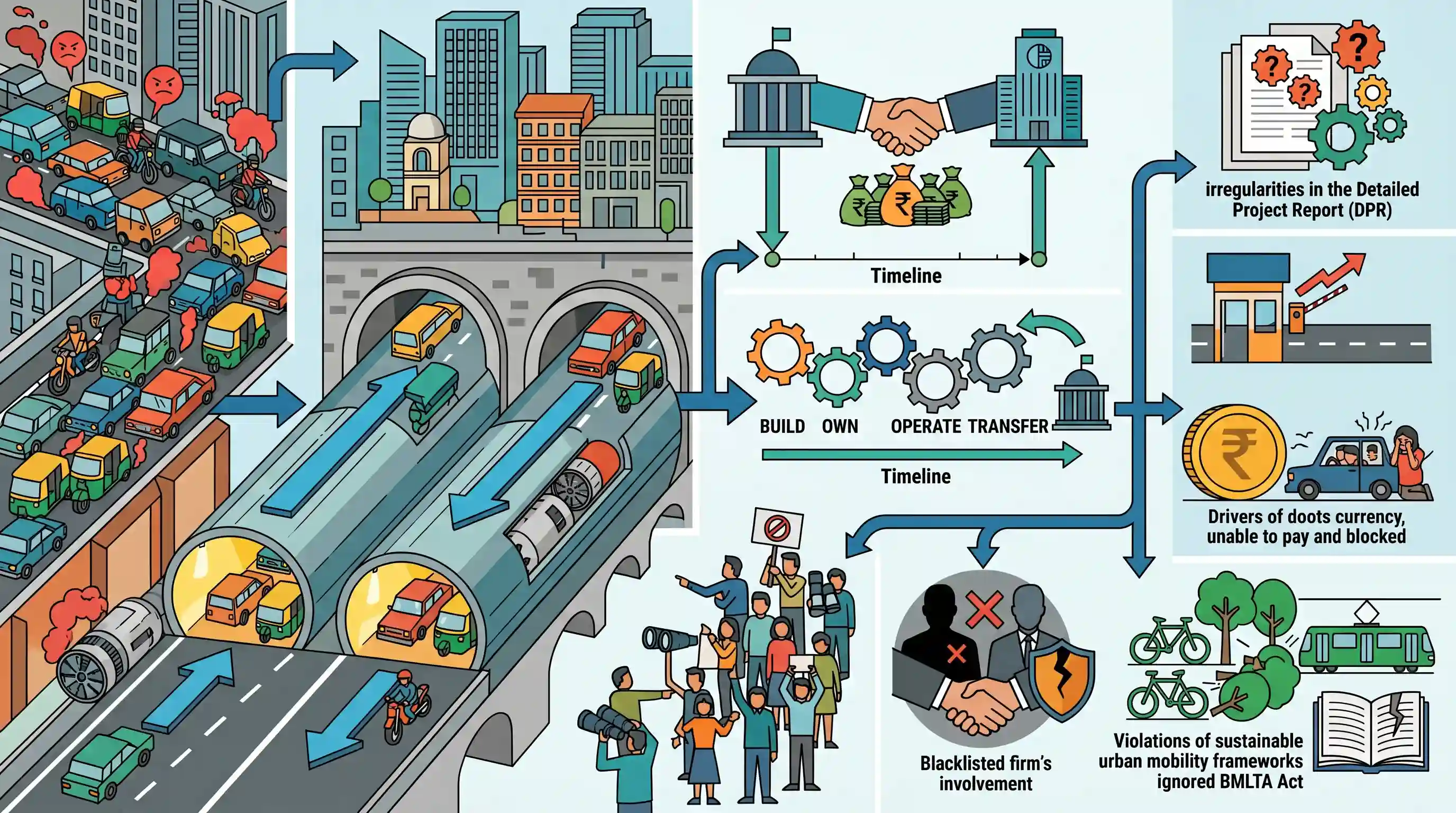
The Karnataka government has invited global tenders for an ambitious Rs 17,698-crore twin-tube tunnel road project in Bengaluru, designed to ease severe traffic congestion along the city's north-south corridor under a BOOT PPP model. However, the megaproject has drawn intense scrutiny and opposition over alleged irregularities in its Detailed Project Report (DPR), high proposed tolls, the involvement of blacklisted consulting firms, and violations of sustainable urban mobility frameworks like the BMLTA Act.
Key Points
- Karnataka government's B-SMILE floated a global tender for a Rs 17,698-crore, 17-km twin-tube tunnel road project in Bengaluru from Hebbal to Silk Board.
- The project will follow a modified build-own-operate-transfer (BOOT) model with a 34-year concession period, aiming to reduce travel time on the north-south corridor from 90 to 45 minutes.
- The project faces severe criticism for proposing a Rs 330 one-way toll for cars and relying on a Detailed Project Report (DPR) allegedly containing glaring errors and prepared by consultants linked to scams or blacklisting.
- Critics, including MP Tejasvi Surya, allege that the project violates the city's Comprehensive Mobility Plan and section 19 of the BMLTA Act.
Important Terms
Bengaluru Metropolitan Land Transport Authority (BMLTA)

A statutory body notified under the BMLTA Act 2022 to unify transport planning in Bengaluru, tasked with coordinating multiple agencies to ensure integrated urban mobility.
UPSC context
GS Paper 2 (Statutory/Regulatory Bodies) & GS Paper 3 (Urban Infrastructure). Tests knowledge of institutional frameworks for urban governance.
Bengaluru Smart Infrastructure Limited (B-SMILE)
A Special Purpose Vehicle (SPV) established by the Karnataka government to execute and manage large-scale infrastructure projects, such as the Bengaluru twin-tube tunnel road.
UPSC context
GS Paper 2 (Governance) & GS Paper 3 (Infrastructure). Tests understanding of SPVs in implementing megaprojects and managing public-private funding.
BOOT Model (Build-Own-Operate-Transfer)
A Public-Private Partnership (PPP) model where a private entity finances, designs, builds, and operates an infrastructure project for a set period before transferring it to the government.
UPSC context
GS Paper 3 (Investment Models). Tests understanding of risk-sharing, private sector participation, and infrastructure financing mechanisms.
Unified Metropolitan Transport Authority (UMTA)
A nodal agency recommended by the National Urban Transport Policy (NUTP) to integrate multiple transport departments (e.g., Metro, Bus, Rail) within a city for seamless multi-modal mobility.
UPSC context
GS Paper 3 (Urbanization/Transport Policy). Tests knowledge of the National Urban Transport Policy (NUTP) and multi-modal transport integration.
Detailed Project Report (DPR)
A detailed technical and financial blueprint of an infrastructure project used to evaluate feasibility, estimate costs, and obtain administrative and financial approvals.
UPSC context
GS Paper 3 (Infrastructure/Planning). Tests awareness of procedural safeguards, technical scrutiny, and accountability in large-scale public expenditures.
Comprehensive Mobility Plan (CMP)
A strategic document outlining a city's long-term transport vision, focusing on public transit, non-motorized transport, and land-use integration to achieve sustainable mobility goals.
UPSC context
GS Paper 3 (Infrastructure). Tests understanding of sustainable urban mobility planning and alignment with climate and accessibility goals.
Prelims Trap
Under the BOOT PPP model, the private developer retains permanent ownership of the completed infrastructure asset.
BOOT implies ownership is strictly temporary, spanning a fixed concession period (e.g., 34 years in this project). It always culminates in a mandatory transfer back to the government.
Static Concepts Connected
What distinguishes the BOOT model from other PPP frameworks?
- Build: The private entity designs and constructs the infrastructure using its own or raised funds.
- Own & Operate: The private partner legally owns and operates the asset for a fixed concession period, recovering costs through user fees (tolls).
- Transfer: Upon expiry of the concession period, the unencumbered asset is handed back to the public authority.
What is the mandate of Unified Metropolitan Transport Authorities (UMTAs)?
- Genesis: Recommended by the National Urban Transport Policy (NUTP) 2006 to act as an umbrella body coordinating fragmented urban transport agencies.
- Statutory Role: Backed by state legislation (like Karnataka's BMLTA Act) to prepare and enforce Comprehensive Mobility Plans (CMPs) for sustainable urban transit.
Cross-Topic Patterns
PPP Models + Urban Governance overlaps
Large capital-intensive urban projects frequently face viability gaps and regulatory challenges, testing the efficacy of statutory Unified Metropolitan Transport Authorities (like BMLTA) against powerful parastatal development agencies.
Car-centric Infra vs. Public Transit
Capital-intensive, high-toll tunnel megaprojects often contradict the National Urban Transport Policy's core mandate of "moving people, not vehicles," sparking debates on urban equity and sustainable mobility.

Prelims 2026: Expect statement-based questions distinguishing BOOT, BOT-Toll, and HAM PPP models, specifically regarding asset ownership.
Linked PYQs · 4
Linked PYQs · 4
- 2022MainsGS3
Why is Public Private Partnership (PPP) required in infrastructural projects ? Examine the role of PPP model in the redevelopment of Railway Stations in India.
- 2014MainsGS3
Explain how Private Public Partnership arrangements, in long gestation infrastructure projects, can transfer unsustainable liabilities to the future. What arrangements need to be put in place to ensure that successive generations' capacities are not compromised?
- 2019MainsGS1
How is efficient and affordable urban mass transport key to the rapid economic development of India?
- 2017MainsGS1
"The growth of cities as I.T. hubs has opened up new avenues of employment, but has also created new problems." Substantiate this statement with examples.
