Karnataka Performance in NITI Aayog Electric Mobility Index
Source:The Hindu ↗
हे का महत्त्वाचे आहे
Indices like NITI Aayog's Electric Mobility Index track sub-national performance and competitive federalism in green energy transition, shedding light on the critical role of charging infrastructure and policy frameworks in scaling EV adoption across India.
सारांश
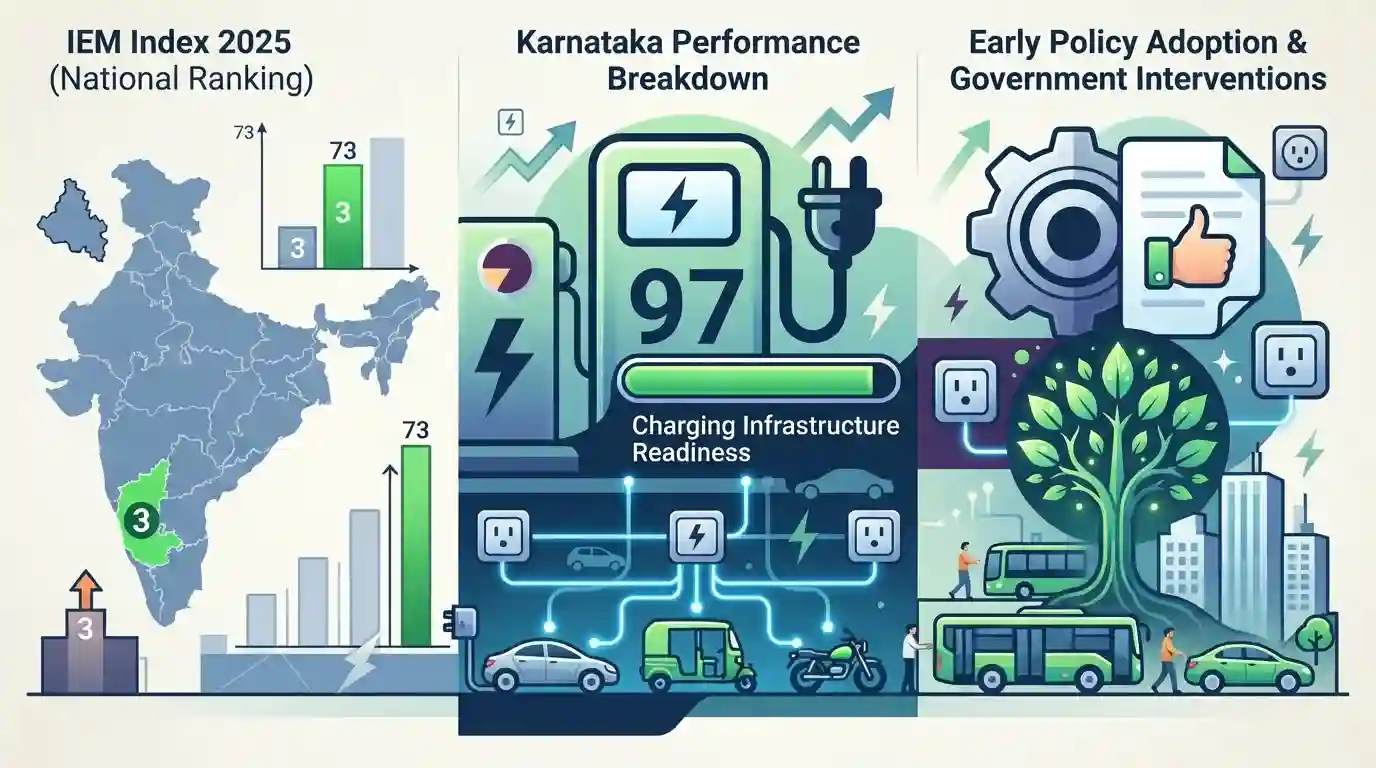
Karnataka ranked third in NITI Aayog's India Electric Mobility Index (IEMI) 2025 with a score of 73, demonstrating robust performance driven by high charging infrastructure readiness (scoring 97) and early policy adoption.
मुख्य मुद्दे
- Karnataka secured the third position nationally in NITI Aayog's India Electric Mobility Index (IEMI) 2025 with a score of 73, behind Delhi (84) and Maharashtra (78).
- Karnataka recorded the highest Charging Infrastructure Readiness (CIR) score in the country at 97.
- The State pioneered India's first dedicated EV policy in 2017 and features a unified charging app (Bescom EV Mithra) and an EV Accelerator Cell.
- EV sales penetration in Karnataka reached nearly 15% in the first five months of FY 2026-27, with cumulative sales ranking third nationally.
महत्त्वाच्या संज्ञा
India Electric Mobility Index 2025 (IEMI 2025)

A policy index developed by NITI Aayog in collaboration with WRI India to evaluate and rank states and Union Territories on their transition to electric mobility across three core pillars.
UPSC context
GS Paper III (Environment, Infrastructure & Economy): Assesses cooperative federalism and state-level progress in achieving India's clean energy and EV transition targets.
Bescom EV Mithra
A mobile application launched by BESCOM in Karnataka to provide EV users with seamless access to charging infrastructure, station reservations, and digital payments.
UPSC context
GS Paper III (Infrastructure & Energy): Highlights state-level digital governance and public utility interventions to support electric vehicle infrastructure rollout.
WRI India
World Resources Institute India is a research organization that partners with governments and businesses to promote sustainable development, environmental protection, and low-carbon transitions.
UPSC context
GS Paper III (Environment & Ecology): Important for questions on think tanks, civil society collaborations, and technical frameworks for national climate goals.
संबंधित स्थिर संकल्पना
What are the core pillars and institutional framework of NITI Aayog's state-level index mechanism?
- Competitive Federalism: Policy Mandate: NITI Aayog evaluates states on thematic indices (e.g., Water, Health, EV) to foster competitive federalism.
- Pillar Weighting: Pillar Weighting: Indices typically balance outcome indicators, policy enablers, and infrastructure readiness.
आंतर-विषय नमुने
State EV Indices & Competitive Federalism
State-level EV indices tie directly into fiscal federalism, where central think-tanks use competitive federalism metrics to incentivize sub-national green infrastructure investments.
EV Adoption & Power Grid Infrastructure
Rapid EV deployment strains traditional thermal-heavy grids, requiring strategic alignment between state DISCOM preparedness (like BESCOM) and renewable integration targets under NAPCC.

NITI Aayog state indices + EV policy parameters frequently form matching or multi-statement questions in Prelims.
संबंधित PYQ · 2
संबंधित PYQ · 2
- 2021MainsGS3
“Investment in infrastructure is essential for more rapid and inclusive economic growth.” Discuss in the light of India's experience.
- 2022MainsGS3
Do you think India will meet 50 percent of its energy needs from renewable energy by 2030 ? Justify your answer. How will the shift of subsidies from fossil fuels to renewables help achieve the above objective ? Explain.
