Karnataka Proposal for Dedicated Electric Vehicle Manufacturing Hub
Source:Indian Express ↗
Why It Matters
Building a dedicated ecosystem for EV testing, research, and talent development is crucial for India to accelerate clean mobility adoption, localize battery technology manufacturing, and achieve decarbonization goals. State-led infrastructure hubs like the proposed EV City serve as a model for holistic industrial development in the e-mobility sector.
Summary
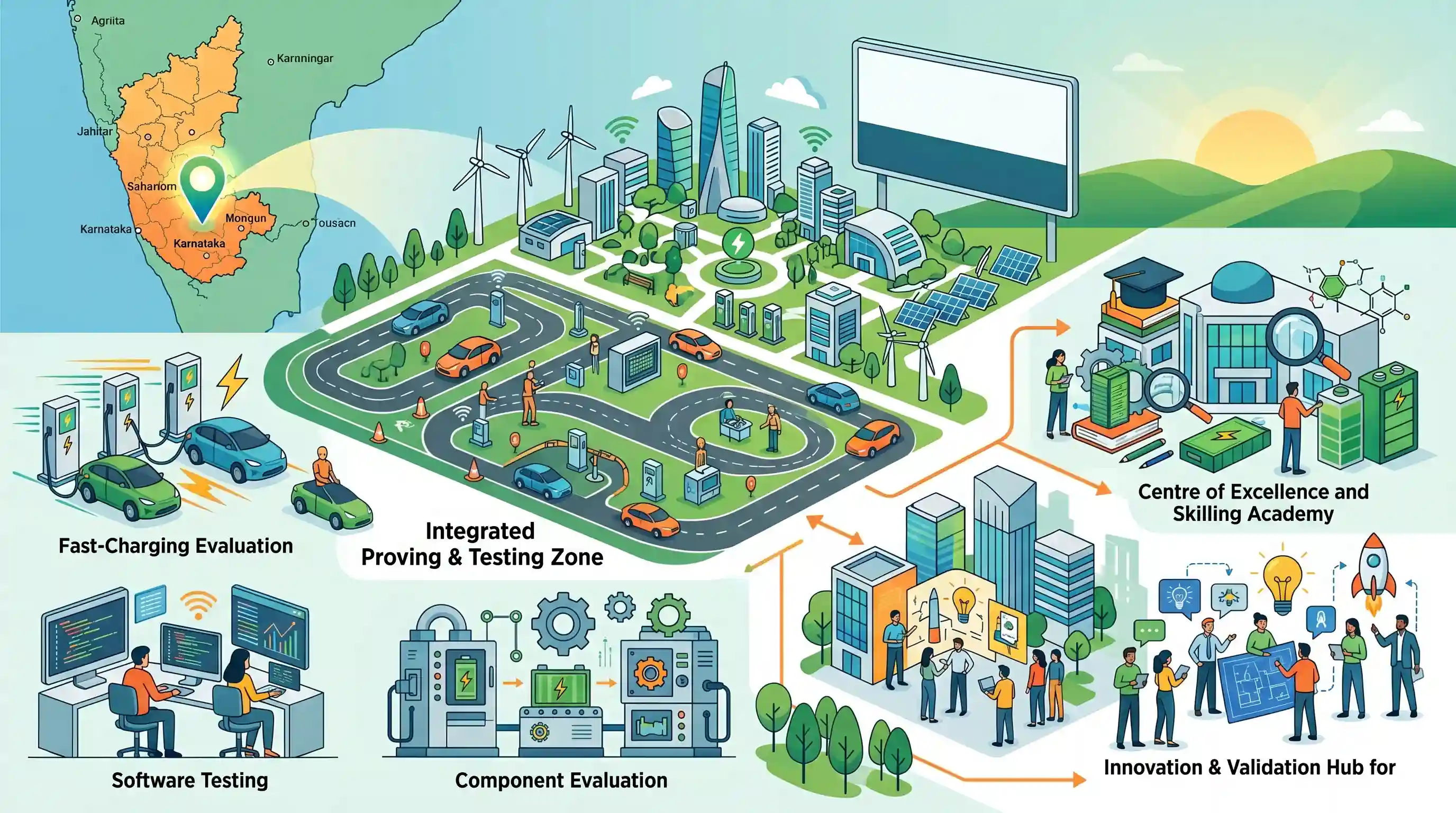
The Karnataka government has announced plans to establish an advanced EV City spanning 100 acres near Bengaluru. Designed as an innovation and validation hub for OEMs, MSMEs, and startups, the hub will feature a 50-acre integrated proving and testing zone for EV software, fast-charging, and component evaluation. Furthermore, the development will host a Centre of Excellence and a skilling academy for battery technologies. This initiative aims to consolidate Karnataka's leading position in India's electric mobility transition.
Key Points
- Karnataka plans to develop a 100-acre EV City within a two-hour drive from Bengaluru to establish an innovation and validation hub for electric vehicles.
- The facility will feature a 50-acre integrated proving and testing zone for outdoor test tracks, EV software, fast-charging test beds, and component benchmarking.
- A Centre of Excellence for EVs and battery technologies, alongside a skilling academy, is proposed to develop specialized talent for the industry.
- Karnataka leads the nation with the highest concentration of EV startups, OEM presence, and over 5,400 public charging stations.
Important Terms
Karnataka Electric Vehicle and Energy Storage Policy

The state framework (current 2023–28) targeting ₹50,000 crore investment and 1 lakh jobs to establish Karnataka as a premier hub for electric mobility and energy storage manufacturing.
UPSC context
GS Paper 3 (Industrial Policy/Energy); tests knowledge of state-level initiatives for the net-zero transition and competitive federalism.
Ather Energy
A prominent Bengaluru-based EV startup (est. 2013) that develops indigenous high-performance electric scooters and an extensive fast-charging network (Ather Grid), representing Indian R&D in clean mobility.
UPSC context
GS Paper 3 (Economic Development/S&T); illustrates 'Make in India' and startup-led innovation in green technology.
Sun Mobility
A technology provider pioneering the 'Battery-as-a-Service' (BaaS) model through an interoperable battery-swapping ecosystem, specifically targeting commercial and heavy electric vehicle fleets to reduce upfront costs.
UPSC context
GS Paper 3 (Infrastructure); relevant to NITI Aayog's Draft Battery Swapping Policy and sustainable logistics solutions.
Yulu
A shared micro-mobility platform using small-format electric two-wheelers to provide affordable, eco-friendly last-mile connectivity in congested urban environments.
UPSC context
GS Paper 1 (Urbanization) & GS Paper 3 (Environment); relates to Smart Cities Mission and sustainable urban transport strategies.
Battery-as-a-Service (BaaS)
An innovative business model where batteries are leased separately from the electric vehicle, lowering initial acquisition costs and utilizing swapping stations for rapid energy replenishment.
UPSC context
GS Paper 3 (Infrastructure/Economy); focuses on financial feasibility and infrastructure models to accelerate EV adoption.
Centre of Excellence for EVs
A specialized R&D and training facility proposed within Karnataka's EV City to advance battery technology, EV software validation, and workforce skilling for the automotive industry.
UPSC context
GS Paper 3 (Science & Tech); vital for discussing Skill India and indigenous research capacity in high-tech manufacturing.
Prelims Trap
"PM E-DRIVE directly mandates and funds the establishment of integrated EV Cities across Indian states."
PM E-DRIVE under the Ministry of Heavy Industries funds vehicle subsidies and charging stations, whereas "EV Cities" are state-led industrial cluster initiatives driven by competitive federalism.
Static Concepts Connected
What is India's institutional framework for automotive testing and certification?
- NATRiP Project: National Automotive Testing and R&D Infrastructure Project (NATRiP) aims to create global-standard testing infrastructure under the Ministry of Heavy Industries.
- Key Facilities: Includes ARAI (Pune), ICAT (Manesar), and NATRAX (Indore), handling homologation, crash testing, and emissions certification.
- Decentralization Need: Startups and MSMEs currently face high costs testing at centralized hubs; decentralized state centers (like Karnataka's EV City) aim to solve this bottleneck.
What are the core pillars of the PM E-DRIVE Scheme (2024-2026)?
- Budget & Subsidies: ₹10,900 crore outlay supporting electric two-wheelers, three-wheelers, e-ambulances, e-trucks, and e-buses. E-cars are notably excluded from subsidies.
- Charging Infra: Allocates ₹2,000 crore exclusively to install 72,000 public EV charging stations across high-penetration cities and highways.
- Testing Upgrade: Promotes modernizing testing agencies under MHI to handle new-age EV technologies and battery certification standards.
Cross-Topic Patterns
EV Clusters & Competitive Federalism
States launching independent "Clean Mobility Policies" to attract OEMs exemplifies competitive federalism driving India’s UNFCCC net-zero 2070 targets through localized industrial hubs.
Domestic Validation & Import Substitution
Creating indigenous testing tracks for EV software and battery components reduces reliance on foreign certification, aligning directly with Atmanirbhar Bharat and tech-sovereignty goals.

Expect a 2026 Prelims question comparing PM E-DRIVE with FAME-II, emphasizing the exclusion of e-cars and state-level EV infra targets.
Linked PYQs · 3
Linked PYQs · 3
- 2023MainsGS3
The adoption of electric vehicles is rapidly growing worldwide. How do electric vehicles contribute to reducing carbon emissions and what are the key benefits they offer compared to traditional combustion engine vehicles?
- 2025PrelimsGS1
In the context of electric vehicle batteries, consider the following elements : I. Cobalt II. Graphite III. Lithium IV. Nickel How many of the above usually make up battery cathodes?
- 2025PrelimsGS1
Consider the following types of vehicles : I. Full battery electric vehicles II. Hydrogen fuel cell vehicles III. Fuel cell-electric hybrid vehicles How many of the above are considered as alternative powertrain vehicles?
