Revision of minimum wage thresholds and industrial impact in Karnataka
Source:The Hindu ↗
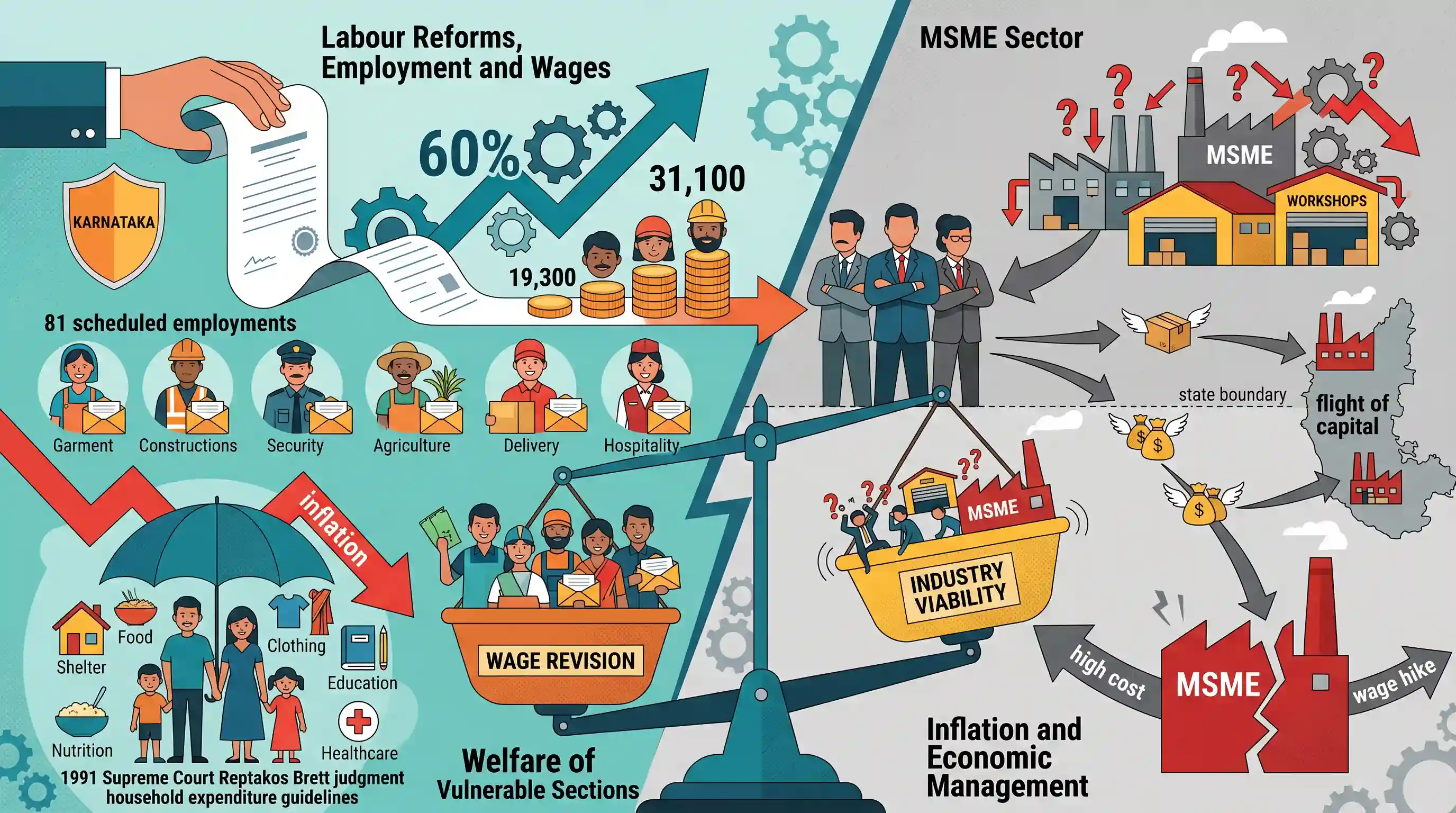
Why It Matters
The article underscores the perennial policy dilemma between securing living wages/social security for the workforce and maintaining the economic viability of industries (like MSMEs). This is a central theme in UPSC syllabus areas covering labour codes, structural unemployment, and equitable economic growth.
Summary
The Karnataka government has notified the final draft of revised minimum wages across 81 scheduled employments, increasing wages by an average of 60%. The newly structured wages range from ₹19,300 to ₹31,100, categorized into three distinct geographical zones. Based on the household expenditure guidelines from the 1991 Supreme Court judgment in the Reptakos Brett case, the move offers crucial financial relief to workers facing high inflation. However, the revision has met resistance from industries, especially the MSME sector, which fears that the steep wage hike might lead to a flight of capital from the state.
Key Points
- Karnataka has notified the final draft of minimum wages for 81 scheduled employments, marking the first revision since 2016-2017.
- Wages have been increased by an average of 60%, ranging from ₹19,300 for unskilled workers in Zone 3 to ₹31,100 for highly skilled workers in Zone 1.
- The revision includes a variable dearness allowance of ₹1,030 for two years and aims to provide relief to workers hit by inflation and standard deductions like ESI and PF.
- Wage calculations were based on household expenditure guidelines established by the Supreme Court in the 1991 Reptakos Brett case.
- While trade unions welcomed the move, businesses, particularly MSMEs, opposed it due to fears of capital flight and inability to afford the new wages.
- Karnataka follows Uttar Pradesh and Haryana in revising minimum wages in recent months.
Important Terms
Reptakos Brett case guidelines (1991)

Guidelines established by the Supreme Court adding a sixth component—covering education, medical needs, and recreation (25% of total wage)—to the five standard minimum wage norms.
UPSC context
GS Paper II & III: Important for labor reforms, judicial activism, and ensuring a 'living wage' beyond bare subsistence.
Minimum Wages Act, 1948
A landmark 1948 law empowering Central and State governments to set and revise minimum wage rates for specific occupations to prevent labor exploitation.
UPSC context
GS Paper II: Tests knowledge of statutory protections for unorganized labor and federal jurisdiction over labor laws.
Scheduled Employment
Specific occupations listed in the Minimum Wages Act for which the government is legally mandated to fix and periodically revise minimum wage rates.
UPSC context
GS Paper III: Relevant for understanding the scope of labor laws and government intervention in the informal economy.
MSME Sector
Enterprises classified by investment and turnover; they are major employers in India but often sensitive to steep operational cost increases like wage hikes.
UPSC context
GS Paper III: Crucial for topics on industrial growth, employment generation, and challenges to Ease of Doing Business.
Employees’ State Insurance (ESI)
A self-financing social security and health insurance scheme for Indian workers, providing medical, maternity, disability, and death benefits.
UPSC context
GS Paper II: Pertains to social security mechanisms and welfare schemes for the vulnerable sections of the workforce.
Employees’ Provident Fund (EPF)
A mandatory retirement savings scheme where both employees and employers contribute a portion of the salary to ensure financial security post-retirement.
UPSC context
GS Paper III: Key to discussions on formalization of the economy and social safety nets for the organized sector.
Code on Wages, 2019
One of four new labor codes that consolidates and replaces previous laws like the Minimum Wages Act to universalize wage protections for all employees.
UPSC context
GS Paper II & III: Essential for current affairs regarding labor law consolidation and the shift toward a national floor wage.
Prelims Trap
"Minimum wage fixation falls exclusively under the State List, preventing the Centre from intervening."
Labour falls under the Concurrent List (Entry 24), not the State List. Both Centre and States can legislate, and the Centre can enforce a National Floor Wage.
Static Concepts Connected
What are the core components of minimum wage calculation in India?
- 15th ILC Criteria: Requires calculation based on 3 consumption units per earner, 2700 calories per adult, and 72 yards of clothing per family.
- Reptakos Brett (1991): Mandated an additional 25% margin for children's education, medical requirements, recreation, and old age contingencies.
- Variable Dearness Allowance: A periodic adjustment linked to the Consumer Price Index (CPI) to shield real wages from inflationary pressures.
How does the Code on Wages (2019) alter minimum wage administration?
- Universalisation: Extends minimum wage and timely payment provisions to all employees across both organized and unorganized sectors.
- National Floor Wage: Empowers the Central Government to fix a statutory floor wage; state-fixed minimum wages cannot legally fall below this level.
Cross-Topic Patterns
Wage hikes vs MSME competitiveness
Steep minimum wage hikes address social justice but create a trilemma by raising operational costs, potentially causing capital flight to states with lower wage floors.
Concurrent List & Wage Disparity
Because Labour is in the Concurrent List, states independently fix minimum wages. This structural federalism feature creates regional disparities, undermining a truly unified national labor market.

Expect a 2026 prelims statement testing if the 'National Floor Wage' under the Code on Wages is legally binding on all states (it is).
Linked PYQs · 3
Linked PYQs · 3
- 2024MainsGS3
Discuss the merits and demerits of the four 'Labour Codes' in the context of labour market reforms in India. What has been the progress so far in this regard?
- 2023MainsGS3
Faster economic growth requires increased share of the manufacturing sector in GDP, particularly of MSMEs. Comment on the present policies of the Government in this regard.
- 2022MainsGS2
Besides the welfare schemes, India needs deft management of inflation and unemployment to serve the poor and the underprivileged sections of the society. Discuss.
