Karnataka Forms Panel to Review Illegal Mining Cases
Source:Indian Express ↗
Why It Matters
Illegal mining is a persistent issue in India, leading to massive environmental degradation and substantial revenue loss for state governments. Understanding the administrative mechanisms (like SITs and cabinet sub-committees) to curb such practices is crucial for the UPSC syllabus covering governance (GS2) and economic/environmental impacts of resource extraction (GS3).
Summary
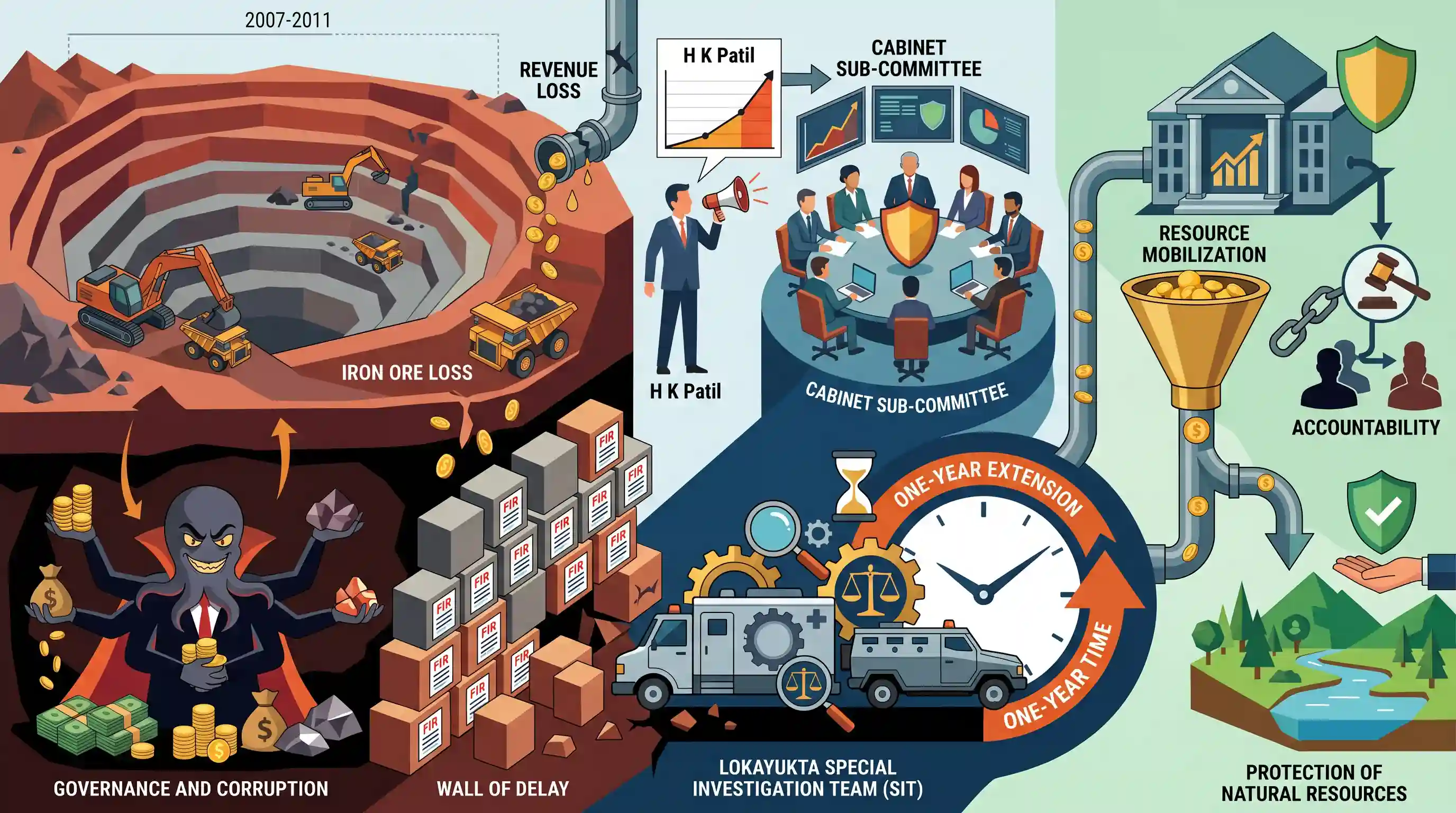
The Karnataka government has formed a cabinet sub-committee, led by Law and Parliamentary Affairs Minister H K Patil, to monitor the probe into illegal mining cases that occurred between 2007 and 2011. This decision stems from Patil's complaint highlighting severe delays and low completion rates in investigating 165 FIRs, which resulted in massive revenue losses for the state. Additionally, the cabinet has extended the tenure of the Lokayukta Special Investigation Team (SIT) handling these cases by one year to ensure accountability and protect the state's natural resources.
Key Points
- The Karnataka government has constituted a cabinet sub-committee headed by Law and Parliamentary Affairs Minister H K Patil to oversee investigations into illegal mining cases from 2007 to 2011.
- Patil highlighted a 'systematic loot' where, despite FIRs being registered in 165 cases, investigations were completed in only a fraction of them (7.6%).
- The illegal mining during this period led to significant losses to the state exchequer, running into thousands of crores.
- To ensure comprehensive probes, the state cabinet also approved a one-year extension for the Lokayukta SIT tasked with investigating these mining cases.
Important Terms
Lokayukta

Statutory state-level anti-corruption ombudsman that investigates allegations of corruption, maladministration, or abuse of power against public officials, including ministers and bureaucrats.
UPSC context
GS II: Statutory Bodies/Accountability. Tests understanding of anti-corruption frameworks and the institutional independence of state ombudsmen.
Special Investigation Team (SIT)
A dedicated task force of specialized officers formed to conduct time-bound investigations into complex or sensitive criminal cases, often reporting to courts or ombudsmen.
UPSC context
GS II: Governance/Investigating Agencies. Tests knowledge of specialized law enforcement mechanisms and their role in handling high-profile corruption scams.
Illegal Mining
Extraction of minerals without legal permits, outside sanctioned areas, or in violation of the Mines and Minerals (Development and Regulation) Act and environmental norms.
UPSC context
GS III: Environment/Internal Security. Relates to resource management, environmental degradation, and the socio-economic impacts of unregulated mineral extraction.
Cabinet Sub-committee
A specialized group of ministers tasked with examining specific policy issues, coordinating inter-departmental efforts, or overseeing sensitive administrative probes before final Cabinet approval.
UPSC context
GS II: Executive/Governance. Tests understanding of cabinet functionality, division of labor, and the process of executive decision-making.
Resource Mobilization
The government's process of generating and managing revenue from national assets, such as mining royalties and taxes, to fund public expenditure and development.
UPSC context
GS III: Indian Economy/Fiscal Policy. Focuses on revenue leakages, fiscal discipline, and efficient management of natural resources.
Justice Santosh Hegde Report
A pivotal 2011 investigative document that exposed a massive mining-political nexus in Karnataka, leading to chief ministerial resignations and major Supreme Court intervention.
UPSC context
GS IV: Ethics/Accountability. Used as a case study for administrative ethics, whistleblowing, and the role of oversight in resource governance.
Prelims Trap
"The Central Government holds exclusive power to make rules to prevent illegal mining under the MMDR Act."
While the Centre regulates the development of major minerals, Section 23C of the MMDR Act explicitly empowers State Governments to frame rules to prevent illegal mining, transportation, and storage.
Static Concepts Connected
How is mineral regulatory authority divided between the Centre and States?
- Major Minerals: The Centre regulates development and frames broad rules; States grant leases and collect royalties.
- Minor Minerals: States have complete authority to regulate, grant leases, and frame rules.
- Illegal Mining: State governments are exclusively empowered to frame rules to curb illegal mining for both major and minor minerals.
What is the constitutional basis and function of Cabinet Committees?
- Constitutional Status: They are extra-constitutional but derive authority from the Transaction of Business Rules under Article 77(3) (Centre) and 166(3) (States).
- Core Function: They reduce the Cabinet's massive workload by allowing detailed, in-depth examination of complex policy issues before final approval.
- Types: They can be Standing (permanent in nature) or Ad-hoc (temporary, constituted for specific issues like this mining probe).
Cross-Topic Patterns
Illegal Mining vs. DMF Evasion
Illegal mining directly bypasses statutory contributions to the District Mineral Foundation (DMF), depriving tribal and mining-affected communities of crucial welfare funds mandated under the PMKKKY.
Lokayukta SITs and Federal Limits
State-level probes (like Lokayukta SITs) investigating massive mining nexuses often face cross-border or federal limitations, historically leading to Supreme Court-monitored CBI investigations (e.g., the Bellary mining scam).

Expect a multi-statement prelims question on the MMDR Act focusing on State vs. Centre jurisdiction over illegal mining and the DMF.
Linked PYQs · 4
Linked PYQs · 4
- 2025MainsGS3
Mineral resources are fundamental to the country's economy and these are exploited by mining. Why is mining considered an environmental hazard? Explain the remedial measures required to reduce the environmental hazard due to mining.
- 2019MainsGS3
Coastal sand mining, whether legal or illegal, poses one of the biggest threats to our environment. Analyze the impact of sand mining along the Indian coasts, citing specific examples.
- 2019PrelimsGS1
With reference to the management of minor minerals in India, consider the following statements: 1. Sand is a 'minor mineral' according to the prevailing law in the country. 2. State Governments have the power to grant mining leases of minor minerals, but the powers regarding the formation of rules related to the grant of minor minerals lie with the Central Government. 3. State Governments have the power to frame rules to prevent illegal mining of minor minerals. Which of the statements given above is/are correct?
- 2025PrelimsGS1
Consider the following statements : Statement I: In India, State Governments have no power for making rules for grant of concessions in respect of extraction of minor minerals even though such minerals are located in their territories. Statement II: In India, the Central Government has the power to notify minor minerals under the relevant law. Which one of the following is correct in respect of the above statements?
