Karnataka Commits to Hold Local Body Elections by December
Source:Indian Express ↗
ఇది ఎందుకు ముఖ్యం
It serves as a real-world case study for GS2 answers on the reluctance or operational difficulties of state governments in empowering local bodies, and how judicial activism ensures compliance with the 73rd and 74th Constitutional Amendments.
సారాంశం
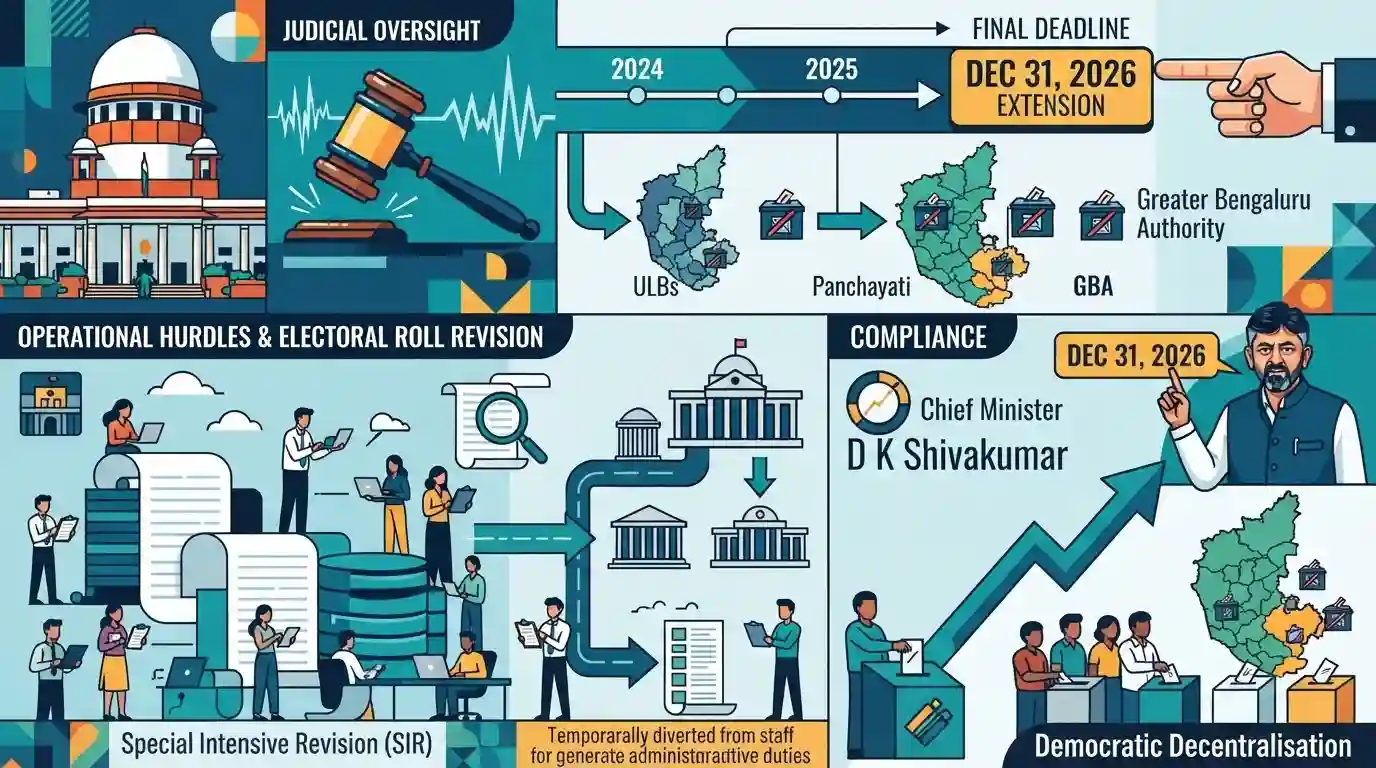
The Supreme Court of India has granted the Karnataka government an extension until December 31, 2026, to conduct elections for Urban Local Bodies (ULBs) and Panchayati Raj Institutions, including the Greater Bengaluru Authority (GBA). The state government sought the delay citing the logistical challenges of conducting the Special Intensive Revision (SIR) of electoral rolls, which temporarily engaged thousands of local administrative staff. Chief Minister D K Shivakumar assured compliance with the new judicial deadline. This development underscores the operational hurdles states face in conducting timely local elections and the crucial role of judicial oversight in enforcing democratic decentralisation.
ముఖ్య అంశాలు
- The Supreme Court of India directed the Karnataka government to complete elections for all Urban Local Bodies (ULBs) and rural panchayats by December 31, 2026.
- The local polls will cover the Greater Bengaluru Authority (GBA), five municipal corporations, zilla panchayats, taluk panchayats, and municipalities.
- Karnataka requested an extension from the original August 31 deadline due to the ongoing Special Intensive Revision (SIR) of electoral rolls, which required the deployment of thousands of local administrative staff.
- The judicial intervention highlights the constitutional mandate to ensure timely elections and empower local self-government institutions as envisioned under the 73rd and 74th Amendments.
ముఖ్యమైన పదాలు
73rd Constitutional Amendment Act

A 1992 constitutional amendment that established a three-tier Panchayati Raj system in India, granting constitutional status and legislative powers to rural local bodies.
UPSC context
GS Paper II: Indian Constitution, Local Self-Government; crucial for understanding rural democratic decentralization.
74th Constitutional Amendment Act
A 1992 constitutional amendment that institutionalized urban local bodies (municipalities) as the third tier of urban governance, specifying their administrative powers and financial devolution.
UPSC context
GS Paper II: Urban Local Bodies, Governance; essential for analyzing metropolitan planning and administrative issues.
Greater Bengaluru Authority
An apex metropolitan coordinating and planning authority created under the Greater Bengaluru Governance Act, 2024, to manage multiple newly-demarcated city corporations in Bengaluru.
UPSC context
GS Paper II: Urban Governance, federal structure; tests knowledge of local administration restructuring.
Democratic Decentralisation
The constitutional process of transferring political, financial, and administrative power from central and state governments to locally elected bodies to ensure grassroots public participation.
UPSC context
GS Paper II: Devolution of Powers, Local Self-Government; highly relevant for mains essays on grassroots democracy.
State Election Commission
An autonomous constitutional body (established under Articles 243K & 243ZA) responsible for the superintendence, direction, and conduct of elections to rural and urban local bodies.
UPSC context
GS Paper II: Constitutional Bodies, Electoral Reforms; tests knowledge of local-body election machinery and disputes.
ప్రిలిమ్స్ ఉచ్చు
The Election Commission of India conducts the Special Intensive Revision of electoral rolls for local body polls.
Constitutionally, State Election Commissions (SECs) hold exclusive authority to prepare electoral rolls and conduct local polls (Art 243K/243ZA), not the ECI.
అనుసంధానమైన స్థిర భావనలు
What is the constitutional mandate regarding the tenure and dissolution of local bodies?
- 5-year tenure: Articles 243E (Panchayats) and 243U (Municipalities) mandate a fixed term of five years for every local body.
- 6-month rule: Fresh elections must be completed before the expiry of duration, or within 6 months of dissolution (unless remainder term is <6 months).
- No delays allowed: The Supreme Court has ruled this mandate is absolute and cannot be delayed on pretexts like delimitation or ward revision.
How is the constitutional independence of State Election Commissions safeguarded?
- Gubernatorial appointment: The State Election Commissioner is appointed by the Governor under Article 243K (Panchayats) and 243ZA (Municipalities).
- Removal process: They can only be removed in the same manner and on the same grounds as a Judge of a High Court (by the President, not Governor).
- Service conditions: Their conditions of service cannot be altered to their disadvantage after their appointment.
అంతర-అంశ నమూనాలు
Local Poll Delays & Delimitation Pretexts
States frequently use delimitation exercises, ward reservation revisions, or OBC quota data gathering as pretexts to stall local elections, prompting regular Supreme Court interventions under Article 142.
Simultaneous Polls and SEC Integration
The push for 'One Nation, One Election' proposes a common electoral roll for all three tiers, which would require constitutional amendments to unify ECI and SEC machineries.

Expect a comparative statement question in Prelims contrasting the removal processes and electoral roll mandates of the ECI versus the SEC.
అనుసంధాన PYQలు · 3
అనుసంధాన PYQలు · 3
- 2024MainsGS2
Analyse the role of local bodies in providing good governance at local level and bring out the pros and cons merging the rural local bodies with the urban local bodies.
- 2023MainsGS2
“The states in India seem reluctant to empower urban local bodies both functionally as well as financially.” Comment.
- 2017PrelimsGS1
Local self-government can be best explained as an exercise in
