Karnataka police suspension over unimplemented hate speech bill notice
Source:Indian Express ↗
Why It Matters
This event perfectly illustrates the constitutional process of legislation (a Bill cannot be enforced until it receives gubernatorial assent) and serves as a case study for evaluating police administrative actions. Furthermore, the proposed hate speech bill directly ties into the UPSC Mains theme of balancing Article 19(1)(a) freedom of expression with Article 19(2) reasonable restrictions.
Summary
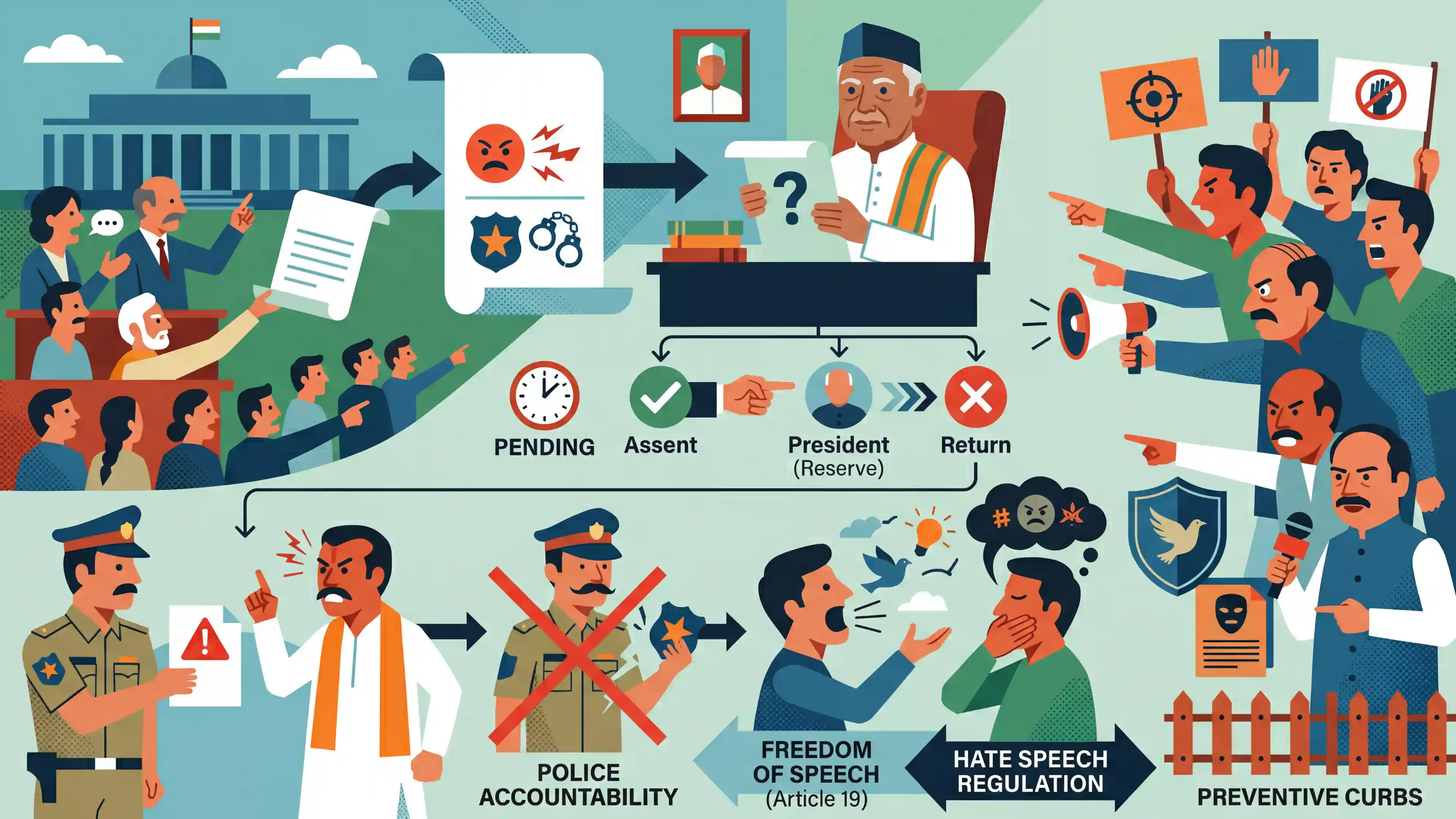
A Karnataka police inspector was suspended for erroneously issuing a notice to a right-wing activist under the Karnataka Hate Speech and Hate Crimes (Prevention and Control) Bill, 2025. The Bill, which makes hate speech a cognizable and non-bailable offence, was passed by the state legislature but remains pending for Governor Thaawarchand Gehlot's assent. The BJP raised the issue in the assembly, accusing the state government of targeting Hindu activists. In response, the Home Minister justified preventive curbs on certain individuals with criminal antecedents to maintain public order. The event brings to the forefront the constitutional mechanisms of lawmaking (Article 200), the ongoing debate over regulating hate speech versus protecting freedom of expression (Article 19), and issues of police accountability.
Key Points
- A Karnataka police inspector was suspended for issuing a notice under the Karnataka Hate Speech and Hate Crimes (Prevention and Control) Bill, 2025, which has not yet become law.
- The Bill was passed by the State Legislature in December 2025 but is still pending the assent of Governor Thaawarchand Gehlot under Article 200 of the Constitution.
- The proposed legislation aims to make hate speech a cognizable and non-bailable offence, with imprisonment ranging from one to seven years depending on repeat offenses.
- The incident sparked political debate, with the BJP alleging targeted harassment of right-wing activists, while the State Home Minister defended preventive restrictions on specific individuals citing prior criminal records and public order concerns.
- The situation highlights police accountability and the necessity for law enforcement to be strictly guided by enacted statutes rather than pending bills.
Important Terms
Karnataka Hate Speech and Hate Crimes (Prevention and Control) Bill, 2025

Proposed state legislation aimed at curbing hate speech through strict penalties (up to 10 years), making offences cognizable and non-bailable, and empowering authorities to block digital content.
UPSC context
GS2 (Polity/Governance): Tests knowledge of state-level social legislation, legal definitions of hate speech, and federal legislative overlaps.
Article 200 of the Constitution of India
Constitutional provision outlining the Governor's options upon receiving a Bill passed by the State Legislature: granting assent, withholding assent, returning for reconsideration, or reserving for the President.
UPSC context
GS2 (State Legislature): Critical for understanding the Governor's role, discretionary powers, and recent judicial interpretations on legislative delays.
Article 19 of the Constitution of India
Fundamental Right guaranteeing all citizens freedom of speech and expression, subject to 'reasonable restrictions' under Article 19(2) for interests like public order and state security.
UPSC context
GS2 (Fundamental Rights): Core topic testing the balance between individual liberty and societal restrictions (e.g., hate speech regulation).
Cognizable Offence
A category of offence where police have the authority to arrest a person without a warrant and commence an investigation without prior court permission.
UPSC context
GS2/GS3 (Criminal Justice): Tests understanding of police powers and procedural law (CrPC/BNSS) in the context of serious crimes.
Non-bailable Offence
An offence where bail is not a matter of right for the accused; the court exercises discretion to grant bail based on the case's merits.
UPSC context
GS2 (Polity): Relevant for understanding the severity of legal provisions and judicial discretion in the Indian criminal justice system.
Governor's Assent
The mandatory final step in the law-making process where the Governor signs a Bill passed by the state legislature, thereby transforming it into an enforceable Act.
UPSC context
GS2 (Polity): Concerns the legislative process and the constitutional relationship between the state executive and the legislature.
Prelims Trap
"The Indian Constitution and the Bharatiya Nyaya Sanhita explicitly define 'hate speech' as a cognizable offence."
Hate speech is not explicitly defined in the Constitution or BNS. It is indirectly penalized via provisions targeting the 'promotion of enmity' and Article 19(2).
Static Concepts Connected
What are the Governor's options under Article 200 for a State Bill?
- Assent or Withhold: The Governor can give assent, withhold assent, or return non-Money Bills to the legislature for reconsideration.
- Reserve for President: The Governor may reserve the bill for Presidential consideration. This is mandatory if the bill endangers the state High Court's position.
- No Time Limit: The Constitution specifies no mandatory timeframe for action under Article 200, implicitly allowing the Governor to sit on bills indefinitely.
How does the Constitution regulate Hate Speech under Article 19?
- No Explicit Mention: Hate speech is not explicitly mentioned in the Constitution; it is regulated as an exception to the Freedom of Speech and Expression (Article 19(1)(a)).
- Reasonable Restrictions: The State restricts such speech via Article 19(2) grounds, specifically focusing on "public order," "decency or morality," and "incitement to an offence."
- Statutory Enforcement: Punishments are executed via criminal statutes (like BNS Section 196 for promoting enmity) rather than by the constitutional text directly.
Cross-Topic Patterns
Federal friction over Article 200
The pending assent in Karnataka mirrors recent Supreme Court litigation initiated by Kerala, Tamil Nadu, and Punjab against their Governors for indefinitely withholding assent to passed State Bills.
Concurrent List and Criminal Law
Criminal law is in the Concurrent List. State-specific bills creating new non-bailable offences often necessitate Presidential Assent (Article 201) if they deviate from Central statutes like the BNS.

Article 200 delays + State criminal laws (Concurrent List) + Article 19(2) hate speech limits will likely form a composite 2026 Polity MCQ.
Linked PYQs · 2
Linked PYQs · 2
- 2014MainsGS2
What do you understand by the concept "freedom of speech and expression"? Does it cover hate speech also ? Why do the films in India stand on a slightly different plane from other forms of expression ? Discuss.
- 2025PrelimsGS1
Consider the following statements : I. The Constitution of India explicitly mentions that in certain spheres the Governor of a State acts in his/her own discretion. II. The President of India can, of his/her own, reserve a bill passed by a State Legislature for his/her consideration without it being forwarded by the Governor of the State concerned. Which of the statements given above is/are correct?
