Supreme Court Appeal on Karnataka SC ST Reservation Hike
Source:Indian Express ↗
Why It Matters
The case involves critical constitutional questions about the 50% ceiling limit on reservations, state legislative competence, and the parameters of judicial review over affirmative action policies for marginalized communities.
Summary
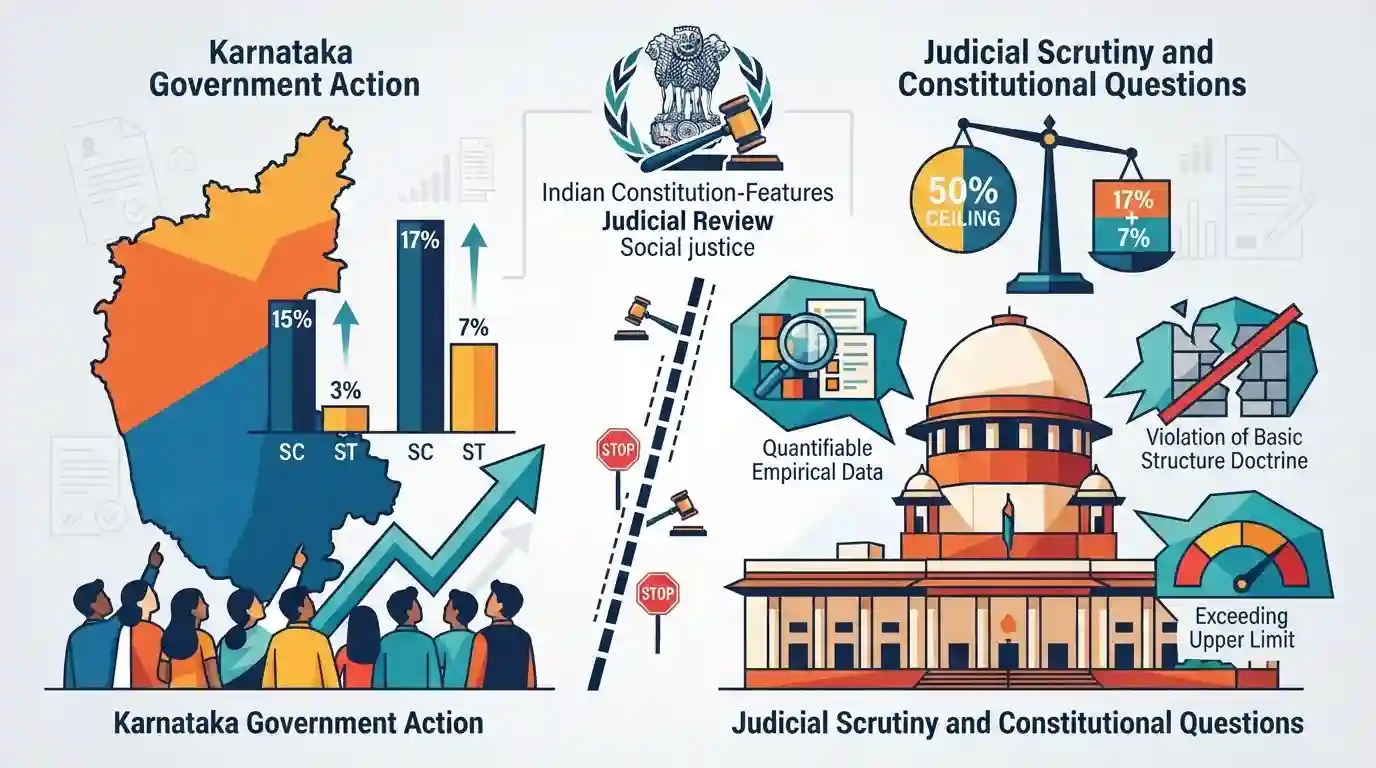
The Karnataka government has decided to appeal in the Supreme Court against judicial scrutiny and legal challenges surrounding its decision to increase reservation quotas for Scheduled Castes and Scheduled Tribes beyond the mandated 50% ceiling limit. The state's hike—raising SC reservation from 15% to 17% and ST reservation from 3% to 7%—faces complex constitutional questions regarding the violation of upper limits, the requirement of quantifiable empirical data, and the doctrine of basic structure.
Key Points
- The Karnataka government decided to approach the Supreme Court challenging a High Court interim order or ruling concerning the hike in SC/ST reservation quotas.
- The state had previously increased reservation quotas for Scheduled Castes (SCs) from 15% to 17% and Scheduled Tribes (STs) from 3% to 7%, pushing total reservations beyond the 50% ceiling limit.
- The legal challenge brings to light constitutional and judicial debates surrounding the 50% reservation cap established in landmark jurisprudence like Indra Sawhney.
- Exceeding the ceiling limit requires robust empirical data and special justification, bringing federal and state legislative competence under judicial scrutiny.
Important Terms
Constitution of India

The supreme law of India, establishing the framework for governance, fundamental rights, directive principles, and the federal distribution of powers between the Union and the States.
UPSC context
UPSC Prelims/Mains (GS Paper II): Fundamental Rights, Constitutional Provisions, Basic Structure Doctrine, and Reservation Policies.
Supreme Court of India
The highest judicial court under the Constitution of India, possessing ultimate appellate jurisdiction and the power of judicial review to interpret constitutional questions.
UPSC context
UPSC Prelims/Mains (GS Paper II): Judiciary, Judicial Review, Judicial Activism, and Constitutional Interpretation.
High Court of Karnataka
The apex state-level court that exercises judicial review over state legislative enactments, executive orders, and administrative actions within Karnataka.
UPSC context
UPSC Prelims/Mains (GS Paper II): Structure, Organization, and Functioning of the Judiciary at the State Level.
Karnataka Government
The executive branch of the state of Karnataka responsible for policy formulation, governance administration, and defending state legislation in constitutional matters.
UPSC context
UPSC Prelims/Mains (GS Paper II): State Executive, Centre-State Relations, and Implementation of Social Welfare Policies.
Prelims Trap
the 50% ceiling limit is an absolute, unalterable statutory limit set directly by the text of the Constitution of India.
Aspirants often assume the 50% reservation cap is an absolute constitutional amendment provision, whereas it was judicially evolved in the Indra Sawhney case with narrow exceptions for extraordinary situations.
Static Concepts Connected
What are the key constitutional provisions and judicial doctrines governing reservation in India?
- Constitutional Basis: Article 15(4) & 16(4) empower the State to make special provisions for the advancement of any socially and educationally backward classes or Scheduled Castes and Scheduled Tribes.
- 50% Cap: Indra Sawhney (1992) set a 50% ceiling limit on reservations and ruled that 'creamy layer' must be excluded from backward classes.
- Efficiency Mandate: Article 335 mandates that claims of SCs and STs shall be taken into consideration consistently with the maintenance of efficiency of administration.
Cross-Topic Patterns
Reservation Caps vs. Ninth Schedule Immunity
When states push quotas beyond the 50% cap, they frequently seek protection under the Ninth Schedule, triggering debates on judicial review versus legislative supremacy.
Federalism and State-Level Affirmative Action
State-level quota enhancements test the federal balance, forcing the Centre and judiciary to evaluate state claims of quantifiable backwardness data.

Expect statement-based questions on the Indra Sawhney exceptions, quantifiable data requirement, and Ninth Schedule judicial review.
Linked PYQs · 3
Linked PYQs · 3
- 2016MainsGS2
What was held in the Coelho case? In this context, can you say that judicial review is of key importance amongst the basic features of the Constitution?
- 2023PrelimsGS1
Consider the following statements: Statement-I: The Supreme Court of India has held in some judgements that the reservation policies made under Article 16(4) of the Constitution of India would be limited by Article 335 for maintenance of efficiency of administration. Statement-II: Article 335 of the Constitution of India defines the term 'efficiency of administration'. Which one of the following is correct in respect of the above statements?
- 2024PrelimsGS1
Consider the following statements : 1. It is the Governor of the State who recognizes and declares any community of that State as a Scheduled Tribe. 2. A community declared as a Scheduled Tribe in a State need not be so in another State. Which of the statements given above is/are correct?
