Karnataka High Court Strikes Down SC ST Reservation Law
Source:The Hindu ↗
Why It Matters
This judgment is significant for understanding the boundaries of affirmative action, the constitutional validity of exceeding reservation quotas, and the scope of judicial review over state-legislated social welfare laws.
Summary
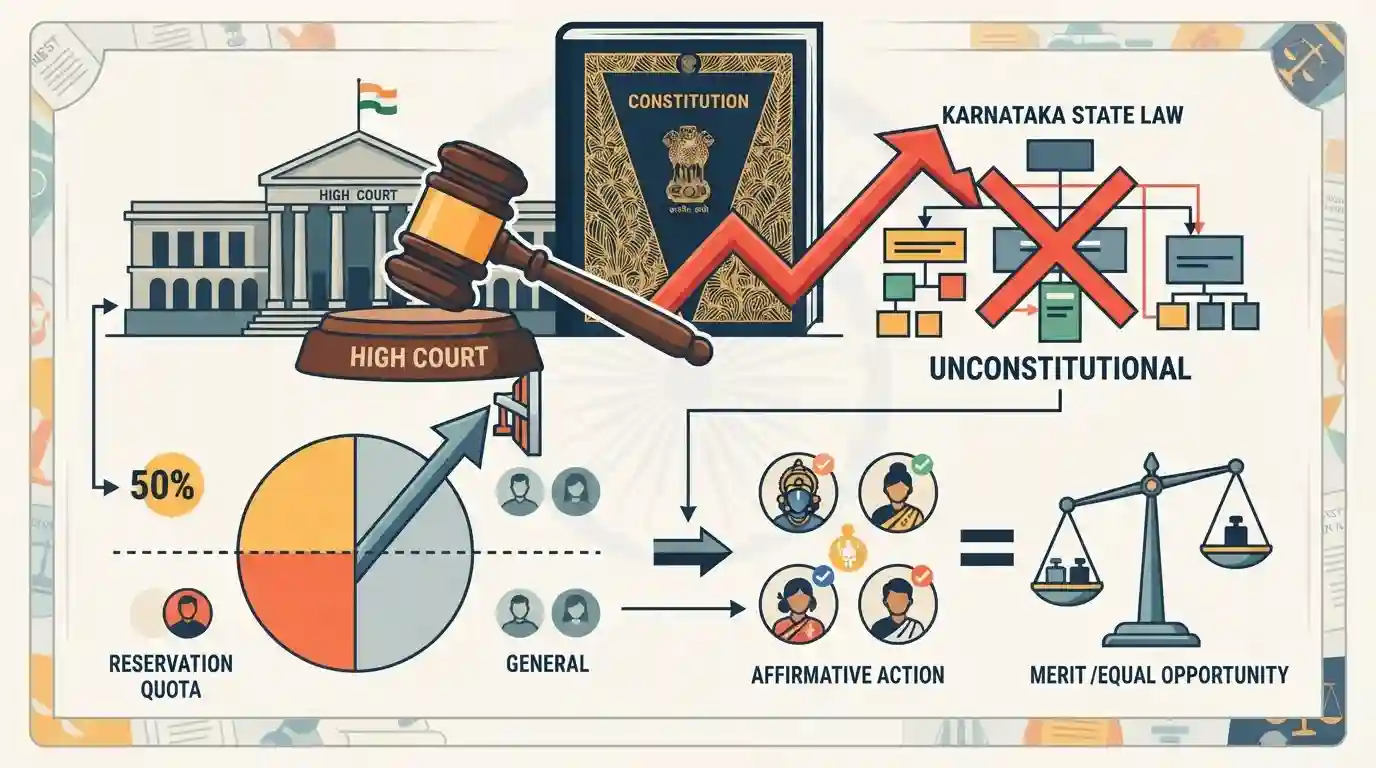
The Karnataka High Court has struck down a state law that sought to increase reservations for Scheduled Castes (SCs) and Scheduled Tribes (STs), declaring it unconstitutional. This ruling touches upon core constitutional debates regarding reservation caps, judicial review, and affirmative action policies in India.
Key Points
- The Karnataka High Court struck down a state law that increased reservations for Scheduled Castes (SCs) and Scheduled Tribes (STs).
- The court declared the legislation unconstitutional, highlighting the violation of constitutional limits and principles regarding reservations.
- The ruling reinforces the legal debate surrounding reservation ceilings and the judicial review of affirmative action laws in India.
Important Terms
Supreme Court of India

The highest constitutional court in India, which established the binding 50% ceiling on reservation quotas in the landmark Indra Sawhney judgment.
UPSC context
Important for GS Paper II under Judiciary, Judicial Review, and constitutional interpretation of fundamental rights.
Karnataka High Court
The constitutional court of Karnataka that struck down the state's 2022 law enhancing SC/ST reservations for breaching the 50% ceiling and violating Articles 14, 15, and 16.
UPSC context
Relevant for GS Paper II under Indian Judiciary, Centre-State legislative powers, and affirmative action policies.
Prelims Trap
The EWS reservation ceiling nullified the 50% cap established under Indra Sawhney for social and educational backward classes.
Aspirants often assume the 103rd Amendment (EWS) raised the general 50% ceiling for SC/ST/OBC reservations. In reality, the 50% cap applies exclusively to social and educational backward classes, while EWS operates on separate economic criteria.
Static Concepts Connected
What were the core rulings of the Supreme Court in the landmark Indra Sawhney case (1992)?
- Ceiling Limit: Established a mandatory 50% ceiling on reservations for backward classes, except in extraordinary circumstances.
- Creamy Layer: Ruled that creamy layer must be excluded from Other Backward Classes (OBC) reservations.
- No Promotion Quota: Held that Article 16(4) does not permit reservation in promotions, though subsequent constitutional amendments modified this.
Cross-Topic Patterns
Reservation Caps vs. Federal Legislative Power
State legislation exceeding the 50% reservation cap frequently collides with the Ninth Schedule protection mechanism and Article 14 equality tests under judicial review.
EWS Quota vs. Social Backwardness Tests
Distinguishes economic criteria (EWS) from social/educational backwardness, reinforcing the distinct classification tests established by constitutional benchmarks.

Expect a statement-based question combining the Indra Sawhney 50% rule, EWS separation, and the adequate vs proportionate representation test.
Linked PYQs · 3
Linked PYQs · 3
- 2025MainsGS2
"Constitutional morality is the fulcrum which acts as an essential check upon the high functionaries and citizens alike...." In view of the above observation of the Supreme Court, explain the concept of constitutional morality and its application to ensure balance between judicial independence and judicial accountability in India.
- 2026PrelimsGS1
Consider the following statements about the provisions pertaining to the Scheduled Castes and the Scheduled Tribes in India : 1. Provisions regarding the administration of the Tribal Areas in the States of Assam, Meghalaya, Tripura and Mizoram are given in the Fifth Schedule of the Constitution of India. 2. Some tribes of India are entitled to exemption from paying Income Tax on certain incomes. 3. The Constitution of India provides for reservation of seats in Panchayats for women belonging to the Scheduled Castes and the Scheduled Tribes. Which one of the following conclusions based on the above statements is correct ?
- 2019PrelimsGS1
Under which Schedule of the Constitution of India can the transfer of tribal land to private parties for mining be declared null and void?
