Karnataka HC Rules Executive Overreach in Nursing Institute Checks
Source:The Hindu ↗
Why It Matters
This ruling serves as a vital case study for UPSC aspirants on the separation of powers between the general executive (ministers and civil administration) and autonomous statutory regulatory bodies. It also provides a practical application of e-governance tools to enhance transparency, accountability, and grievance redressal in the heavily scrutinized education and healthcare sectors.
Summary
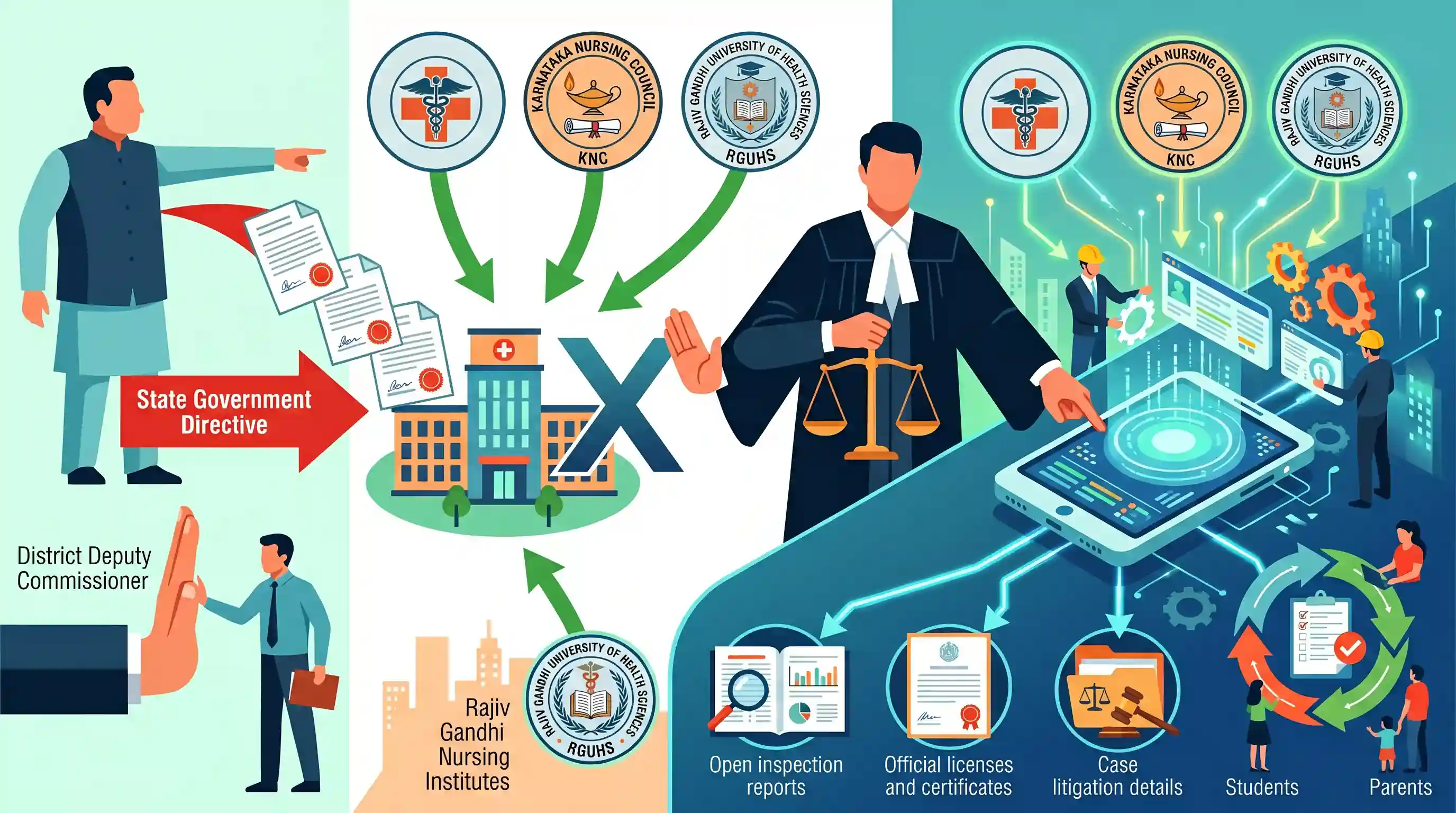
The Karnataka High Court has quashed a state government directive that ordered district Deputy Commissioners to inspect nursing institutes, ruling that such authority belongs exclusively to specialized statutory bodies like the Indian Nursing Council (INC), Karnataka Nursing Council (KNC), and Rajiv Gandhi University of Health Sciences (RGUHS). The directive, initiated by the Medical Education Minister, was deemed an overreach of executive power that bypassed established legal frameworks. To resolve systemic irregularities and enhance accountability, the court mandated these regulatory councils to develop a comprehensive e-governance web portal. This portal will provide public access to institutional inspection reports, licenses, and litigation details, while also serving as an online grievance redressal platform for students and parents.
Key Points
- The Karnataka High Court struck down a state directive allowing district Deputy Commissioners (DCs) to inspect nursing institutes, citing jurisdictional overreach.
- The court reaffirmed that inspections and regulatory compliance checks fall exclusively under the purview of statutory bodies like the INC, KNC, and RGUHS, not the general executive.
- The judgment emphasized that ministers lack the statutory authority to bypass established regulatory frameworks and order district administrative checks on specialized professional institutions.
- To combat irregularities and enhance transparency, the court ordered the creation of a unified web portal to publicly host inspection reports, institute licenses, and litigation histories.
- The portal will also feature an interactive grievance redressal mechanism for students and parents, leveraging e-governance to enforce accountability in higher medical education.
Important Terms
Indian Nursing Council (INC)

A national statutory body established under the Indian Nursing Council Act, 1947, to regulate nursing education and ensure uniform standards of training across India.
UPSC context
GS Paper II: Statutory/regulatory bodies. Tests understanding of apex healthcare regulators and central vs. state regulatory powers.
Indian Nursing Council Act, 1947
The foundational legislation that constitutes the INC and empowers it to recognize nursing qualifications and set minimum standards for nursing curricula nationwide.
UPSC context
GS Paper II: Important aspects of governance; legislative framework for social sector/health.
Rajiv Gandhi University of Health Sciences (RGUHS)
A premier health sciences university in Karnataka, established to regulate and promote higher education, research, and uniform instruction in modern and Indian systems of medicine.
UPSC context
GS Paper II: Issues relating to development/management of Education and Health. Relevant for state-level institutional frameworks.
Karnataka Nurses, Midwives and Health Visitors Act, 1961
The state legislative act that provides for the registration of nurses, midwives, and health visitors in Karnataka and establishes the Karnataka Nursing Council.
UPSC context
GS Paper II: State laws governing professional registration and regulatory decentralization.
Karnataka Nursing Council (KNC)
The state regulatory body responsible for maintaining the register of nursing professionals and supervising nursing practice within the State of Karnataka.
UPSC context
GS Paper II: Regulatory bodies. Illustrates the division of labor between national and state-level sector regulators.
Statutory Body
An organization created by an Act of Parliament or State Legislature, possessing legal authority to oversee specific sectors (e.g., INC, KNC, RGUHS).
UPSC context
GS Paper II: Fundamental concept regarding executive vs. legislative authority and institutional autonomy.
Prelims Trap
"The District Collector has overarching authority to inspect all educational institutions."
Professional medical/nursing institutes are regulated exclusively by specialized statutory bodies (like INC or NMC). The general executive cannot usurp this statutory jurisdiction.
Static Concepts Connected
What is the statutory framework of the Indian Nursing Council (INC)?
- Statutory body: Established under the Indian Nursing Council Act, 1947 to establish uniform standards of training for nurses, midwives, and health visitors.
- Regulatory autonomy: It operates independently to inspect and recognize institutes; its jurisdiction cannot be usurped by general state administrative directives.
How does administrative law define the limits of executive directives?
- Statutory supremacy: Executive orders (e.g., from a Minister) cannot override, amend, or bypass established statutory rules and jurisdictions laid down by the legislature.
- Jurisdictional limits: General administrative officers (like DCs) cannot exercise powers specifically vested in specialized professional councils by law.
Cross-Topic Patterns
E-governance enforcing statutory compliance
Mandating web portals with inspection reports reflects a judicial trend using e-governance to cure systemic irregularities in the social sector, overlapping with GS-2 transparency topics.
Executive vs. Regulatory Autonomy
The ruling parallels recent debates over RBI, ECI, and SEBI autonomy, emphasizing that political executives cannot bypass the statutory authority of specialized regulators.

Questions mapping specific educational/medical regulatory bodies (INC, NMC, AICTE) to their parent statutes are likely in 2026 Prelims.
Linked PYQs · 3
Linked PYQs · 3
- 2015MainsGS2
For achieving the desired objectives, it is necessary to ensure that the regulatory institutions remain independent and autonomous. Discuss in the light of the experiences in recent past.
- 2024MainsGS2
e-governance is not just about the routine application of digital technology in service delivery process. It is as much about multifarious interactions for ensuring transparency and accountability. In this context evaluate the role of the 'Interactive Service Model' of e-governance.
- 2023MainsGS2
e-governance, as a critical tool of governance, has ushered in effectiveness, transparency and accountability in governments. What inadequacies hamper the enhancement of these features ?
