Sacramental Nature of Marriage and Divorce Laws in India
Source:Indian Express ↗
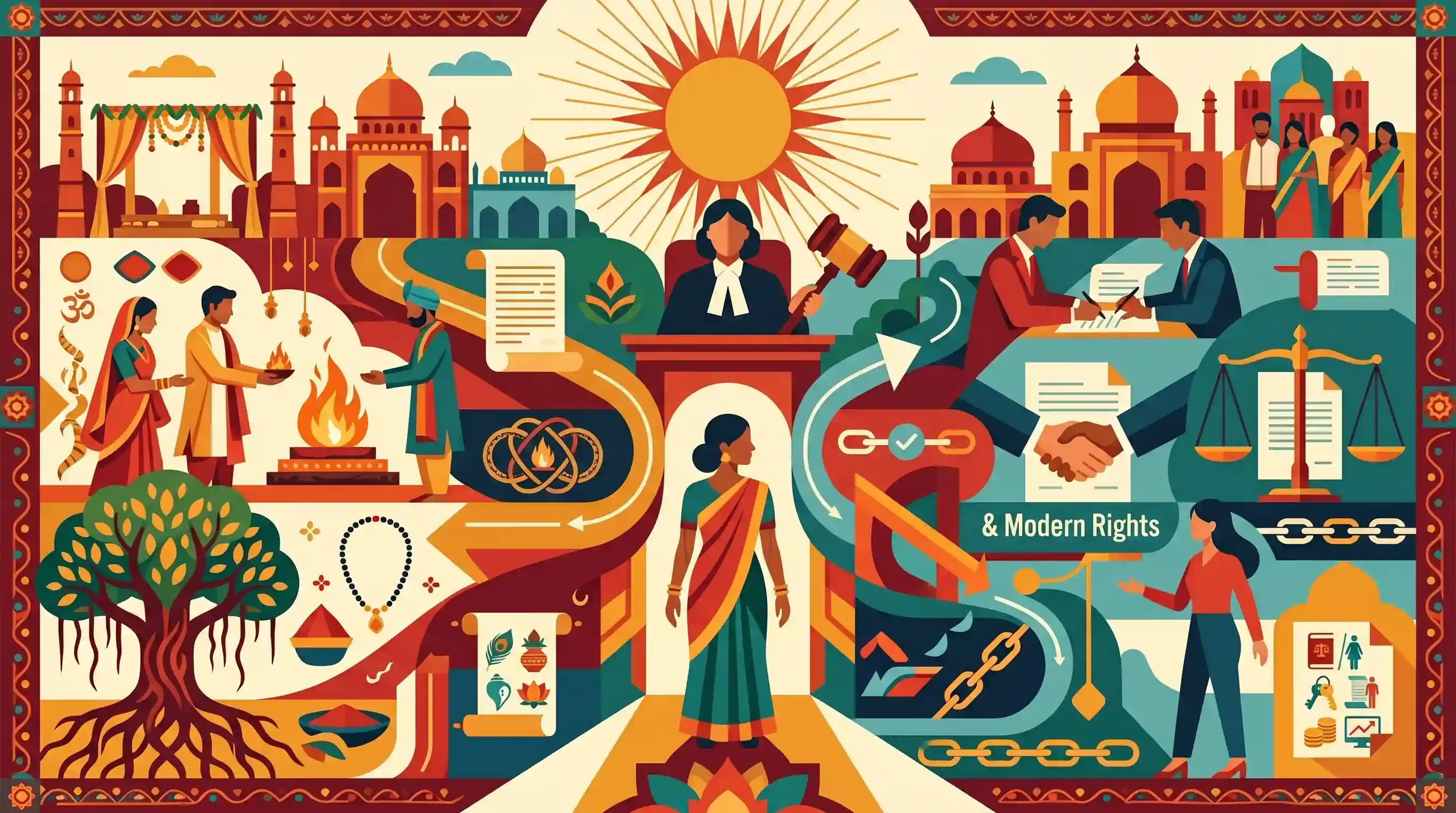
Why It Matters
This judicial pronouncement is directly relevant to the GS1 topic of the 'Institution of Marriage' and societal changes, highlighting the conflict between traditional views of marriage as an indissoluble sacrament and modern notions of individual autonomy and divorce.
Summary
The Karnataka High Court, while hearing a divorce petition, observed that Hindu marriage is a "sacred" and "eternal union" rather than a civil contract. Citing traditional perspectives embedded in the Hindu Marriage Act, the court denied divorce to the petitioning woman. This judgment underscores the ongoing judicial debate regarding marriage as a sacrament versus the modern emphasis on individual rights and the ease of dissolving marriages.
Key Points
- The Karnataka High Court ruled that under Hindu law, marriage is considered a sacred and eternal union rather than a mere civil contract.
- The court denied a divorce petition filed by a woman, invoking the sacramental nature of Hindu marriage.
- The judgment underscores the ongoing tension between traditional religious interpretations of personal laws and contemporary demands for individual liberty and easier divorce mechanisms.
- The ruling touches upon Section 13 of the Hindu Marriage Act, which outlines the grounds for divorce, while emphasizing the traditional indissolubility of the marital bond.
Important Terms
Hindu Marriage Act, 1955

A 1955 law codifying marriage and divorce for Hindus, Buddhists, Jains, and Sikhs, transitioning Hindu marriage from an indissoluble union to a legally dissolvable one under specific grounds.
UPSC context
GS Paper II (Polity/Social Justice). Tests understanding of personal laws, legislative reforms, and the legal framework governing Indian society.
Marriage as a Sacrament
The traditional Hindu view of marriage as a holy, spiritual, and eternal union (Sanskara), rather than a dissolvable legal agreement, emphasizing lifelong commitment and religious duties.
UPSC context
GS Paper I (Indian Society). Tests the evolution of social institutions and the tension between traditional values and modern legal rights.
Civil Contract
A legal agreement between two parties based on mutual consent and exchange of obligations. In personal law, it refers to marriages (like Nikah) that are primarily legal agreements.
UPSC context
GS Paper II (Judiciary). Tests the comparative understanding of different personal laws and judicial interpretations of the nature of marriage.
Section 13 of HMA (Divorce)
A provision in the Hindu Marriage Act listing grounds for divorce, such as adultery, cruelty, and desertion. The Karnataka HC recently clarified that "cruelty" requires substantial evidence.
UPSC context
GS Paper II (Polity). Tests knowledge of specific legal provisions regarding family law and the judiciary's role in interpreting divorce grounds.
Saptapadi
An essential Hindu marriage ritual involving seven steps around a sacred fire. Under Section 7 of the HMA, a marriage is not legally complete or valid without this ceremony.
UPSC context
GS Paper I (Culture/Society). Tests understanding of the intersection between religious rituals and legal validity in Indian personal law.
Purusharthas
The four goals of human life in Hindu philosophy—Dharma (duty), Artha (prosperity), Kama (pleasure), and Moksha (liberation)—which the court noted as the "fourfold purposes" of marriage.
UPSC context
GS Paper I (Indian Society/Ethics). Relevant for understanding the traditional socio-religious values that continue to influence judicial philosophy and societal norms.
Prelims Trap
"Irretrievable breakdown of marriage is a codified ground for divorce under the Hindu Marriage Act."
False. It is not codified in the HMA, 1955. Only the Supreme Court can grant divorce on this ground using extraordinary powers under Article 142.
Static Concepts Connected
How does the Supreme Court's divorce jurisdiction differ from High Courts?
- High Courts: Strictly bound by statutory grounds under personal laws (e.g., fault theory or mutual consent). They cannot bypass the Hindu Marriage Act.
- Supreme Court: Can invoke Article 142 to grant divorce for "irretrievable breakdown" to ensure complete justice, bypassing statutory limitations entirely.
How is marriage conceptualized across different Indian laws?
- Hindu Law: Viewed as a religious sacrament (Samskara) and an eternal union under the Hindu Marriage Act, 1955.
- Muslim Law: Considered a civil contract (Nikah) requiring a proposal (Ijab), acceptance (Qubool), and consideration (Mahr).
- Special Marriage Act: Provides a secular, statutory framework allowing marriage purely as a civil union, regardless of religion.
Cross-Topic Patterns
Personal Laws + Uniform Civil Code
The emphasis on specific religious tenets (sacrament) highlights the fragmented nature of personal laws, driving the GS2 debate on implementing Article 44 (Uniform Civil Code).
Article 142 + Judicial Activism
Because lower courts cannot bypass statutory restrictions, the Supreme Court frequently uses Article 142 to dissolve broken marriages, showcasing judicial intervention where legislation lags.

Expect a GS1/GS2 Mains question analyzing the friction between traditional personal laws (sacrament) and modern fundamental rights (liberty).
Linked PYQs · 2
Linked PYQs · 2
- 2023MainsGS1
Do you think marriage as a sacrament is loosing its value in Modern India?
- 2019PrelimsGS1
Which Article of the Constitution of India safeguards one's right to marry the person of one's choice?
