Karnataka High Court Directives on Drinking Water Maintenance
Source:The Hindu ↗
Why It Matters
It underscores the judiciary's role in enforcing fundamental rights (Article 21) concerning basic amenities like clean drinking water. It highlights systemic governance challenges in local infrastructure maintenance and the critical need for administrative accountability at the panchayat and municipal levels.
Summary
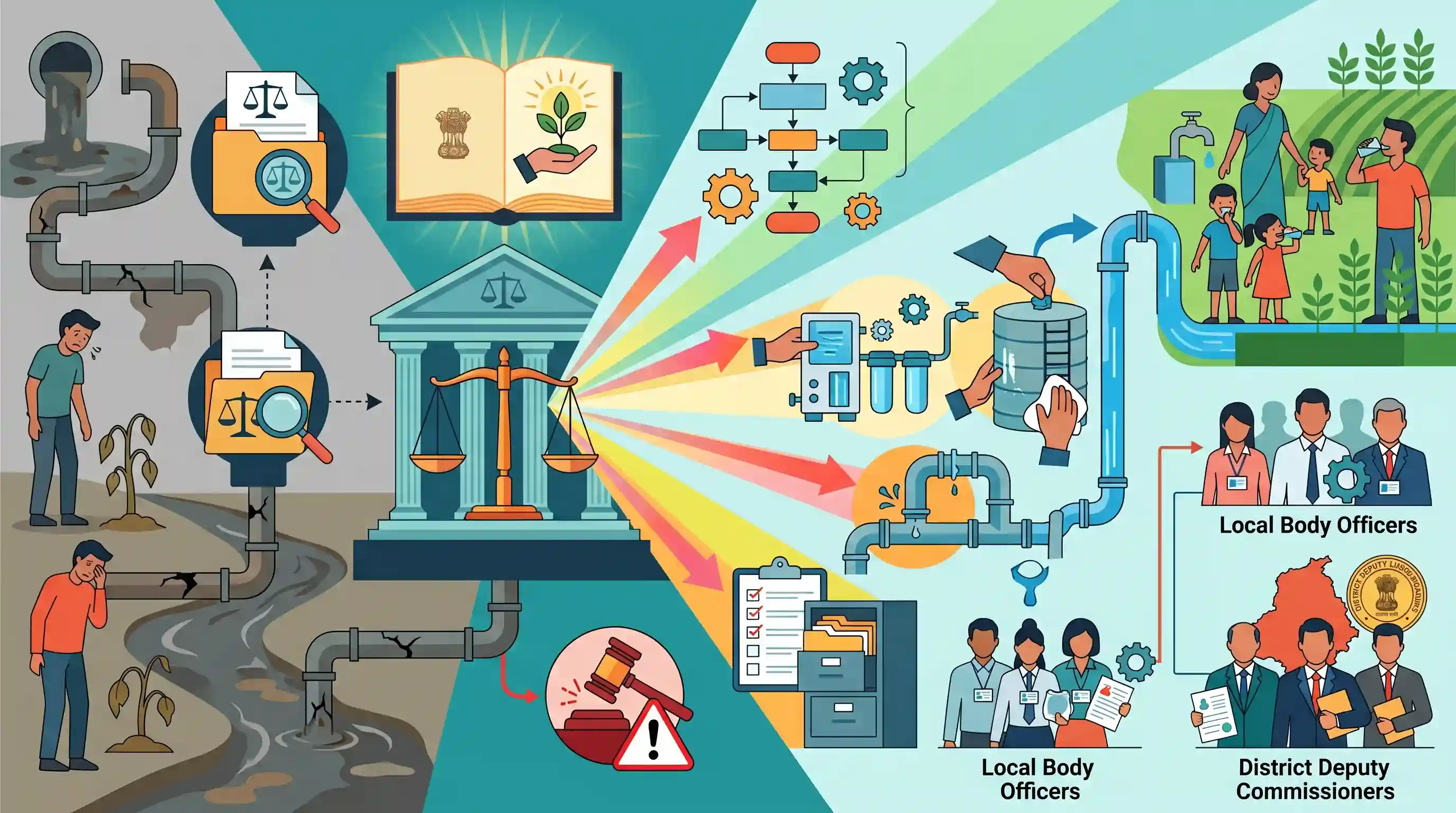
The Karnataka High Court has issued sweeping directions to the State government to ensure the regular and scientific maintenance of drinking water infrastructure, including RO plants, storage tanks, and pipelines. Expanding a Public Interest Litigation (PIL) over contaminated water in Tumakuru district to the entire state, a Division Bench emphasized that providing clean drinking water is a constitutional obligation, and failing to do so infringes on fundamental rights. The court mandated the creation of a standard operating procedure (SOP), systematic record-keeping of maintenance, and the immediate repair of non-functional RO plants. It also stressed accountability by making local body officers and district deputy commissioners responsible, terming any dereliction of duty in maintaining water pipelines a criminal act endangering public health.
Key Points
- The Karnataka High Court directed the State government to maintain drinking water infrastructure properly, expanding a PIL from Tumakuru to the entire state.
- The court ruled that failing to supply clean drinking water violates the State's constitutional obligations, as it is a fundamental duty linked to the right to life.
- Authorities must formulate a comprehensive standard operating procedure (SOP) and maintain systematic records for the upkeep of pipelines, RO plants, and storage tanks.
- The bench characterized the dereliction of duty in maintaining drinking water pipelines as a criminal act endangering public health.
- Panchayat development officers, designated urban local body officers, and deputy commissioners are held accountable for implementing these directives and overseeing maintenance.
Important Terms
Public Interest Litigation (PIL)

A legal mechanism allowing individuals or groups to approach the court on behalf of the public or marginalized sections to enforce fundamental rights.
UPSC context
GS Paper-II (Judiciary); fundamental to understanding access to justice and legal aid mechanisms in India.
Article 21
A fundamental right guaranteeing that no person shall be deprived of their life or personal liberty, judicially expanded to include clean drinking water.
UPSC context
GS Paper-II (Fundamental Rights); tests the evolution of judicial interpretation regarding socio-economic rights and environment.
Judicial Activism
The proactive role of the judiciary in interpreting the law to protect citizens' rights and ensure the executive fulfills its constitutional obligations.
UPSC context
GS Paper-II (Separation of Powers); crucial for analyzing the balance between the judiciary and executive branches.
Accountability
The obligation of public officials to be answerable for their performance and decisions, particularly in ensuring the delivery of essential services like water.
UPSC context
GS Paper-II/IV (Governance/Ethics); central to topics on administrative ethics and quality of service delivery.
Standard Operating Procedure (SOP)
A detailed set of instructions designed to ensure routine administrative tasks are performed consistently, scientifically, and according to established norms.
UPSC context
GS Paper-II (Governance); reflects tools for improving transparency and systematic management in public administration.
District Deputy Commissioner (DC)
The administrative head of a district responsible for law, order, and overseeing the implementation of state policies and judicial directives.
UPSC context
GS Paper-II (Local Governance/Administration); relates to the executive's role in district-level monitoring and crisis management.
Prelims Trap
The Right to Safe Drinking Water is explicitly mentioned as a fundamental right in Part III of the Constitution.
The Right to Water is not explicitly written in the Constitution; it is implicitly read into Article 21 (Right to Life) through judicial interpretation by the Supreme Court.
Static Concepts Connected
How is responsibility for drinking water distributed across government tiers?
- State Subject: Water supplies and drainage fall strictly under the State List (Entry 17 of List II) of the 7th Schedule.
- Panchayat Function (11th Schedule): Drinking water is Item 11 of the 11th Schedule, meaning State legislatures can devolve this function to Panchayats (Article 243G).
- ULB Function (12th Schedule): Water supply for domestic purposes is Item 5 of the 12th Schedule, empowering Municipalities (Article 243W).
How did the Right to Water evolve under Article 21?
- Judicial Interpretation: Expanded via landmark cases like Subhash Kumar v. State of Bihar and Narmada Bachao Andolan, linking pollution-free water directly to the Right to Life.
- State Obligations: It imposes both a positive obligation (supply clean water) and a negative obligation (prevent pollution and contamination) on the State.
Cross-Topic Patterns
Jal Jeevan Mission's O&M governance gap
While Jal Jeevan Mission focuses on building infrastructure (FHTCs), courts are now spotlighting the critical gap in post-installation Operation & Maintenance (O&M) and water quality monitoring by local bodies.
Continuing mandamus in public health PILs
The High Court expanding a localized Tumakuru PIL to a state-wide directive is a classic example of continuing mandamus, where constitutional courts monitor long-term systemic governance failures.

Mains 2026 may frame a question linking Article 21 (Right to Water) with the functional capacity of local bodies to ensure O&M.
Linked PYQs · 5
Linked PYQs · 5
- 2024MainsGS2
Right to privacy is intrinsic to life and personal liberty and is inherently protected under Article 21 of the constitution. Explain. In this reference discuss the law relating to D.N.A. testing of child in the womb to establish its paternity.
- 2021MainsGS2
“Besides being a moral imperative of a Welfare State, primary health structure is a necessary precondition for sustainable development.” Analyze.
- 2024MainsGS2
Analyse the role of local bodies in providing good governance at local level and bring out the pros and cons merging the rural local bodies with the urban local bodies.
- 2020MainsGS2
The strength and sustenance of local institutions in India has shifted from their formative phase of 'Functions, Functionaries and Funds' to the contemporary stage of 'Functionality'. Highlight the critical challenges faced by local institutions in terms of their functionality in recent times.
- 2024MainsGS2
Explain the reasons for the growth of public interest litigation in India. As a result of it, has the Indian Supreme Court emerged as the world's most powerful judiciary ?
