Karnataka High Court Ruling on Irrigation Power Subsidies
Source:The Hindu ↗
Why It Matters
This judgment highlights critical intersections between fundamental rights (Article 14), agricultural economics (farm subsidies), and sustainability (groundwater/power consumption). It serves as an excellent case study for Mains answers on the flaws in subsidy targeting, the need to promote cooperative farming among smallholder farmers, and the environmental impacts of unmetered agricultural power connections.
Summary
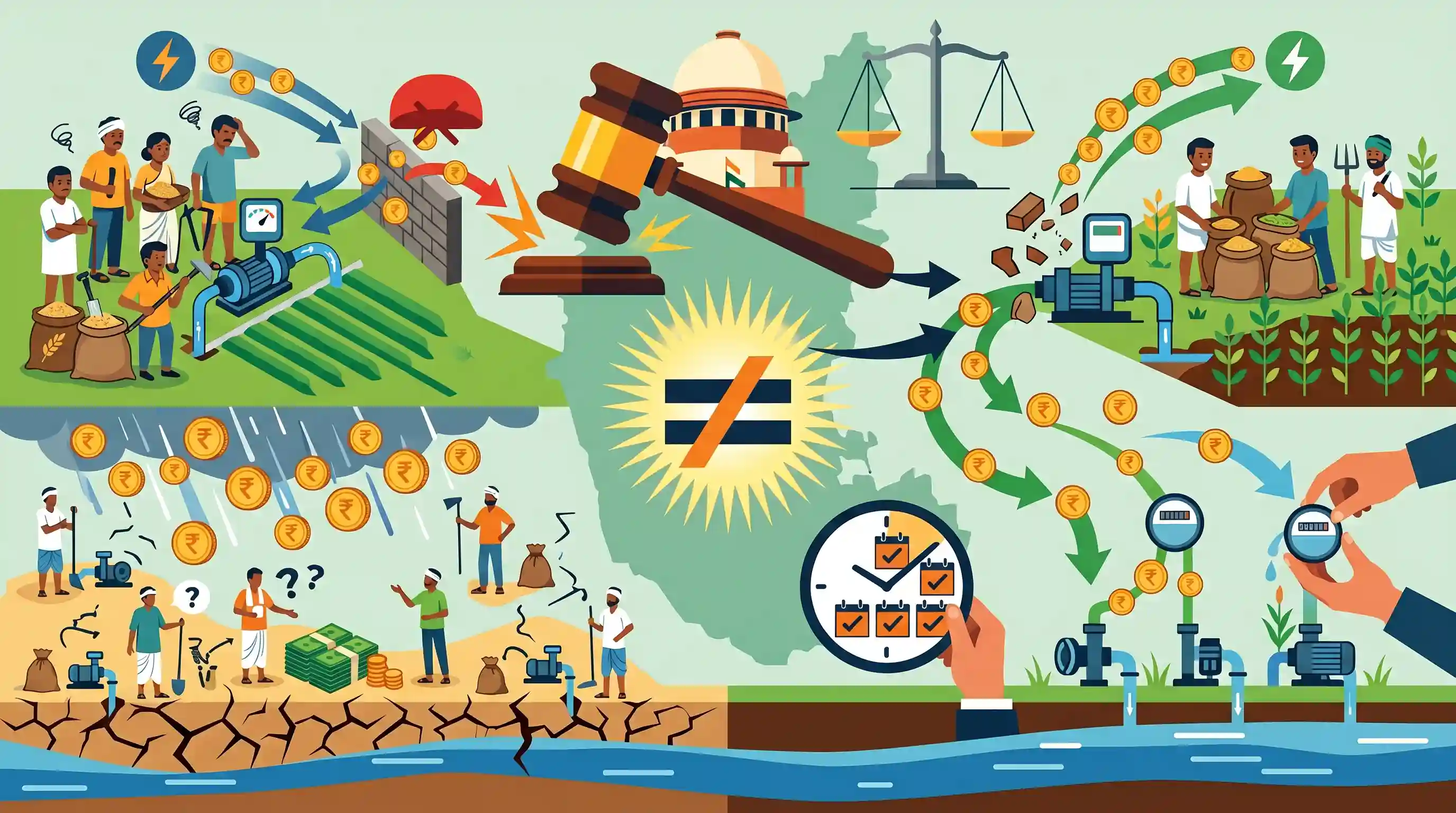
The Karnataka High Court has declared the state's policy on power tariff subsidies for irrigation pump sets unconstitutional, as it arbitrarily excluded registered farmers' societies. The court found that denying subsidies to these collectives—merely because their total consumption exceeded limits, despite individual members using less power—violates the right to equality (Article 14). The bench emphasized that such policies inadvertently penalize cooperative farming and resource-sharing, which are crucial for the sustainability of small and marginal farmers. Furthermore, the court highlighted the contradiction in granting massive subsidies to unmetered individual connections based on estimated usage, leading to inefficiency and potential groundwater depletion, and directed the government to amend the policy within six months.
Key Points
- The Karnataka High Court struck down the state's power tariff subsidy policy for irrigation pump sets as unconstitutional because it denied benefits to registered farmers' societies.
- The court ruled that denying subsidies based solely on the collective power consumption of a society violates Article 14 (equality before the law), as the per capita consumption of its members may be lower than individual subsidy limits.
- The judgment noted that penalising collectives discourages cooperative farming, which is vital for long-term agricultural sustainability, reducing costs, and increasing efficiency among small and marginal farmers.
- The court criticized the practice of releasing thousands of crores in subsidies to unmetered individual pump sets based on estimated consumption, which promotes inefficiency and groundwater depletion.
- The state government and Escoms have been directed to amend the policy within six months to extend subsidies to farmers' societies based on metrics like per capita consumption or landholding.
Important Terms
Article 14 of the Constitution of India

Guarantees equality before the law and equal protection of the laws in India. It prohibits arbitrary state action and requires any classification to be based on 'intelligible differentia' with a 'rational nexus' to the objective.
UPSC context
GS Paper II (Polity); tests Fundamental Rights, judicial review, and the doctrine of reasonable classification against executive arbitrariness.
Karnataka Policy on Power Tariff Subsidy for Irrigation Pump Sets
A 2008 state mandate (EN 55 PSR 2008) providing free/subsidized electricity to individual irrigation pump sets while excluding farmers' societies whose collective consumption exceeded specific horsepower limits.
UPSC context
GS Paper II & III; concerns agricultural subsidies, executive overreach, and equitable resource distribution for marginal farmers.
Cooperative Farming
An agricultural model where small and marginal farmers pool land and resources, like lift irrigation systems, to improve efficiency and sustainability while maintaining individual ownership.
UPSC context
GS Paper III (Agriculture); focuses on institutional reforms, resource-sharing strategies, and doubling farmers' income through collective action.
Electricity Supply Companies (Escoms)
State-owned distribution utilities (e.g., BESCOM, HESCOM) responsible for supplying power and managing subsidies for irrigation pump sets under regulatory frameworks like the Electricity Act, 2003.
UPSC context
GS Paper III (Energy/Infrastructure); relates to power sector reforms, cross-subsidization, and the challenge of unmetered agricultural connections.
Sri Shrimant (Tatya) Patil Neeru Balakedrara Sangha
A registered collective of farmers that filed a writ petition challenging the state's discriminatory subsidy rules, highlighting how excluding societies penalizes resource-sharing efforts.
UPSC context
GS Paper II (Pressure Groups); illustrates the role of farmers' associations in using the judiciary to correct policy inequities.
Metered vs. Unmetered Connections
The legal requirement (per Section 55 of the Electricity Act, 2003) to record power usage via meters to ensure transparency and prevent groundwater depletion caused by inefficient unmetered connections.
UPSC context
GS Paper III (Environment/Agriculture); crucial for understanding the water-energy nexus and groundwater conservation policies.
Prelims Trap
The High Court declared power subsidies for agricultural pump sets unconstitutional.
The court struck down the arbitrary exclusion of farmers' collectives from subsidies under Article 14, not the provision of subsidies itself.
Static Concepts Connected
What are the core features of Cooperative Farming in India?
- Resource pooling: Farmers voluntarily pool land, capital, and labor for joint cultivation while retaining their individual land ownership rights.
- Economies of scale: Helps marginal farmers overcome land fragmentation, reducing shared input costs (irrigation, machinery) and improving market bargaining power.
How do agricultural electricity subsidies worsen the water-energy nexus?
- Zero marginal cost: Flat-rate or unmetered free power removes financial disincentives, heavily encouraging unregulated and excessive groundwater extraction.
- Crop distortion: Incentivizes the cultivation of water-guzzling crops like paddy and sugarcane even in semi-arid, water-stressed regions.
- Financial masking: Unmetered agricultural connections allow state DISCOMs to hide Aggregate Technical and Commercial (AT&C) losses as agricultural consumption.
Cross-Topic Patterns
Water-Energy Nexus & DISCOM stress
Connects state populism (free power) to groundwater depletion (CGWB data) and systemic DISCOM debt, directly linking GS3 agriculture with GS3 infrastructure and environment.
FPOs, cooperatives and input parity
Highlights policy contradictions where governments promote Farmer Producer Organisations (FPOs) and cooperatives, but deny them equitable input subsidies due to aggregated consumption metrics.

Expect a GS3 question evaluating how unmetered power subsidies distort the water-energy nexus and penalize cooperative farming models.
Linked PYQs · 4
Linked PYQs · 4
- 2023MainsGS3
What are the direct and indirect subsidies provided to farm sector in India? Discuss the issues raised by the World Trade Organization (WTO) in relation to agricultural subsidies.
- 2017MainsGS3
How do subsidies affect the cropping pattern, crop diversity and economy of farmers? What is the significance of crop insurance, minimum support price and food processing for small and marginal farmers?
- 2025MainsGS3
Examine the factors responsible for depleting groundwater in India. What are the steps taken by the government to mitigate such depletion of groundwater?
- 2023MainsGS2
“Development and welfare schemes for the vulnerable, by its nature, are discriminatory in approach.” Do you agree? Give reasons for your answer.
