पॉक्सो मामले का प्रबंधन और पीड़ित पुनर्वास मानक संचालन प्रक्रिया
स्रोत:इंडियन एक्सप्रेस ↗
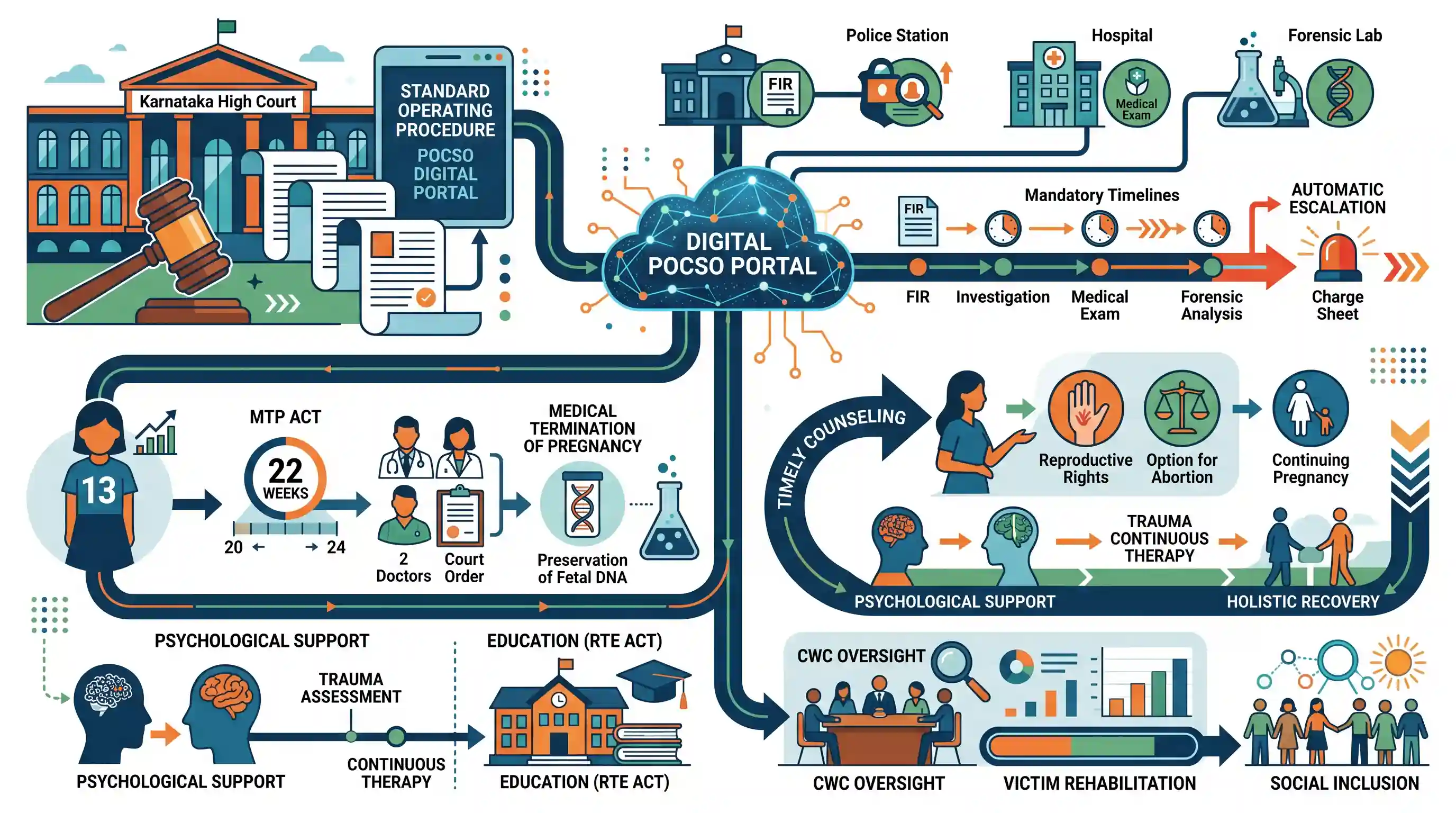
क्यों मायने रखता है
This ruling highlights a forward-looking integration of e-governance into the criminal justice system to ensure strict compliance with statutory deadlines. It also brings crucial focus to the intersection of child sexual abuse (POCSO) and reproductive autonomy (MTP Act), setting a precedent for holistic, technology-backed rehabilitation and forensic investigation.
सारांश
The Karnataka High Court has ordered the implementation of a comprehensive Standard Operating Procedure (SOP) and a specialized digital portal to stream-line and monitor POCSO cases. Aimed at eliminating procedural delays, the portal will track mandatory timelines for investigations and medical examinations, issuing automatic escalations for any lapses. The ruling stemmed from a case where a 13-year-old victim was granted permission to terminate a 22-week pregnancy under the MTP Act, with the court also directing the preservation of fetal DNA for criminal evidence. The holistic SOP highlights the need for timely counseling regarding reproductive rights, continuous education under the RTE Act, and rigorous oversight by Child Welfare Committees to ensure robust victim rehabilitation.
मुख्य बिंदु
- The Karnataka High Court mandated a technology-driven Standard Operating Procedure (SOP) and a dedicated online portal to monitor the processing of cases under the POCSO Act.
- The proposed digital platform will track statutory deadlines for medical exams, statements, and chargesheets, automatically triggering escalation alerts (SMS/email) to senior officials if delays occur.
- The directive emerged during a hearing for a 13-year-old sexual assault victim seeking to terminate a 22-week pregnancy, which the court permitted citing severe risks to the minor's physical and mental health.
- The court underscored that authorities often fail to inform minor victims and their guardians about their rights under the Medical Termination of Pregnancy (MTP) Act in a timely manner.
- अपराधी के विरुद्ध आपराधिक अभियोजन में सहायता हेतु, न्यायालय ने फॉरेंसिक जांच के लिए गर्भपात किए गए भ्रूण के DNA को संरक्षित करने का आदेश दिया।
- The SOP also emphasizes post-trauma rehabilitation, ensuring the continuation of the minor's schooling under the RTE Act, and mandates active oversight by Child Welfare Committees (CWCs) and legal aid via DLSAs.
महत्वपूर्ण शब्द
यौन अपराधों से बच्चों का संरक्षण (POCSO) अधिनियम

A specialized 2012 legislation designed to protect children from sexual assault, harassment, and pornography. It features child-friendly trial procedures, mandatory reporting, and gender-neutral provisions, defining a child as anyone under 18.
UPSC context
GS-II (Social Justice/Laws for Vulnerable Sections); critical for understanding child protection frameworks and judicial sensitivity in criminal justice.
Medical Termination of Pregnancy (MTP) Act
A 1971 law (amended in 2021) that regulates legal abortion in India. It allows termination up to 24 weeks for vulnerable categories, including rape survivors, and requires medical board approval thereafter.
UPSC context
GS-II (Social Justice/Health); tests awareness of women's reproductive rights, bodily autonomy, and evolving legal standards for maternal health.
Right of Children to Free and Compulsory Education (RTE) Act
A 2009 Act that operationalizes the fundamental right to free and compulsory education for all children aged 6 to 14, as mandated under Article 21A of the Indian Constitution.
UPSC context
GS-II (Social Justice/Education); fundamental for questions on human resource development and the State’s obligation to provide equitable access to learning.
Child Welfare Committees (CWCs)
A district-level statutory body established under the Juvenile Justice (Care and Protection of Children) Act. It is the final authority for the care, protection, and rehabilitation of children in need.
UPSC context
GS-II (Statutory Bodies/Vulnerable Sections); tests knowledge of the institutional architecture for child rights and the implementation of the JJ Act.
District Legal Services Authorities (DLSAs)
A statutory body formed under the Legal Services Authorities Act, 1987, at the district level. It provides free legal aid to marginalized sections and organizes Lok Adalats to ensure accessible justice.
UPSC context
GS-II (Judiciary/Governance); linked to Article 39A (Free Legal Aid) and tests understanding of alternative dispute resolution and judicial reach.
प्रारंभिक ट्रैप
"Termination of pregnancy for a minor under the MTP Act requires mandatory approval from a High Court."
HC approval is not statutorily required if within the 24-week limit for minors. The MTP Act only requires guardian consent and the opinion of two registered medical practitioners.
संबंधित अवधारणाएँ
What are the key provisions of the Medical Termination of Pregnancy (Amendment) Act, 2021?
- Gestation Limits: Increased the upper limit from 20 to 24 weeks for special categories of women, including minors and rape survivors.
- Medical Opinion: Requires the opinion of one doctor for termination up to 20 weeks, and two doctors for 20-24 weeks.
- Medical Board: A state-level Medical Board's approval is mandatory for terminations beyond 24 weeks, strictly in cases of substantial fetal abnormalities.
- Guardian Consent: For minors, written consent of the guardian is absolutely mandatory before performing the termination.
What is the institutional framework for victim support under the POCSO Act?
- Special Courts: Mandates the designation of Special Courts in each district to ensure child-friendly procedures and speedy trials (completed within 1 year).
- बाल कल्याण समितियां (CWCs): Under the JJ Act and POCSO Rules, CWCs must provide a 'support person' and recommend immediate interim financial relief to the victim.
- Statutory Timelines: मामलों की जांच अपराध की रिपोर्टिंग की तारीख से दो महीने के भीतर पूरी की जानी चाहिए।
अंतर-विषय पैटर्न
E-Governance in Criminal Justice
Auto-escalation portals transition digital governance from passive record-keeping (like CCTNS) to proactive accountability mechanisms, enforcing statutory timelines for police and medical officers.
Fundamental Rights & Victim Rehabilitation
The RTE Act functions as a rehabilitative tool under Article 21, mandating continuous schooling to prevent dropouts and facilitate psychological recovery for traumatized minor victims.

Expect a multi-statement question linking the MTP Act's 24-week limit for minors with POCSO statutory timelines and the role of CWCs.
संबद्ध PYQ · 3
संबद्ध PYQ · 3
- 2024MainsGS2
Right to privacy is intrinsic to life and personal liberty and is inherently protected under Article 21 of the constitution. Explain. In this reference discuss the law relating to D.N.A. testing of child in the womb to establish its paternity.
- 2025MainsGS2
The National Commission for Protection of Child Rights has to address the challenges faced by children in the digital era. Examine the existing policies and suggest measures the Commission can initiate to tackle the issue.
- 2023MainsGS2
e-governance, as a critical tool of governance, has ushered in effectiveness, transparency and accountability in governments. What inadequacies hamper the enhancement of these features ?
