Prisoner Rights and Undertrial Welfare Guidelines
Source:Indian Express ↗
Why It Matters
Prison administration is a State subject (Entry 4, List II of the Seventh Schedule), and the living conditions of undertrial prisoners often feature in discussions on human rights (Article 21) and prison reforms. This development is relevant for understanding state-level prison manuals and the judiciary's role in standardizing undertrial rights.
Summary
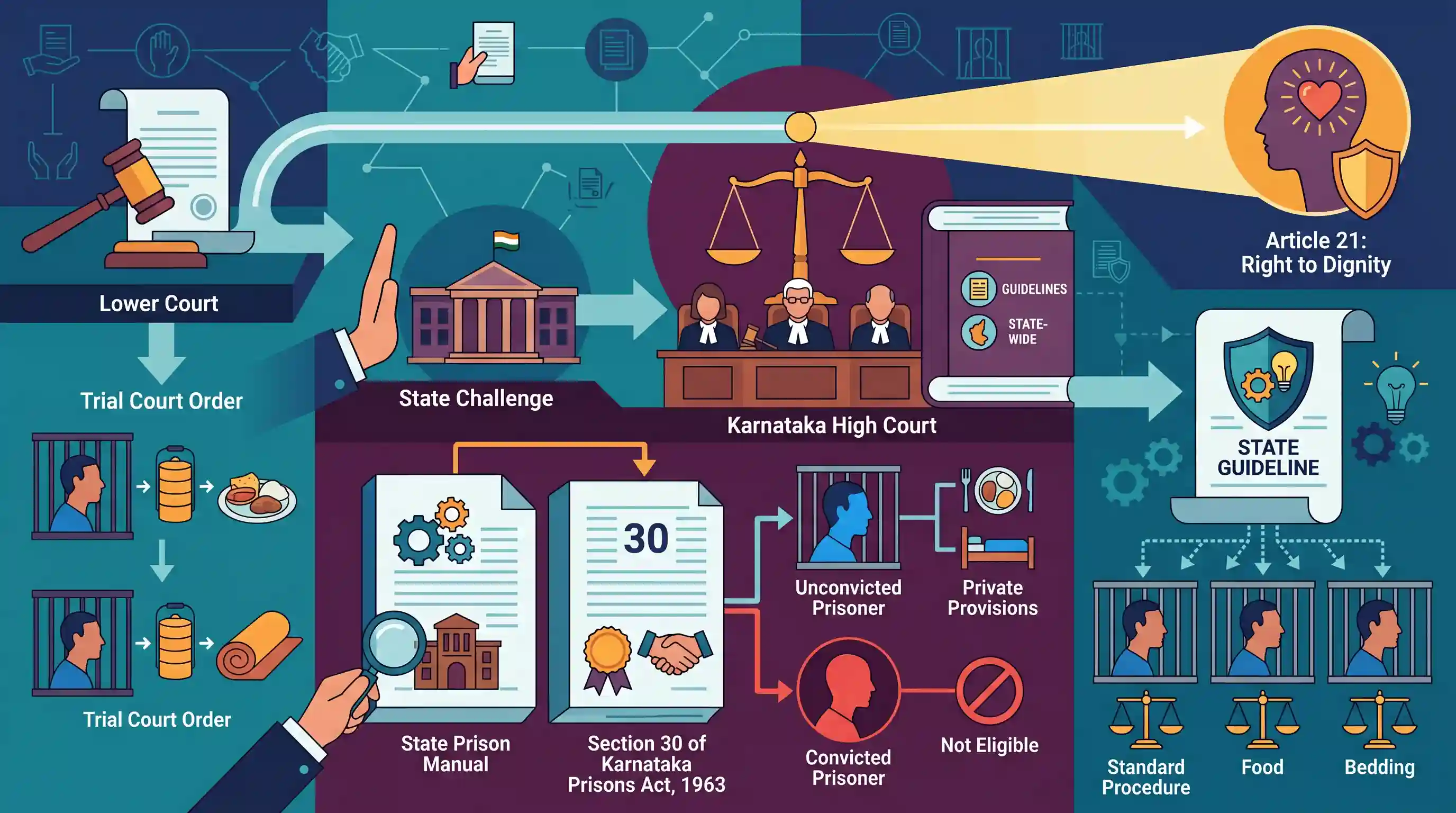
The Karnataka High Court has decided to frame comprehensive state-wide guidelines concerning the provision of home-cooked food and bedding to undertrial prisoners. This development occurred during a hearing on the state government's challenge to a trial court's order granting such amenities to the accused in the Renukaswamy murder case. The High Court will examine the State Prison Manual and Section 30 of the Karnataka Prisons Act, 1963—which permits unconvicted prisoners to receive private provisions under specific regulations—to establish a standard legal procedure for these requests.
Key Points
- The Karnataka High Court has announced it will formulate clear guidelines for providing home-cooked food and bedding to under-trial prisoners across the state.
- The initiative was triggered by the state government challenging a trial court order that granted home-cooked food once a week to the co-accused in the Renukaswamy murder case.
- Section 30 of the Karnataka Prisons Act, 1963, allows civil or unconvicted criminal prisoners to purchase or receive food, clothing, and bedding from private sources, subject to regulations approved by the Inspector-General.
- The Court has directed the state government to submit the Prison Manual and details of prior unchallenged orders to assist in laying down the law for such special circumstances.
Important Terms
Undertrial Prisoner

An individual held in judicial custody while awaiting trial or completion of legal proceedings. Not yet convicted, they enjoy the presumption of innocence but face curtailed liberty.
UPSC context
GS-II: Governance & Social Justice. Crucial for topics on criminal justice reform and prison overcrowding (NCRB data).
Prison Reforms
Systemic changes aimed at transforming prisons from punitive centers to rehabilitative institutions. Focuses on human rights, health, vocational training, and reducing overcrowding.
UPSC context
GS-II & GS-III: Internal Security/Polity. Tests knowledge of committees like Mulla and Justice Amitava Roy.
Article 21
A fundamental right guaranteeing that no person shall be deprived of life or personal liberty except by procedure established by law. It includes the right to dignity in prisons.
UPSC context
GS-II: Indian Constitution. Fundamental for rights of prisoners and judicial activism in prison administration.
Karnataka Prisons Act, 1963
State-specific legislation regulating prison management. Section 30 permits unconvicted (undertrial) prisoners to receive food, bedding, and clothing from private sources, subject to regulatory approval.
UPSC context
GS-II: State Legislations. Demonstrates the balance between statutory rights and administrative security.
Prison Manual
A detailed administrative document outlining rules for prison superintendence. It guides officials on daily management, including prisoner classification, medical care, and food provisions.
UPSC context
GS-II: Governance. Important for understanding the 'State Subject' nature of prisons (7th Schedule).
Karnataka High Court
The state's highest judicial body, which recently moved to frame statewide guidelines ensuring equitable access to amenities for prisoners regardless of their social or financial status.
UPSC context
GS-II: Judiciary. Reflects judicial oversight in ensuring prisoner welfare and preventing administrative chaos.
Prelims Trap
Prisons and their administration fall under the Concurrent List, allowing the Union government to mandate uniform prison manuals.
Prisons fall exclusively under the State List (Entry 4, List II). The Union government can only issue advisories or model acts, which states may choose to adopt or ignore.
Static Concepts Connected
What is the constitutional and statutory framework governing prisons in India?
- State Subject: Prisons and persons detained therein fall under Entry 4 of the State List (List II) in the Seventh Schedule of the Constitution.
- Core Legislation: Primarily regulated by the colonial-era Prisons Act, 1894, and individual State Prison Manuals, giving state governments autonomous rule-making authority.
- Undertrial Allowances: Section 31 of the 1894 Act explicitly permits civil and unconvicted criminal prisoners to receive food and bedding from private sources, subject to regulations.
Which key committees and international rules guide modern prison reforms?
- Nelson Mandela Rules: The UN Standard Minimum Rules for the Treatment of Prisoners advocate that untried prisoners may procure food from outside at their own expense.
- Justice Amitava Roy Committee: A 2018 Supreme Court-appointed committee that highlighted overcrowding and recommended the mandatory segregation of undertrials from convicts to prevent criminal contamination.
Cross-Topic Patterns
New Criminal Laws (BNSS) & Undertrials
The Bharatiya Nagarik Suraksha Sanhita (BNSS) introduces strict max-detention timelines for releasing undertrials. This aligns with judicial interventions focusing on undertrial welfare and their fundamental rights under Article 21.
Federalism and the Model Prisons Act
While the Centre circulated the Model Prisons Act, 2023 to modernize the colonial 1894 law, states like Karnataka rely on their own Acts, highlighting constitutional State-List autonomy over prison administration.

A Prelims multi-statement question will likely pair 'Prisons as a State Subject' with the 'Nelson Mandela Rules' on prisoner rights.
Linked PYQs · 2
Linked PYQs · 2
- 2023PrelimsGS1
Consider the following statements: Statement-I: In India, prisons are managed by State Governments with their own rules and regulations for the day-to-day administration of prisons. Statement-II: In India, prisons are governed by the Prisons Act, 1894 which expressly kept the subject of prisons in the control of Provincial Governments. Which one of the following is correct in respect of the above statements?
- 2021PrelimsGS1
With reference to India, consider the following statements : 1. When a prisoner makes out a sufficient case, parole cannot be denied to such prisoner because it becomes a matter of his/her right. 2. State Governments have their own Prisoners Release on Parole Rules. Which of the statements given above is/are correct?
