Karnataka Surplus Cauvery Water Release Sparks Mekedatu Reservoir Push
Source:The Hindu ↗
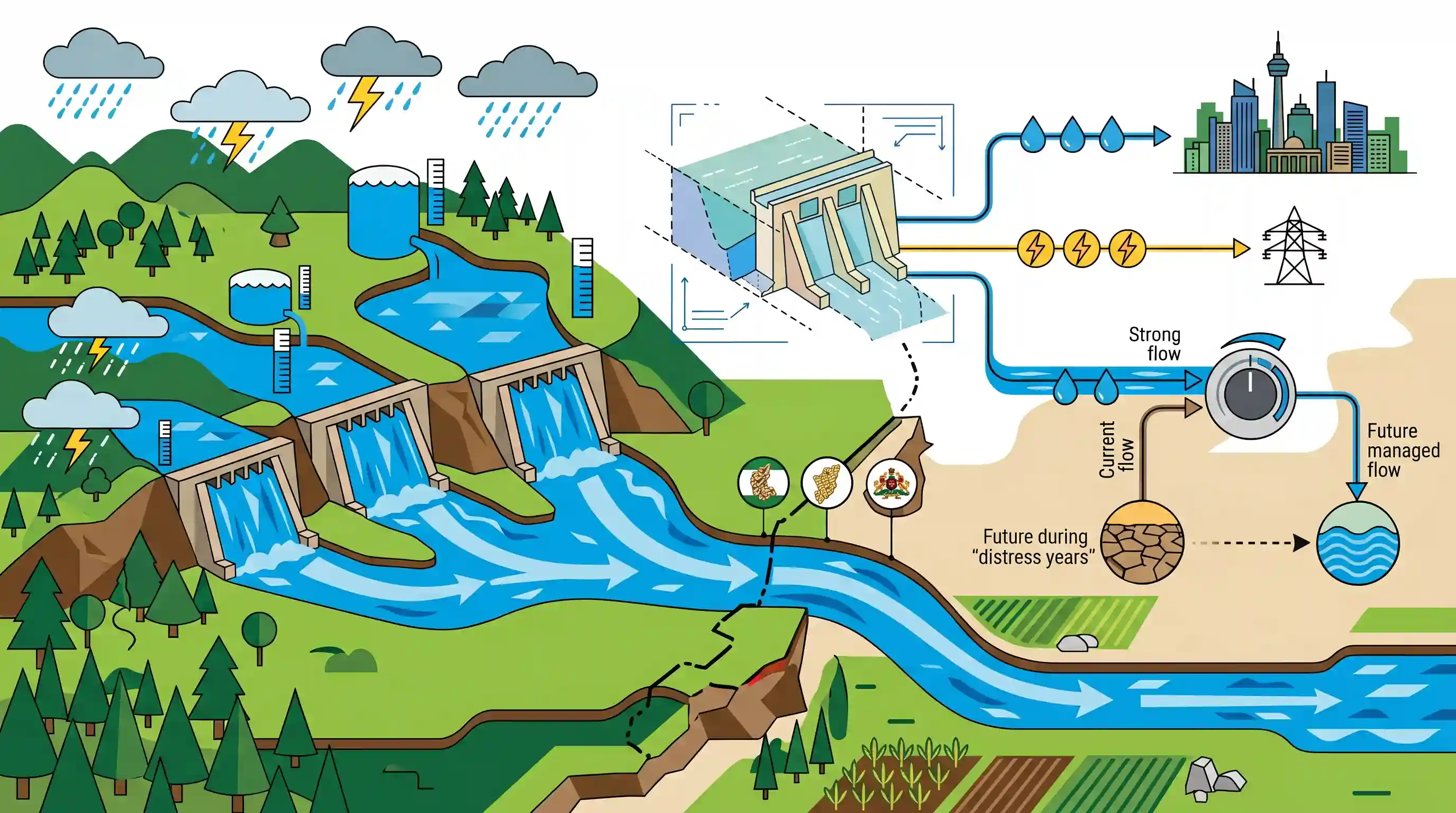
Why It Matters
The Cauvery river dispute is a classic case study of federal friction over shared water resources in India. The push for the Mekedatu balancing reservoir highlights the complex interplay between upper-riparian infrastructure development (for urban drinking water and power) and lower-riparian agricultural water security rights.
Summary
Karnataka Chief Minister Siddaramaiah announced that the state has released more than its stipulated annual share of 177.25 tmcft of Cauvery water to Tamil Nadu, owing to surplus rainfall and full reservoirs. With major dams like Krishnaraja Sagar (KRS), Kabini, and Hemavati at maximum capacity, he renewed the pitch for the proposed 67-tmcft Mekedatu balancing reservoir. He appealed to Tamil Nadu to drop its opposition, arguing that Mekedatu would not only supply drinking water to Bengaluru and generate power but also act as a crucial buffer to ensure regulated water release to the lower-riparian state during distress or deficit years.
Key Points
- Karnataka has released more than the mandated annual share of 177.25 tmcft of Cauvery water to Tamil Nadu due to surplus rainfall.
- Major dams in the Cauvery basin in Karnataka, including Krishnaraja Sagar (KRS), Kabini, Harangi, and Hemavati, have reached full capacity.
- Karnataka Chief Minister Siddaramaiah urged Tamil Nadu to drop its opposition to the proposed Mekedatu balancing reservoir.
- The Mekedatu project (67 tmcft capacity) is intended to generate electricity, provide drinking water for Bengaluru, and act as a buffer to release water to Tamil Nadu during distress years.
Important Terms
Mekedatu balancing reservoir project

A proposed multi-purpose project at the Cauvery-Arkavathi confluence in Karnataka, designed for hydroelectric power and providing drinking water to Bengaluru. It also acts as a buffer for regulating downstream water releases.
UPSC context
GS II (Inter-state relations). Tests knowledge of specific infrastructure projects triggering federal friction and riparian water-sharing disputes.
Cauvery Water Management Authority (CWMA)
A statutory body established under the Inter-State River Water Disputes Act (1956) to implement the Supreme Court's 2018 verdict on equitable Cauvery water sharing among four riparian entities.
UPSC context
GS II (Statutory Bodies). Tests understanding of institutional mechanisms for resolving inter-state river water conflicts and cooperative federalism.
Article 262 of the Indian Constitution
A constitutional provision empowering Parliament to adjudicate disputes regarding the use or distribution of inter-state river waters. It allows Parliament to bar the jurisdiction of courts in such matters.
UPSC context
GS II (Indian Constitution). Tests knowledge of the constitutional framework and legal bars for managing inter-state river water disputes.
Lower Riparian State
A state located downstream on a river basin (e.g., Tamil Nadu). It possesses specific legal rights to equitable water shares and protection against upstream obstructions by upper-riparian states.
UPSC context
GS I (Geography) and GS II (Federalism). Tests conceptual understanding of river basin dynamics and riparian rights in inter-state disputes.
Krishnaraja Sagar (KRS) Dam
A gravity dam on the Cauvery River in Mandya, Karnataka, designed by Sir M. Visvesvaraya in 1932. It is vital for irrigation and drinking water for Mysore and Bengaluru.
UPSC context
GS I (Geography) and GS III (Infrastructure). Important for identifying major dams and the contribution of historical figures like Sir M. Visvesvaraya.
TMCFT (Thousand Million Cubic Feet)
Stands for 'Thousand Million Cubic Feet,' a standard volume unit in India used to measure large-scale reservoir capacities and water release quantities in river basins.
UPSC context
General Knowledge. Essential for interpreting the quantitative data used in inter-state water sharing awards and tribunal decisions.
Prelims Trap
The Supreme Court exercises original jurisdiction under Article 131 to resolve all inter-state river water disputes.
Article 262 explicitly allows Parliament to bar SC's original jurisdiction in river disputes (ISRWD Act, 1956). The SC hears these cases via Special Leave Petition (Art 136), not Art 131.
Static Concepts Connected
What are the key geographical features and tributaries of the Cauvery River?
- Origin: It originates at Talakaveri in the Brahmagiri range of the Western Ghats in Karnataka.
- Left-bank tributaries: Harangi, Hemavati, Shimsha, and Arkavathi. Mekedatu is proposed at the confluence of Cauvery and Arkavathi.
- Right-bank tributaries: Lakshmanatirtha, Kabini, Suvarnavati, Bhavani, Noyyal, and Amaravati.
How does the Indian Constitution address Inter-State River Water Disputes?
- Constitutional Provision: Article 262 empowers Parliament to adjudicate disputes regarding the use, distribution, or control of inter-state river waters.
- ISRWD Act, 1956: Enacted under Art 262, it allows the Centre to set up ad-hoc tribunals. Decisions of tribunals are binding and have the force of a Supreme Court decree.
- Management Authority: The Cauvery Water Management Authority (CWMA) was created to implement the Supreme Court's 2018 final verdict on the dispute.
Cross-Topic Patterns
Dam Infrastructure + Wildlife Clearances
The Mekedatu project sits near the Cauvery Wildlife Sanctuary. UPSC often tests large dam infrastructure projects by pairing them with the specific national parks, tiger reserves, or sanctuaries they impact.
Climate Variability + Cooperative Federalism
The dispute flares during "distress years." Climate-induced erratic monsoons make rigid water-sharing formulas harder to enforce, linking physical geography (El Nino/monsoons) directly to challenges in cooperative federalism.

Tributary mapping of Cauvery (Kabini/Hemavati) paired with Article 262 tribunal mechanisms is a highly probable 2026 prelims pairing.
Linked PYQs · 4
Linked PYQs · 4
- 2019PrelimsGS1
What is common to the places known as Aliyar, Isapur and Kangsabati?
- 2015PrelimsGS1
Consider the following rivers: 1. Vamsadhara 2. Indravati 3. Pranahita 4. Pennar Which of the above are tributaries of Godavari?
- 2020MainsGS3
Suggest measures to improve water storage and irrigation system to make its judicious use under depleting scenario.
- 2016PrelimsGS1
Recently, linking of which of the following rivers was undertaken?
