Karnataka considers social media ban for minors below sixteen
Source:Indian Express ↗
Why It Matters
The proposal to ban social media for minors touches upon crucial UPSC themes across multiple papers: the sociological impact of technology on children (GS1), government policy formulation for child protection (GS2), and constitutional nuances regarding the jurisdiction over internet and tech regulation (Union vs. State legislative powers).
Summary
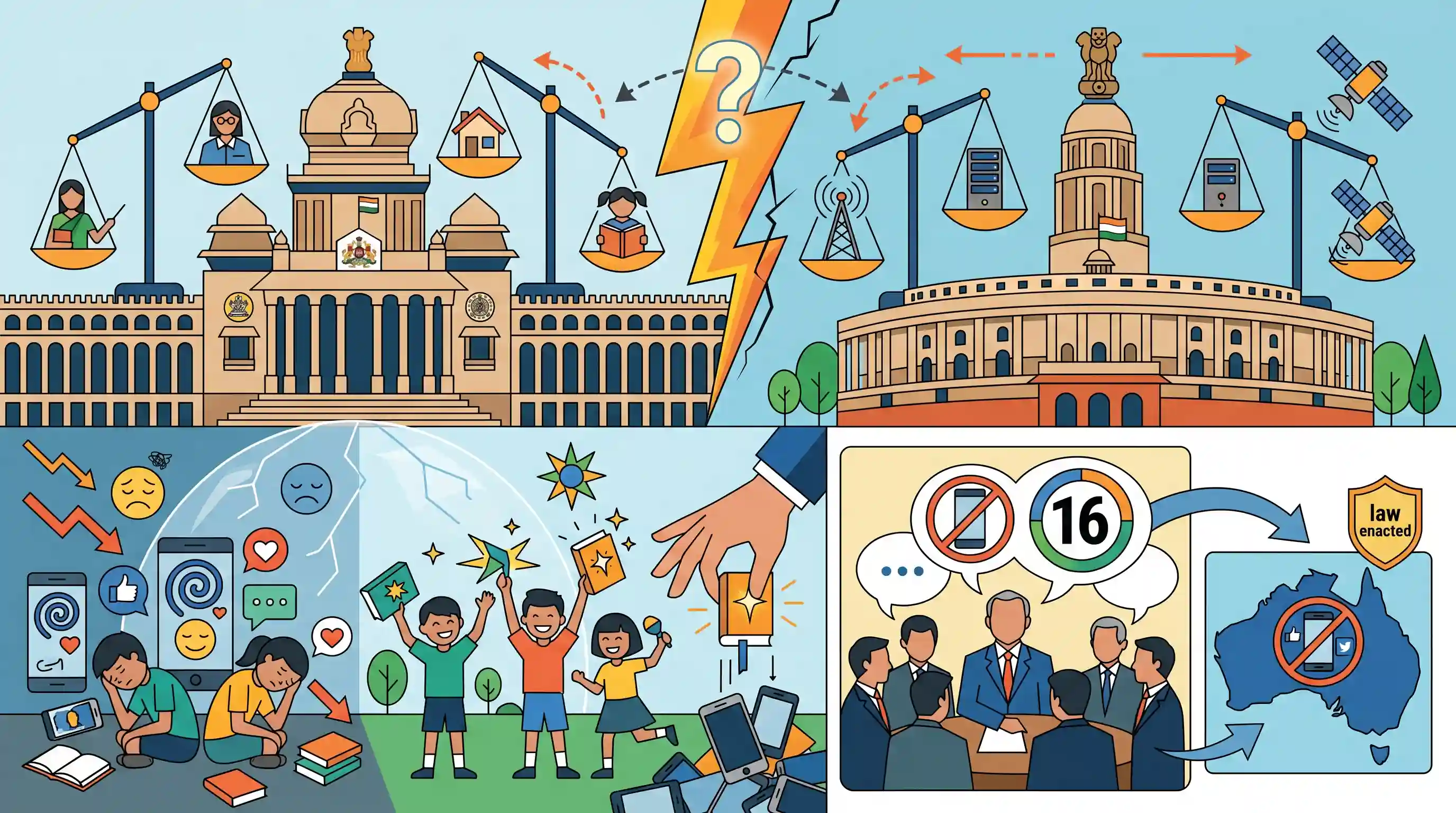
The Karnataka government is contemplating a ban on social media use for children under the age of 16, drawing inspiration from similar legislation enacted in Australia. Chief Minister Siddaramaiah discussed the proposal during a Vice-Chancellors' conclave to address concerns over mobile addiction, online gaming, and their adverse effects on children's academic performance and mental health. This follows the state's launch of the 'Mobile Bidi, Pustaka Hidi' campaign. However, jurisdictional challenges persist regarding whether such regulations fall under state purview or require intervention by the Union government through IT laws.
Key Points
- The Karnataka government is considering banning social media for children below 16, following Australia's recent legislation.
- The proposed ban aims to tackle mobile addiction, which is negatively impacting children's academics, memory, imagination, and physical fitness.
- The state recently launched the 'Mobile Bidi, Pustaka Hidi' (Leave the phone, pick a book) campaign to curb tech addiction among students.
- A legal and constitutional debate remains on whether the state has the jurisdiction to enforce such a ban or if it requires Union government legislation.
Important Terms
Mobile Bidi, Pustaka Hidi campaign

A Karnataka government initiative launched to reduce mobile addiction in children under 16. It promotes reading habits, physical activities, and library usage as healthy alternatives to excessive screen time.
UPSC context
Relevant for GS Paper II (Government Policies) and GS Paper I (Social Issues: Impact of technology on children).
School Development Monitoring Committees (SDMCs)
Statutory bodies mandated under the Right to Education (RTE) Act, 2009, comprising parents and teachers to oversee school management, development plans, and the protection of children's rights at the grassroots level.
UPSC context
Crucial for GS Paper II (Education, Governance, and Local Bodies). Tests knowledge of community participation in policy implementation.
Seventh Schedule (Article 246)
A constitutional framework under Article 246 that distributes legislative powers between the Union and States. Internet and telecommunications fall under the Union List (Entry 31), complicating state-led digital bans.
UPSC context
Core topic for GS Paper II (Federalism and Center-State Relations). Tests understanding of jurisdictional boundaries in emerging technology law.
Information Technology (IT) Act, 2000
The primary central legislation governing cyber activities and digital intermediaries in India. It grants the Union government exclusive authority to regulate online content and digital communication platforms.
UPSC context
Significant for GS Paper II (Governance) and GS Paper III (Cyber Security). Relevant for discussions on digital sovereignty and intermediary liability.
Department of School Education and Literacy (Karnataka)
The state-level nodal agency responsible for primary and secondary education. In Karnataka, it leads the implementation of the social media ban draft and the 'Mobile Bidi' reading initiatives.
UPSC context
Relevant for GS Paper II (Issues relating to development and management of Social Sector/Services relating to Education).
Women and Child Welfare Department
A state body that implements child protection schemes and manages Anganwadis. It is tasked with educating parents and the community about the psychological risks of early social media exposure.
UPSC context
Important for GS Paper II (Social Justice and Welfare Schemes for vulnerable sections).
Prelims Trap
State governments have explicit constitutional authority to regulate internet platforms under the State List for child welfare.
Internet and IT platforms fall under the Union List and residuary powers. States face significant constitutional hurdles in framing structural digital platform laws.
Static Concepts Connected
How is digital and communication jurisdiction mapped in the Constitution?
- Union List (Entry 31): Telecom, wireless, broadcasting, and forms of communication fall under the exclusive domain of the Union Parliament.
- Residuary Powers: Parliament leverages Article 248 for substantive IT laws (like the IT Act 2000), as cyberspace was undefined during drafting.
- Public Order (Entry 1): States utilize Entry 1 of the State List for temporary internet suspensions, but lack authority to frame structural digital platform regulations.
What are India's primary legal safeguards for minors on social media?
- DPDP Act 2023: Mandates verifiable parental consent before platforms can process any personal data of individuals under 18 years of age.
- IT Rules 2021: Obligates intermediaries to swiftly remove child sexual abuse material (CSAM) and deploy measures to ensure general user safety.
- NCPCR Interventions: The commission issues guidelines and actively directs tech platforms to implement stringent age-gating and safety mechanisms.
Cross-Topic Patterns
DPDP Act age gating vs State Bans
The Union's DPDP Act relies on parental consent for minors (<18), whereas state-level absolute bans represent a paternalistic friction against central digital frameworks.
Behavioral nudges in public policy
Karnataka's 'Mobile Bidi, Pustaka Hidi' campaign reflects behavioral economics (nudge theory)—a non-coercive governance tool UPSC often pairs with public policy initiatives.

Expect a Mains GS2 question analyzing federal friction when states attempt to regulate digital spaces overlapping Union IT and DPDP Acts.
Linked PYQs · 3
Linked PYQs · 3
- 2025MainsGS2
The National Commission for Protection of Child Rights has to address the challenges faced by children in the digital era. Examine the existing policies and suggest measures the Commission can initiate to tackle the issue.
- 2023MainsGS1
Child cuddling is now being replaced by mobile phones. Discuss its impact on the socialization of children.
- 2019MainsGS2
From the resolution of contentious issues regarding distribution of legislative powers by the courts, 'Principle of Federal Supremacy' and 'Harmonious Construction' have emerged. Explain.
